

Tooth fractures can be very varied, depending on the size and position of the fracture lines. They may affect only the enamel, the enamel and part of the dentine, or reach the nerve of the tooth. Treatment depends on the depth and direction of the fracture – from a photopolymer filling for small fractures to extraction of the tooth in the most severe cases.
What causes a tooth to break?
Fractures result from:
- a blow during sport, play or a fall;
- biting hard food (in the front teeth);
- especially often – in teeth with thinned walls following endodontic (root canal) treatment.
What types of fractures are there and what are the symptoms?
In some cases the root of the tooth may break, at varying depth in the bone. Depending on the depth and direction of the fracture, there may be symptoms (pain, loosening) or none at all.
Fracture of the enamel and dentine
Fracture of the enamel / Fracture of the enamel and dentine with involvement of the nerve of the tooth
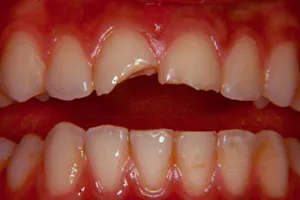
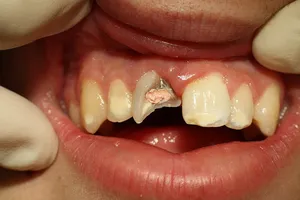
- With small, superficial fractures of the enamel there is no pain or only slight sensitivity. The only thing noticed is that the appearance of the tooth is spoiled by the missing piece.
- With more complex fractures that also involve the dentine, there is pain, which may be spontaneous or provoked.
- When the nerve is also involved, the pain is unbearable even from breathing in cold air, and there may be slight bleeding from the site of the exposed nerve.
- In some cases the only symptom may be movement of part of the tooth while chewing.
- With fractures in the area of the neck of the tooth, the whole crown breaks off and only the root remains in the gum. This type of fracture is seen very often with incorrectly made crowns, as well as with serious sports injuries.
Vertical fractures
Vertical fractures are very common. They pass through the crown and the root of the tooth at the same time and amount to a splitting of the tooth lengthwise into one or several pieces. They most often occur after endodontic treatment of the tooth (removal of the nerve) and in many cases lead to loss of the tooth.
Vertical fractures of the crown and root of the tooth
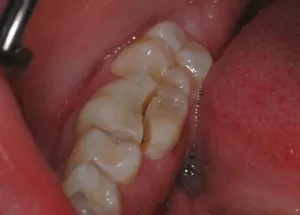
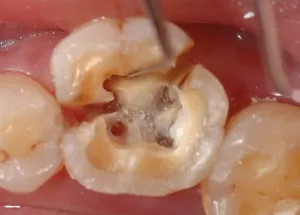
Fracture of the root
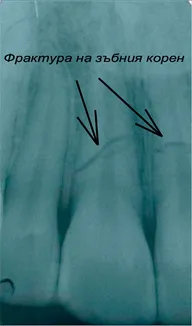
In sports injuries the root of the tooth may break at varying depth in the bone. In some cases root fractures are difficult to diagnose by an ordinary examination alone, so an X-ray of the suspect tooth is needed. In fractures of the tooth crown where the fragments have not shifted, staining with special dyes is used, which show the size of the fracture line.
How is a broken tooth treated?
- Small fractures in the area of the enamel and dentine: photopolymer fillings can be used to restore the defect, which restore function and aesthetics completely.
- Larger fractures in the area of the dentine: the condition of the tooth has to be monitored – in serious injuries the tooth may lose its vitality on its own. Depending on whether the tooth stays alive or not, further treatment follows.
- Fractures involving the dental pulp (nerve): endodontic treatment is carried out before the tooth is restored.
- Fractures in the area of the neck (the whole crown is missing): root canal treatment is carried out, after which a metal or glass-fibre post is placed in the root canal, a tooth build-up is made and a crown is placed.
- The most severe cases – the presence of infection, treatment not being possible, and vertical fractures: the tooth has to be extracted.
Teeth that have stayed alive after treatment of a fracture must be monitored at 20 days, 3 months and 6 months, to see whether they begin to lose vitality.
Frequently asked questions
Does a broken tooth hurt?
It depends on the depth and direction of the fracture. With small fractures of the enamel there is no pain or only slight sensitivity, with fractures involving dentine there is pain, and when the nerve is involved the pain is unbearable even from breathing in cold air.
How is a small fracture of a tooth treated?
For small fractures in the area of the enamel and dentine, photopolymer fillings can be used, which restore function and aesthetics completely.
What is done when the whole crown is broken off?
Root canal treatment is carried out, after which a metal or glass-fibre post is placed in the root canal, a tooth build-up is made and a crown is placed.
When is a broken tooth extracted?
In the most severe cases – the presence of infection, treatment not being possible, and vertical fractures.
Is monitoring needed after treatment of a fracture?
Yes. Teeth that have stayed alive after treatment are monitored at 20 days, 3 months and 6 months, to see whether they begin to lose vitality.