

Sealing protects children’s baby and permanent teeth from caries on the chewing surfaces by covering the deep fissures with a sealant. The procedure is short and painless, and when the sealant is placed correctly the protection is almost 100%. We see children from the age of 5.
What is sealing?
Sealing the teeth is an innovative method developed to protect children’s baby and permanent teeth from developing caries on the chewing surfaces. As a method, it means covering the deep fissures with a sealant.
The sealant is a polymer material in liquid form with great strength, and it is either transparent or tooth-coloured. In some cases fluoride ions can also be added to its composition to speed up the mineralisation process.
Why do children’s teeth need protection?
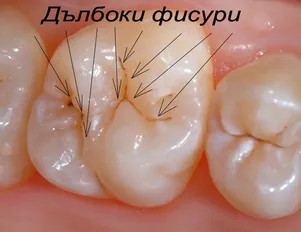
In children’s teeth the fissures on the chewing surfaces are deep and still poorly mineralised, and they are among the first places to be attacked by caries. The deep fissures fill with plaque that cannot be cleaned out. The accumulated plaque acts on the poorly mineralised bottom of the fissure and very quickly leads to the development of caries.
How is a sealant placed?
Before the procedure, the fissures must be thoroughly cleaned and it must be established that there is only a deep fissure and no caries.
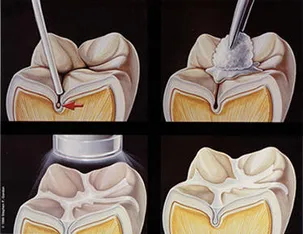
For well-cleaned, healthy deep fissures, the surface of the tooth is etched (prepared for bonding) and a small amount of sealant is applied and spread over the chewing surface. After all the fissures have been filled with a thin layer of sealant, it is hardened by shining the curing lamp on it.
The procedure is short, absolutely painless and causes the child no discomfort at all.
How long does a sealant last, and is follow-up needed?
As a material, sealants are more brittle than the material for photopolymer fillings and, with the child’s normal chewing, they wear away over time. This means they must be checked periodically and, if necessary, replaced after a period of 8 months to 1 year.
Which teeth is it used on, and when?
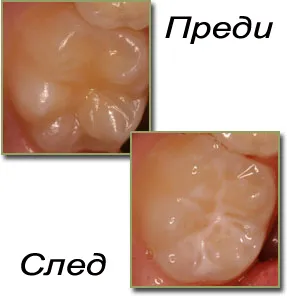
Sealing is applied to both baby and permanent children’s teeth. When the sealants are placed correctly, it can provide almost 100% protection against the development of caries on the chewing surfaces.
Sealants should be placed as soon as possible after the baby and permanent teeth erupt. For baby (milk) teeth, the molars are suitable for sealing, while for permanent children’s teeth sealants can be placed on both the molars and the premolars.
How much does it cost?
Like every method in prevention, sealing is non-invasive and saves money: the price of one sealant is lower than that of a photopolymer filling, and unlike placing a filling, no preparation of the tooth is required. Fissure sealant on a child’s tooth: 40 – 60 € per tooth. All prices are in the Price list.
Frequently asked questions
Does placing a sealant hurt?
No. The procedure is short, absolutely painless and causes the child no discomfort at all.
Which teeth are sealed?
Both baby (milk) and permanent children’s teeth — the molars of baby teeth, and the molars and premolars of permanent teeth.
When should the sealant be placed?
As soon as possible after the baby and permanent teeth erupt.
How long does a sealant last?
Sealants wear away over time with normal chewing, so they must be checked periodically and, if necessary, replaced after a period of 8 months to 1 year.
How well does a sealant protect against caries?
When sealants are placed correctly, protection against caries on the chewing surfaces is almost 100%.