
Crowns and bridges are fixed, non-removable prosthetic restorations for treating tooth defects and missing teeth. They restore aesthetics, speech and the chewing function and feel like natural teeth. When the conditions are suitable, they are always preferred to removable restorations (dentures).
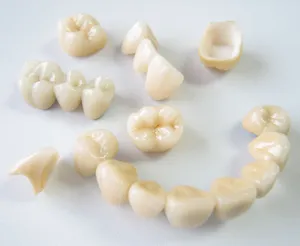
What are the advantages of crowns and bridges?
Compared with removable restorations (dentures), fixed ones are superior, so they are always preferred if the conditions for making them are suitable. Their advantages are that they:
- transmit chewing pressure in a physiological way and protect the mucosa from direct impact – with dentures, chewing forces are transmitted to the mucosa through the plastic part of the denture;
- provide functional loading of the abutment teeth within normal limits without unpleasant sensations or consequences, and feel like natural teeth;
- are highly aesthetic and restore the shape, colour and individual characteristics of the patient’s teeth;
- do not interfere with speech, and one gets used to them quickly.
When they are made according to constructional principles, they do not damage the periodontium, do not change the bite and do not impair the chewing function.
What does a dental bridge consist of?
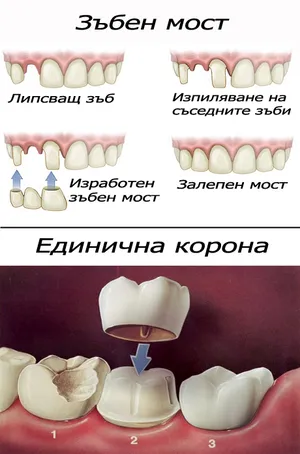
Dental bridges consist of abutments and pontics:
- abutments are the teeth bordering the defect and bearing the additional load;
- pontics replace the missing teeth and restore aesthetics and function.
How are a crown or bridge made?
Depending on the type of tooth defect and the choice of fixed restoration, bridges and crowns are made in 3 – 4 visits.
For crowns as well as for bridges, preliminary preparation is necessary. It includes extraction (removal) of remaining roots, correction of old fillings or endodontic treatment.
After that the teeth chosen as abutments are prepared (with or without a shoulder finish line), an impression is taken, and the restoration is made in the dental laboratory with the necessary try-ins and finally bonded temporarily or permanently, at the dentist’s discretion. What happens at each visit is described in detail in Fabrication of a dental crown.
For defects in the front and for missing or prepared teeth, a temporary plastic restoration is always made. It provides comfort and aesthetics until the permanent restoration is ready.
Can they be made on root canal treated teeth?
Crowns and bridges can be made both on living teeth and on teeth that have had endodontic treatment.
When making a bridge on endodontically treated teeth, it is essential that the root canals are filled to the end. If this condition is not met, the canals must be refilled, and only then is a bridge or crown made.
What are the disadvantages and when are they removed?
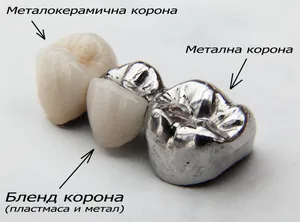
A disadvantage of fixed restorations (bridges and crowns) is the preparation of the hard tissues of the abutment teeth and the irritation of the gum in the area of the tooth neck. These disadvantages are avoided with glass-fibre bridges, which are made without grinding down the teeth.
Once bonded in the mouth, bridges and crowns are difficult to remove and cannot be adjusted on the spot.
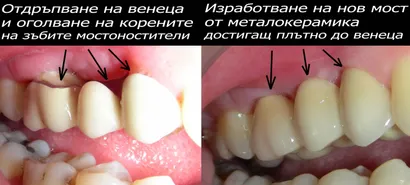
Reasons for removing bridges and crowns are:
- pain in the teeth under the abutments;
- perforation of crowns (abutments);
- a break between an abutment and a pontic;
- exposure of the tooth necks or injury to the gums as a result of inflammation;
- breakage or wear of the plastic covering of veneered crowns.
How long do they last and how much do they cost?
The recommended period for replacing crowns and bridges is 8 – 10 years, and when well planned and made to a high quality they sometimes last much longer. They remain the most commonly used restorations for a large number of tooth defects.
Depending on the type of material and the method of fabrication, prices vary – veneered and metal-ceramic crowns and the glass-fibre support cost the same, while metal-free crowns (porcelain and zirconia) are more expensive. Indicative prices:
- veneered crown / bridge with plastic: 250 €;
- veneered crown / bridge with ceramic: 250 €;
- metal-ceramic crown: 250 €;
- all-ceramic crown (IPS e.max): 400 €;
- zirconia crown: 300 €;
- glass-fibre support: from 250 €;
- bridge without grinding down the teeth (adhesive bridge): 400 – 600 €.
All prices are in the Price list.
What types of crowns and bridges are there?
Crowns and bridges can be made from different materials and, depending on that, come in several types:
- Bridges and crowns from metal and plastic – a metal-and-plastic bridge/crown is called a veneered bridge/veneered crown;
- Bridges and crowns from metal-ceramic – metal-ceramic crowns and bridges have wide indications and are the best;
- Bridges and crowns from zirconia and IPS e.max ceramic – all-ceramic crowns and bridges are the most aesthetic;
- A bridge on a glass support – the glass support (ZX-27) is a special glass-polymer stump;
- Bridges without grinding down the teeth – one of the main disadvantages in the making of standard restorations is the grinding down of the teeth.
Frequently asked questions
What is the difference between crowns and bridges?
Crowns and bridges are fixed prosthetic restorations. A bridge consists of abutments – the teeth bordering the defect and bearing the additional load – and pontics, which replace the missing teeth and restore aesthetics and function.
How many visits do a crown or bridge need?
Depending on the type of tooth defect and the choice of fixed restoration – 3 – 4 visits.
How long do crowns and bridges last?
The recommended period for replacing them is 8 – 10 years, and when well planned and made to a high quality they sometimes last much longer.
Can bridges be made without grinding down the teeth?
Yes. The disadvantage of preparing the hard tooth tissues is avoided with glass-fibre bridges, which are made without grinding down the teeth.
What is used in the mouth while the restoration is being made?
For defects in the front and for missing or prepared teeth, a temporary plastic restoration is always made. It provides comfort and aesthetics until the permanent restoration is ready.