
At Ralev Dental Clinic we make 30 types of crowns and bridges for patients with partial or complete tooth loss. Some of them are widely known among patients, while others are specialised and we use them in specific clinical cases. For each type, the fabrication time and the price are given.
Crowns and bridges are of 2 main kinds – temporary and permanent. Permanent crowns and bridges are in turn divided into 4 subtypes – metal-containing, metal-free, specific and implant.
Temporary crowns and bridges
1. Temporary crowns and bridges made of bis-acrylic resin
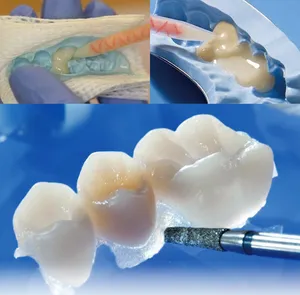
These are among the most commonly used temporary crowns in modern dentistry. They are made of a special self-curing bis-acrylic resin that comes in cartridges for automatic mixing. The main advantage of this type of temporary crown and bridge is that they are made on the spot at the clinic by the dentist.
To make them possible, an impression of the patient’s teeth must be taken before they are prepared, or from a specially prepared wax model. After the teeth are prepared, the material is applied to the impression taken in this way and the impression is returned to the mouth. After it sets, which takes 2 – 3 minutes, the impression is removed together with the finished crown/bridge.
They are an exact copy of the patient’s teeth or of the wax plan, and after finishing and polishing they are cemented with temporary cement. They are recommended for a short stay in the mouth – 2 to 4 weeks. These are patients’ “favourite” temporary crowns, as they are made and placed immediately at the clinic and there are no periods when a person has to go without teeth.
- Fabrication: On the spot at the clinic within 20 – 30 minutes
- Price: about 60 € per tooth
2. Temporary crowns and bridges made of PMMA resin
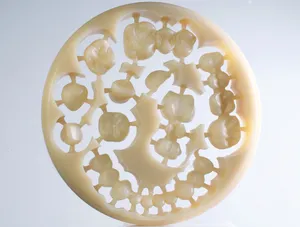
These are the so-called long-term temporary crowns. They are extremely strong and durable and can stay in the mouth for up to 6 months. They are made of polymethyl methacrylate, which comes in the form of special discs for CAD/CAM machines.
This type of crown and bridge is designed and milled entirely on a computer in the dental laboratory. They have very good aesthetics, because the discs they are made from are coloured in the standard tooth shades, and there are even multilayer discs with a gradual blending of colour in depth. Thanks to the computer-aided fabrication and the specific properties of the material, this type of crown and bridge is extremely fine and polishes very well, does not irritate the gums and does not discolour easily, thus ensuring comfort for the patient throughout the whole period of wearing them.
- Fabrication: about 3 – 4 days with 2 visits to the dental clinic
- Price: about 80 € per tooth
Permanent crowns and bridges
They come in 4 main subgroups – metal-containing, metal-free, specific and implant. Some of these types of crowns and bridges are outdated and have drawbacks, because of which we avoid offering and making them, but in certain clinical cases and with specific requirements we could use them without any problem.
Subgroup A: Metal-containing crowns and bridges
3. Metal crowns and bridges – base alloy – Cr-Co
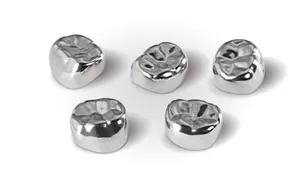
This is the oldest type of dental crown and bridge used in prosthetic dentistry. They have only one major drawback, which has almost put them out of use, and that is their aesthetics.
The modern metal alloys used to make them are nickel-free and mainly chromium-cobalt based, and do not cause the allergic reactions characteristic of the nickel-containing alloys of the past. Their other advantages are: fast and accurate fabrication (they can be laser-sintered or milled on CAD/CAM machines), they are practically everlasting because they cannot break or wear away, they require the least preparation of all types of crowns and bridges, and they cost slightly less than metal-ceramic ones.
- Fabrication: about 3 – 5 days with 2 visits to the dental clinic
- Price: about 250 € per tooth
4. Metal crowns and bridges – noble alloy – 22k gold
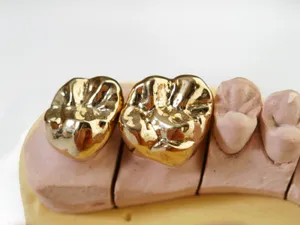
Crowns and bridges made of 22k gold are the “gold” standard in prosthetic dentistry. They are now used ever more rarely because of their 2 main drawbacks – the aesthetics and the high price. Beyond that, this type of prosthetics has only advantages.
These are the most biological crowns and bridges, which preserve the teeth beneath them to the greatest extent. We see gold crowns that have functioned for more than 40 years without any problems for the patients. Besides longevity, other advantages are minimal preparation, no irritation of the gums, wear similar to that of natural teeth, and, when precisely made, the ability to seal the micro-gap between the tooth and the cement very well, thus protecting the tooth under the crown as far as possible from the harmful action of the cariogenic bacteria in saliva.
- Fabrication: about 7 – 10 days with 2 visits to the dental clinic
- Price: about 250 € per tooth (the price of the gold is separate, according to the amount used)
5. Veneered crowns and bridges with resin
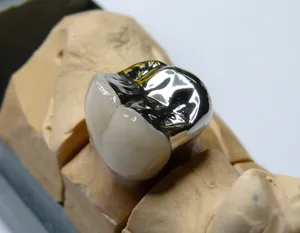
Veneered crowns are the next generation after all-metal ones. In them the aesthetics are improved by adding resin to the outer visible side of the teeth. This resin comes in various colours and significantly improves the aesthetics.
But the advantages of this type of crown and bridge end there. They have practically gone out of use in modern dentistry because of the unfavourable qualities of the resin – easy discolouration and a high rate of chipping from the metal base, which means the crown has to be redone. Veneered crowns can also be made of gold, which corrects the unfavourable aesthetics of all-gold crowns.
- Fabrication: about 7 days with 2 visits to the dental clinic
- Price: about 250 € per tooth (for gold ones the price of the gold is separate)
6. Veneered crowns and bridges with ceramic
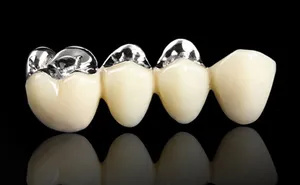
In design this type of crown and bridge is analogous to the previous type, but the resin aesthetic facing is replaced with a ceramic one. This avoids the effects of discolouration of the visible part of the crown.
They are made with the same technology as metal-ceramics and in essence are metal-ceramic crowns. We use them mainly in cases of insufficient space between the lower and upper jaw, when there is no way to prepare enough of the teeth to place ceramic on the chewing surface as well.
- Fabrication: about 7 days with 2 visits to the dental clinic
- Price: about 250 € per tooth
7. Crowns and bridges made of metal-photopolymer/resin
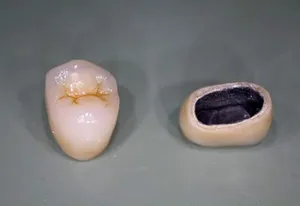
This type of crown is the predecessor of metal-ceramics. It is a metal coping completely covered with photopolymer or resin. In aesthetics it is absolutely equal to metal-ceramics, but both the resin and the photopolymer coating are not durable over time.
This is due to 2 factors – the mechanical bond of the photopolymer to the metal and its poor resistance to wear. This leads to the metal copings being exposed after a short time in function.
The other significant drawback is that plaque is retained at the edges of the photopolymer/resin coating, which leads to irritation and inflammation of the gums. This type of crown is made only as long-term, highly aesthetic crowns.
- Fabrication: about 7 days with 2 visits to the dental clinic
- Price: about 250 € per tooth
8. Metal-ceramic – standard (base alloy – Cr-Co)
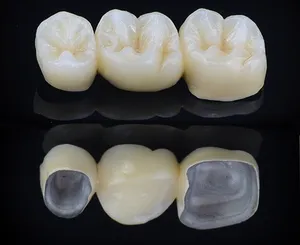
These are the most commonly made crowns and bridges in Bulgaria at present. They are the most balanced option in terms of price-quality ratio, with very good aesthetics, excellent strength and an affordable price. Modern metal-ceramics is made by laser-sintering the metal framework on 3D metal printers, after which 4 layers of ceramic with different optical and colour properties are applied by hand, layer by layer, to achieve their high aesthetics.
The drawbacks of standard metal-ceramics are mainly due to the presence of a base metal. There are 2 main ones – the possibility of allergic reactions in some patients and a grey tint of the gum at the base of metal-ceramic crowns and bridges. These drawbacks are avoided by using semi-noble and noble alloys, which are much better tolerated biologically than standard Cr-Co alloys.
- Fabrication: about 7 days with 2 visits to the dental clinic
- Price: about 250 € per tooth for base alloy – Cr-Co
9. Metal-ceramic – high grade (noble and semi-noble alloys – gold/palladium/platinum)
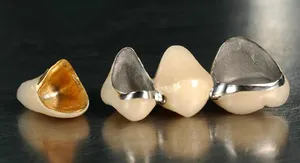
This is the best metal-ceramics. It is made by exactly the same method as the standard one, but the metal framework is cast from semi-noble or noble alloys with different gold content. Depending on the amount of gold in the alloy, its colour varies.
It can be grey, white or yellow for the grades with the highest gold content. Crowns and bridges made of metal-ceramics with a noble gold alloy have excellent aesthetics owing to the yellow colour of the metal and are suitable for highly aesthetic front crowns that do not cause a change in colour or greying of the gum.
In addition there is the extremely good biological tolerance of the gum to the gold alloy and the absence of allergic reactions to it. The only drawback of this type of crown and bridge is their high price, owing to the expensive alloys and the specific ceramic masses used to make them.
- Fabrication: about 7 – 10 days with 2 visits to the dental clinic
- Price: individual, according to the type of alloy and the amount needed
Subgroup B: Metal-free crowns and bridges
10. Pure ceramic crowns – porcelain crowns
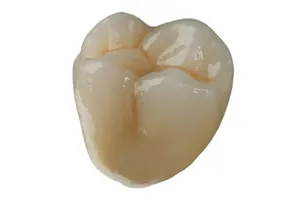
This type of crown was the first metal-free crown to be made. They use feldspathic dental ceramic, which is the same as that used in metal-ceramic crowns and bridges. Porcelain crowns have unsurpassed aesthetics, but also one main drawback, which has led to their being made ever more rarely, and that is strength.
Porcelain is a brittle material and breaks easily under twisting and lateral forces. For this reason bridges are not made from feldspathic porcelain.
Nowadays they are used ever more rarely and mainly for highly aesthetic crowns on front teeth. They are gradually being replaced by modern synthetic ceramic materials – leucite ceramic and lithium disilicate ceramic.
- Fabrication: about 7 days with 2 visits to the dental clinic
- Price: about 300 € – 400 € per tooth
11. Leucite glass-ceramic crowns – IPS Empress
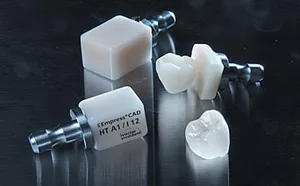
These are the next generation of pure ceramic crowns. They have improved mechanical qualities compared with standard porcelain crowns. The strength of crowns made of IPS Empress ceramic reaches a flexural strength of about 180 MPa.
This makes them very suitable for highly aesthetic single crowns on front teeth in patients who require high aesthetics. Another advantage is that the material they are made from is available both for dental laboratories and in the form of ready-made blocks of multilayer ceramic. With the help of CAD/CAM systems, this type of crown can be milled from them and finished within 1 day.
- Fabrication: from 3 hours (CAD/CAM) to 7 days (dental technician) with 1 or 2 visits to the dental clinic
- Price: about 300 € per tooth
12. Crowns and bridges made of lithium disilicate ceramic – IPS e.max
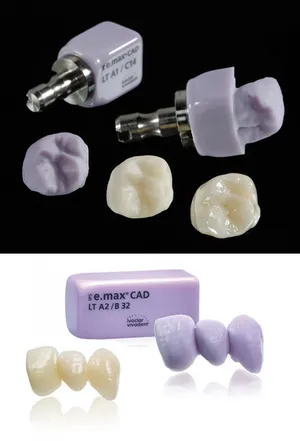
Lithium disilicate ceramic is the modern material closest to natural enamel. It surpasses zirconia in aesthetics, and at the same time it is much stronger than previous generations of ceramic materials. This gives it a leading place in modern fixed prosthetics, both for making highly aesthetic single crowns on all teeth in the mouth and for three-unit bridges on the front teeth.
Another advantage over zirconia and metal-ceramics is that it can be adhesively bonded. This makes it possible to make highly aesthetic and strong veneers and partial crowns from this material too. It is used in two main forms – press ceramic (for work in the dental laboratory) and CAD/CAM ready-made purple blocks with a non-crystallised formula for directly milling crowns with the CEREC system within a few hours.
The purple colour before crystallisation is a distinguishing feature of the material (IPS e.max). It is a specific crystal form with reduced strength, which allows the machines to mill a crown/bridge from the material.
After that it has to be re-crystallised at a temperature of 860 degrees and under vacuum in special ceramic furnaces, which increases the strength of the material to about 400 MPa, more than 2 times that of standard pure ceramics. After crystallisation the purple colour turns into the preset natural tooth shade, and it can also be additionally stained with special ceramic stains, which further improves the individuality and aesthetics of crowns and bridges made of lithium disilicate.
- Fabrication: from 2-4 hours (CAD/CAM CEREC) to 7 days (dental technician) with 1 or 2 visits to the dental clinic
- Price: about 400 € per tooth
13. Crowns and bridges made of zirconia-reinforced lithium disilicate ceramic – Suprinity
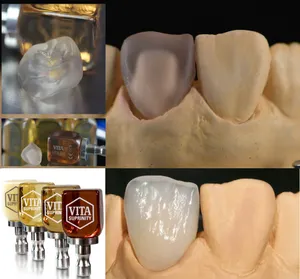
This is the second generation of lithium disilicate ceramic, whose strength is improved by adding 10% zirconia to the material. It is the strongest pure ceramic on the market at present. It comes in the form of blocks for CAD/CAM machines (CEREC), and just like IPS e.max it is initially in a softer form so that the machines can mill it.
The look of the non-crystallised ceramic blocks is characteristic – they are transparent and resemble the colour of bee honey, and after milling the crowns offer excellent visibility at try-in, so that their accuracy and fit to the natural teeth can be judged. Both IPS e.max and Suprinity crowns and bridges can be adhesively bonded to natural teeth. Again they have wonderful aesthetics and are an excellent choice for single crowns on any tooth, front or back.
- Fabrication: from 2-4 hours (CAD/CAM CEREC) with 1 visit to the dental clinic
- Price: about 400 € per tooth
14. Zirconia crowns and bridges (full contour) – tetragonal zirconia – BruxZir
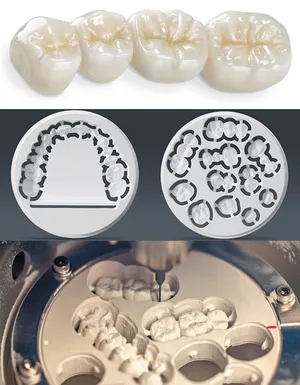
Zirconia is the strongest metal-free material used in modern prosthetic dentistry. It comes in two main kinds – tetragonal and cubic. Tetragonal is zirconium dioxide stabilised with yttrium.
It is the strongest of all types of zirconia and reaches a flexural strength of up to 1200 MPa. It can be used to make both frameworks for applying ceramic over them (as with metal-ceramics) and monolithic crowns and bridges (full contour). Zirconia comes in the form of special discs for CAD/CAM machines, from which the digitally designed dental restorations are milled.
The crowns or bridges milled in this way are chalky white and brittle. After that they are sintered (hardened) and stained in special high-temperature furnaces for about 7-8 hours to look like real teeth.
Full contour crowns and bridges made of tetragonal zirconia are the strongest, but they have one significant drawback, which is that their aesthetics are not good enough because of the lack of translucency. That is why we use this type of crown and bridge only for back teeth.
- Fabrication: about 7 days with 2 visits to the dental clinic
- Price: about 300 € per tooth
15. Zirconia crowns and bridges (full contour) – cubic zirconia – Katana/DDCubeX/ZirCad Prime
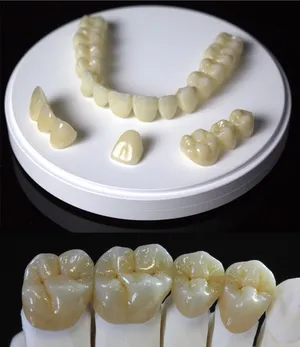
This is the newest generation of zirconia used in modern prosthetic dentistry. Unlike tetragonal zirconia, cubic zirconia is highly translucent and its aesthetics come as close as possible to those of lithium disilicate ceramics. In strength it takes an intermediate place between modern glass ceramics and standard opaque zirconia, with a flexural strength of about 750 MPa.
Again it comes in the form of discs, from which crowns and bridges are milled on CAD/CAM machines. They are sintered and stained in special furnaces at a temperature just over 1500 degrees for about 2 hours. It is an excellent choice for crowns and bridges throughout the mouth.
However, it has drawbacks in that it can break in longer bridges in the back regions of the mouth and in patients who clench their teeth at night (bruxism). That is why we prefer to use it mainly for small bridges. For single crowns it is stronger than lithium disilicate ceramics, but it is inferior to them because it cannot be adhesively cemented.
- Fabrication: about 7 days with 2 visits to the dental clinic
- Price: about 300 € per tooth
16. Zirconia crowns and bridges covered with lithium disilicate ceramic
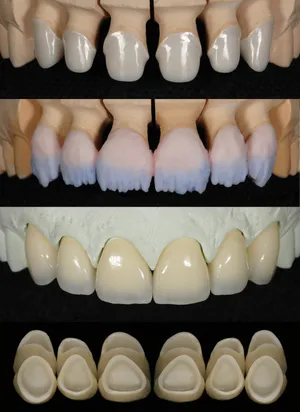
This type of zirconia crown and bridge is the highest class of dental restoration. They have both high strength, owing to the tetragonal zirconia framework, and excellent aesthetics, thanks to the coating of highly aesthetic ceramics. They are made in combination, with the frameworks designed and milled on a computer with CAD/CAM systems, and the ceramic applied by hand, layer by layer, by the dental technician.
In this way we come as close as possible to the appearance of natural teeth without compromising on strength. Depending on how much of the zirconia copings is covered with ceramic, this type of crown and bridge is of two main kinds – veneered and fully covered. In fully covered ones the zirconia framework is thin and completely hidden under the ceramic, as in metal-ceramic crowns.
In the veneered version ceramic is applied only to the outer visible side of the teeth, while on the chewing surfaces and on the inner side the crowns and bridges are made full contour. We choose this type of bridge and crown for patients with bruxism or for bridges of great length, to ensure a greater thickness of the zirconia framework and hence greater strength.
- Fabrication: about 7 days with 2 visits to the dental clinic
- Price: about 460 € per tooth
Subgroup C: Specific crowns and bridges
17. Partial crowns made of hybrid ceramic – inlay, onlay, overlay
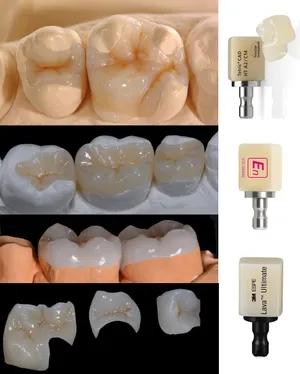
Inlays, onlays and overlays are in essence partial crowns, differing in the area of the tooth they cover. Inlays are the smallest, and overlays cover the largest area. This type of crown has been known for a long time, but it has not been widely used because it was made of metal or metal-ceramics, which do not bond well to teeth, and so debonding and loss of the restorations was often observed.
With the development in the last few years of the so-called hybrid ceramics, and dentists’ move towards maximum micro-invasiveness, this type of crown is being made more and more often. Hybrid ceramics are extremely interesting materials. They are a photopolymer matrix that plays the role of a framework, with ceramic as a filler, thus combining the strength and durability of ceramic with the micro-elasticity of polymer materials.
This type of ceramic is also called force absorbing, because it can absorb part of the chewing forces and in this way protects the teeth from breaking. They come in the form of ready-made ceramic blocks for CAD/CAM machines, from which the partial crowns are milled.
They can be painted with special stains for additional individualisation and colour matching. They are adhesively bonded (like fillings) to the enamel and are a modern, micro-invasive, aesthetic and extremely precise restoration of the patient’s teeth without additional preparation.
- Fabrication: from 3 hours (CAD/CAM) to 7 days (dental technician) with 1 or 2 visits to the dental clinic
- Price: about 300 € per tooth
18. Partial crowns on the visible surfaces of the teeth – veneers
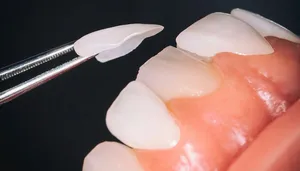
Veneers, despite their popularity as separate dental restorations, in fact belong to the category of partial crowns. They can be made on the front teeth, where they are widely known, and also on the back teeth. According to their thickness they are of two main kinds – standard and thin (Lumineers).
They also differ according to how much of the tooth is prepared – they can cover only the outer surfaces or, in addition, the side and chewing surfaces of the teeth. There are also patients in whom it is even possible to make veneers without preparation.
They can be made from leucite, lithium disilicate and hybrid ceramics, as well as composite. Zirconia is not used because of the problems of bonding it to the enamel of the teeth.
- Fabrication: from 3 hours (CAD/CAM) to 7 days (dental technician) with 1 or 2 visits to the dental clinic
- Price: about 400 – 520 € per tooth for a ceramic veneer and 100 – 240 € per tooth for a composite one
19. Endocrowns
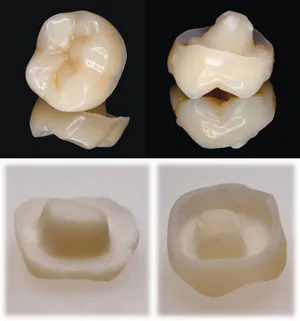
Endocrowns are a specific type of crown that is made only on devitalised teeth. In essence they are partial crowns, analogous to overlays, but unlike them they do not rely only on adhesive cementation, but also have mechanical retention in the tooth. In devitalised teeth, as is known, the nerves are wide and form the so-called pulp chamber.
With standard crowns, after root canal treatment a post is placed there and the cavity is filled and built up in the form of a tooth stump, onto which the crown is placed. With endocrowns no build-up is made, and the crown is designed to replace the post and the build-up of the tooth, so that the whole structure is monolithic. It is then adhesively cemented in the tooth.
Endocrowns are made both from lithium disilicate ceramics and from the new hybrid ceramics. They are a very good solution that reduces the number of visits for treating a given tooth and at the same time eliminates the need for a post build-up of the tooth, which also leads to a lower overall cost of treatment.
- Fabrication: from 3 hours (CAD/CAM) to 7 days (dental technician) with 1 or 2 visits to the dental clinic
- Price: about 400 € per tooth
20. Adhesive bridges (bridges without preparation) – ceramic and composite
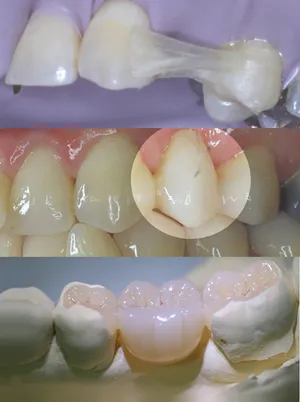
Adhesive bridges are a modern micro-invasive option for replacing lost teeth. They originally arose as temporary bridges, but in practice have proved themselves as long-lasting solutions.
The main and important requirements for making adhesive bridges are: patients should have teeth in good condition, a correct bite and, most importantly, the two supporting teeth of the bridge must NOT have had their nerves removed (they must be vital). According to how they are made, they are of two main kinds – direct and laboratory-made.
Direct ones are made from glass fibre and composite, straight in the mouth, and the procedure takes a few hours. When they are intended for permanent treatment, small ledges must be prepared in the supporting teeth, in which the glass fibres are fixed for additional strength.
Laboratory-made ones are made from zirconia and ceramic in the dental laboratory. For them too, small ledges must be prepared on the chewing surfaces of the supporting teeth. They are made extremely precisely and are adhesively bonded to the enamel of the teeth.
Adhesive bridges are a very good modern solution for patients who are afraid of having implants placed and at the same time do not wish to have their teeth prepared for standard bridges.
- Fabrication: from 4-6 hours (direct) to 7 days (laboratory-made) with 1 or 2 visits to the dental clinic
- Price: individual, after a consultation at the clinic and determining the type and difficulty of fabrication
21. Maryland bridges – lithium disilicate adhesive bridges
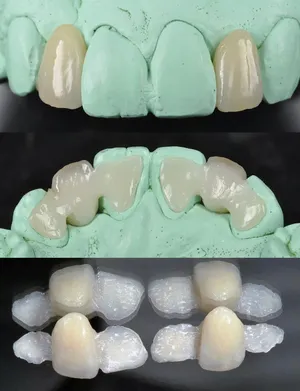
Maryland bridges are a variety of adhesive bridge that has gained great popularity and is often made thanks to the arrival of lithium disilicate ceramic. With its excellent aesthetics, high strength and the possibility of adhesive cementation, it surpasses both zirconia and standard ceramics. Maryland bridges are made to restore missing front teeth in the area from canine to canine.
In essence they consist of the missing tooth with one or two wings (veneers) attached to it, which are positioned on the inner side of the supporting teeth. In the lower jaw this type of bridge is made without any preparation of the teeth, while in the upper jaw, because of the bite, fine ledges have to be made for the wings. Very often they are used as permanent micro-invasive bridges in young patients with congenitally missing lateral incisors, in whom implant treatment cannot be applied.
They are also a very good choice for patients in whom one of the lower front teeth becomes loose and falls out. Their additional advantage is that they are made outside the patient’s mouth with the CEREC system within a few hours. They can also be made in the laboratory.
- Fabrication: from 2-4 hours (direct – CEREC) to 7 days (dental technician) with 1 or 2 visits to the dental clinic
- Price: individual, after a consultation at the clinic and determining the feasibility and difficulty of fabrication
22. Hybrid zirconia bridges
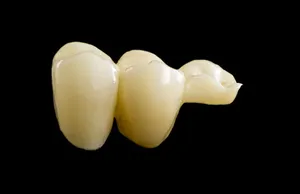
A special type of bridge made as a combination of a standard and an adhesive bridge, in which one supporting tooth is prepared in the standard way, and in the other tooth a ledge is made for an inlay retainer. They are usually used when we have a case with one missing tooth, where one of the supporting teeth is devitalised and the other vital. In this case making a standard adhesive bridge is risky because of the increased brittleness of devitalised teeth.
With the hybrid bridge, the tooth with the nerve removed is prepared in the standard way for a full-coverage crown that will protect it from splitting, while for the vital one, to be as micro-invasive as possible, we make only a ledge for the inlay retainer. It is a very good option for avoiding implant treatment through stable and at the same time micro-invasive bridge prosthetics.
- Fabrication: about 7 days with 2 visits to the dental clinic
- Price: about 300 € per tooth
23. Dental bridges on a glass support – Zx 27
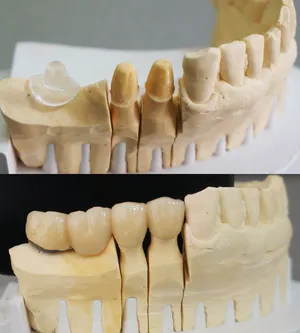
Dental bridges made on a glass support (Zx-27) are a specific type of restoration used when a rear supporting tooth is missing. Its role is taken over by a special support made of a glass-like material, which is cast from an exact impression of the relief of the gum. It is placed in the area of the missing tooth passively on the gum, exerting light pressure on it.
It is held in the exact position by bonding it to the bridge, and then the bridge itself is bonded to the supporting teeth and the whole structure is fixed. In its mechanics this type of structure is a combination of cantilever bridges and dentures in the way chewing pressure is transmitted.
The glass transmits the chewing forces to the gum like a denture, thus reducing the load on the supporting teeth. For these reasons, bridges made on a glass support have specific indications, and the decision to use them is made individually for each clinical case according to the condition of the supporting teeth and the bite.
- Fabrication: about 7 – 10 days with 2 visits to the dental clinic
- Price: individual, after a consultation to determine the feasibility of fabrication and the number of supports needed.
Subgroup D: Implant crowns and bridges
24. Standard cemented implant crowns and bridges
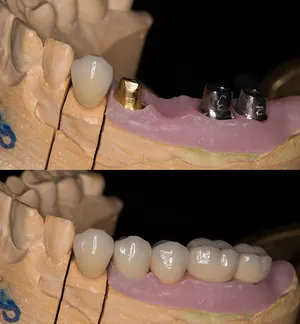
This is the classic type of implant crown and bridge. They are made on standard ready-made implant abutments that imitate tooth stumps. The abutments are prepared to the required height of the bite and screwed onto the implants, after which the finished crown or bridge is cemented on them in the same way as on natural tooth stumps.
This type of implant crown can be made from metal-ceramics, as well as from zirconia and even lithium disilicate ceramic. Metal-ceramics is the most commonly used, because with the other two types of crown the grey colour of the abutment may show through and worsen the aesthetics. This type of crown and bridge has one significant drawback, which is the very difficult removal of the cement that gets under the gum after cementation.
Another drawback is that they cannot be removed intact from the implant if the abutment becomes loose. These drawbacks are avoided in the new screw-retained crowns.
- Fabrication: about 10 days with 2 visits to the dental clinic
- Price: about 350 € – 400 € per tooth for Zimmer implants
25. Screw-retained crowns and bridges on implants – Multi-unit abutments
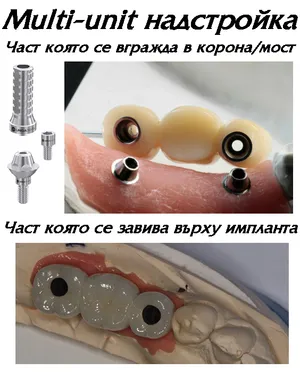
Screw-retained implant crowns are the modern option for prosthetics on implants. One way to make such crowns and bridges is to use the so-called multi-part abutments (Multi-unit). These are specific abutments made of 3 parts – an implant part, a bridge part and a connecting screw.
The implant part is screwed into the implant and stays at the level of the gum or slightly below or above it. The bridge (crown) part of the abutment is incorporated by a special technology into the metal framework of the bridge/crown. A particular feature of this type of crown and bridge is that they have a hole on the chewing surface, in which the third element – the connecting screw – is placed, and the finished bridge/crown is tightened to the implant.
After tightening, the screw is sealed in a suitable way so that it remains accessible for unscrewing when the structure needs to be removed, and the hole is filled with a photopolymer filling, like a natural tooth. With this type of crown and bridge there is no danger of debonding and falling off, because there is no cement.
Their only drawback is the possibility of the connecting screw becoming loose, but tightening it is easy. Access to it is through the chewing surface, simply replacing the photopolymer filling covering it.
- Fabrication: about 10 days with 2 visits to the dental clinic
- Price: about 450 € – 500 € per tooth for Zimmer implants
26. Digitally made (CAD/CAM) screw-retained implant crowns and bridges – Ti-Base crowns
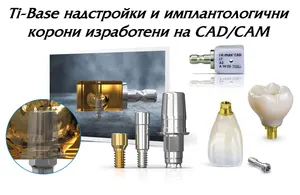
This is the most modern type of implant crown. They are made entirely on a computer with CAD/CAM systems. To make this type of crown, special standardised abutments called Ti-base are used, which are placed on the implants and scanned with an intraoral or laboratory scanner.
The crowns are then made, and they can be metal-ceramic, zirconia or lithium disilicate (e.max). They fit the abutment perfectly because they are milled on CAD/CAM machines. The crown made in this way again has a hole on the chewing surface (in back teeth) or the rear (invisible) surface in front teeth.
The crowns are cemented to the titanium base (Ti-base) outside the mouth with special high-strength cements, after which they are removed from the model and the excess cement is cleaned off under visual control. The next step is simply to screw them onto the implant in the patient’s mouth and hide the access to the screw with photopolymer.
- Fabrication: from 4-6 hours (CAD/CAM) to 10 days (laboratory-made) with 1 or 2 visits to the dental clinic
- Price: about 350 – 500 € per tooth for Zimmer implants
27. Implant crowns and bridges on custom abutments
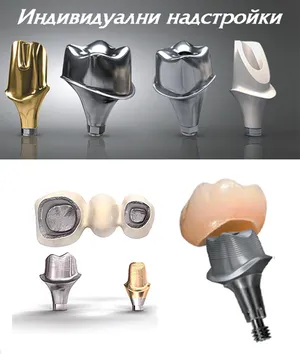
These are again a high class of crowns and bridges used in prosthetics on implants. In them the abutment on which they are placed is individually made, unlike all the other types of implant restoration, where various types of standard abutments are used. This type of crown is again made entirely digitally.
The particular feature is that, to take an impression, special scanning devices are placed on the implants and the position of the implant and the shape of the gum around it are scanned in the laboratory. Then, with a special computer program, both the abutment and the crown are designed, after which both are milled. Most often the abutment is milled from titanium or zirconia, and the crowns from zirconia.
Custom abutments are especially suitable when we have problems with the profile and shape of the gum and when the implants are tilted strongly to the side and standard crowns and bridges could not be made. Their other advantage is that they have a shoulder at the level of the gum, so that when the crowns are cemented on them the excess cement is cleaned off easily and reliably. Another specific feature of theirs is that they closely resemble the shape of natural teeth prepared for full-coverage crowns, which further improves the aesthetics.
- Fabrication: about 2-3 weeks with 2 – 3 visits to the dental clinic
- Price: about 350 – 450 € per tooth for Zimmer implants
28. Highly aesthetic crowns on implants – Veneer abutment
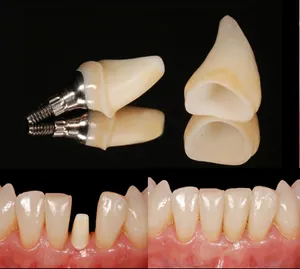
This type of crown is metal-free and is used mainly in patients with very high aesthetic requirements. It is most often used when restoring a single front tooth with an implant. In this case we use crowns of pure ceramic or lithium disilicate.
They have a certain translucency, however, that gives them a natural look, which leads to a problem after they are cemented on standard abutments – a grey tint in the crown due to the abutment showing through. To hide the grey colour of the abutment, a specific Veneer abutment is made.
It is made by hand or on a CAD/CAM system, with opaque porcelain applied to the standard abutment or a ceramic coping stained in the colour of the neighbouring teeth cemented onto it. In this way we create a base for the crown that imitates dentine and is as close as possible to the look of a natural prepared tooth.
- Fabrication: about 2 weeks with 2 visits to the dental clinic
- Price: about 500 € per tooth for Zimmer implants
29. All-on-Four bridges on 4 implants
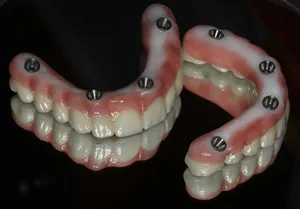
These are the so-called Toronto bridges. They are made on a minimum of 4 implants in Nobel Biocare’s All-on-Four concept (when there is not enough bone to place more than 4 implants). They can also be made on 6 – 8 or more implants in patients with enough bone volume to place them.
This type of bridge is made of two parts – a framework and an aesthetic facing. The framework can be of two kinds – metal or zirconia, and the aesthetic facing can be ceramic applied directly to the metal framework/zirconia, or ready-made individual lithium disilicate crowns bonded in a special way onto a zirconia framework. With the second option extremely high aesthetics of the structure is achieved and the effect of fused (stuck-together) teeth seen in standard bridge structures with applied ceramic is avoided.
This type of bridge is usually screw-retained and is made on multi-part (Multi-unit) abutments. This allows them to be removed easily by the dentist at the clinic for cleaning and checking of the implants.
- Fabrication: about 2-4 weeks with 2 – 3 visits to the dental clinic
- Price: individual, after a consultation at the clinic and determining the treatment plan and the number of implants
30. Titanium-photopolymer bridges on 4-6-8 implants
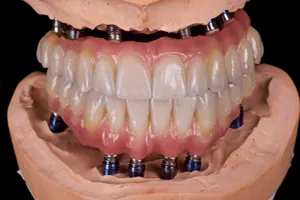
This is the most modern way of making large bridge structures on multiple implants. This type of bridge is in essence also a Toronto bridge, but differs mainly in the way it is made and the materials it is made of. Again they are two-part structures, consisting of a titanium framework and a photocomposite imitating the gum and teeth.
The titanium frameworks are milled on special high-precision CAD/CAM machines and, as with metal/zirconia ones, are screw-retained on the implants by means of (Multi-unit) abutments. On the framework made in this way, highly aesthetic composites of different colours are applied by hand, recreating both the teeth and the gum precisely.
This type of structure has 2 main advantages: they are much lighter than metal-ceramic and zirconia ones, and so put less load on the supporting implants. Their other unique advantage is that, in the event of chipping or a problem with the photopolymer facing, it is repaired by removing the damaged part and adding new photopolymer directly in the mouth in just a few minutes.
- Fabrication: about 2-4 weeks with 2 – 3 visits to the dental clinic
- Price: individual, after a consultation at the clinic and determining the treatment plan and the number of implants
How much do crowns and bridges cost?
The approximate price of each type is given above, and for some types it is individual. All prices are in the Price list.
Frequently asked questions
How many types of crowns and bridges do you make?
30 types – temporary and permanent. The permanent ones are metal-containing, metal-free, specific and implant.
How quickly can a temporary crown be made?
A temporary crown made of bis-acrylic resin is made on the spot at the clinic within 20 – 30 minutes. It is recommended for a short stay in the mouth – 2 to 4 weeks. The long-term PMMA temporary crown is made in about 3 – 4 days with 2 visits and can stay in the mouth for up to 6 months.
Can a ceramic crown be made in one day?
Yes, with the CEREC CAD/CAM system. An IPS e.max or Suprinity crown is made in 2 – 4 hours in one visit, and an IPS Empress crown from 3 hours.
Which crowns and bridges are made most often?
Standard metal-ceramic (base alloy Cr-Co). It is the most commonly made in Bulgaria and the most balanced option in terms of price and quality – with very good aesthetics, excellent strength and an affordable price. It takes about 7 days with 2 visits.
What is the strongest metal-free material?
Zirconia. Tetragonal zirconia reaches a flexural strength of up to 1200 Mpa, but its aesthetics are not good enough because of the lack of translucency, so we use it only for back teeth.