
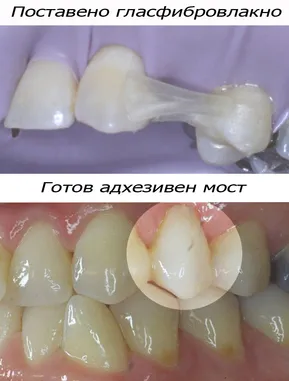
A bridge without grinding (an adhesive bridge) replaces one or two missing teeth without grinding down the healthy neighbouring teeth. It is possible thanks to two materials – lithium disilicate ceramic (e.max ceramic) and glass-fibre. A condition is that the two supporting teeth of the bridge are vital (they must NOT have had their nerves removed).
Why a bridge without grinding?
One of the main disadvantages of standard dental bridges is the grinding down of the neighbouring teeth that support the bridge (the abutment teeth). In many patients these teeth are healthy or have small cavities, and grinding them down is a far too invasive and undesirable procedure.
In these cases the best option is an implant, but this procedure is not financially affordable for all patients, so another option has to be found. That is why modern dentistry increasingly uses the technology of making adhesive bridges without grinding down the teeth.
What are adhesive bridges made of lithium disilicate ceramic?
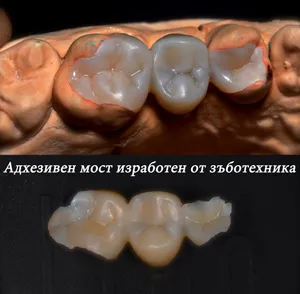
Lithium disilicate ceramic e.max is a high-strength ceramic that makes it possible to produce adhesive bridges without grinding down the teeth completely. Unlike metal-ceramic and zirconia, e.max ceramic is bonded adhesively instead of cemented, which makes micro-invasive replacement of a missing tooth possible.
Ceramic adhesive bridges are made on a CAD/CAM system by computer design, or by a dental technician. Computer-made ones can be ready within 1 – 2 days, while those made in the dental laboratory take 5 working days.
What are their advantages?
- They are made of ceramic, which is mechanically stronger than glass-fibre and photopolymer.
- Because they are made outside the mouth, they are extremely fine and precise and do not irritate the gum.
- Better aesthetics are achieved.
- The time in the dental chair is about the same as for an ordinary filling, compared with 4 – 5 hours for an adhesive bridge from glass-fibre and composite.
- Small fractures can be repaired directly in the mouth.
What is a Maryland bridge?
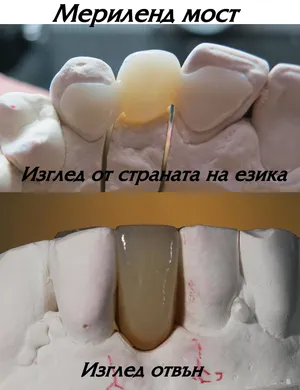
Maryland bridges are another type of adhesive bridge made of lithium disilicate ceramic. They are used to replace missing front teeth and are perfect for patients who lose a lower or upper front tooth because of periodontitis (the tooth becomes loose and falls out of the gum), as well as for tooth loss from other causes. They are made within 1 – 2 days using the CAD/CAM system.
Their main specific feature is that 1 or 2 special ceramic wings are used for retention, bonded to the inner side of the supporting teeth, so the bridge is indistinguishable from a natural tooth. On lower-jaw teeth no grinding is needed at all, while on upper-jaw teeth fine seats are prepared on the tongue side, no deeper than 1 mm.
They are bonded with special high-strength cements and fully restore normal aesthetics and correct speech.
What are adhesive bridges made of glass-fibre and composite?
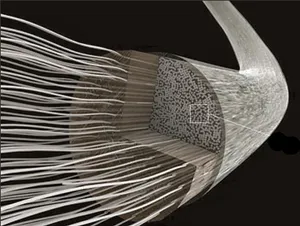
Glass-fibre is a special fibre made up of a huge number of glass filaments, immersed in a special resin base and bonded inseparably, giving the material exceptional strength and durability. It was originally developed for motor sports (Formula 1) and aircraft construction because of its exceptional strength and lightness, and elements of the wings of Stealth aircraft are made from it.
It was introduced into dentistry at the end of the 90s and used to make temporary bridges over implants, which had to last about 6 months until osseointegration was complete. Clinical observations of patients who missed the set time for completing their implant treatment showed that this type of bridge is more durable than expected and can be used as a permanent one.
What are their advantages?
- Great strength and a strong adhesive bond.
- They do not irritate the gums.
- They contain no metal and are suitable for allergic patients.
- They can easily be reworked, fixed and adjusted directly in the mouth.
- Good biological tolerance by the teeth and gums.
- They transmit the functional load of chewing in a physiological way.
- They cost less than a metal-ceramic bridge.
How is it made?
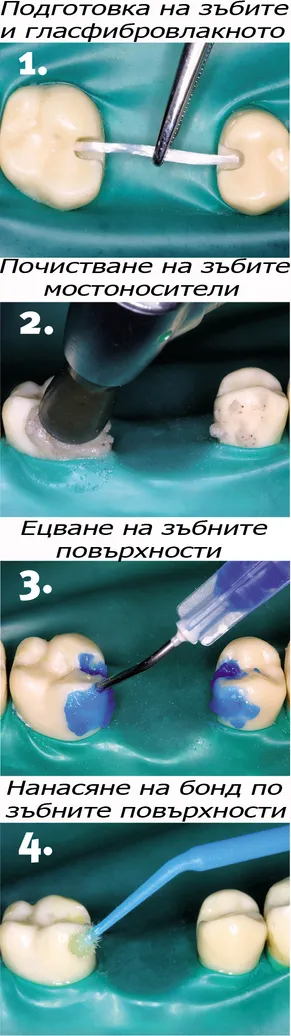
Adhesive bridges without grinding can be made when one or two teeth are missing. Another important advantage is that they can be made in one day. A glass-fibre bridge is made in a single visit, which lasts about 4 – 5 hours.
- Miniature grooves of only 1 – 2 mm are made in the abutment teeth, and if there is caries or an old filling, practically nothing more is ground from the tooth.
- A rubber dam is placed – a sheet for isolation that makes the dentist’s work easier and gives the patient comfort.
- The grooves or cleaned cavities are treated in the same way as when placing a photopolymer filling.
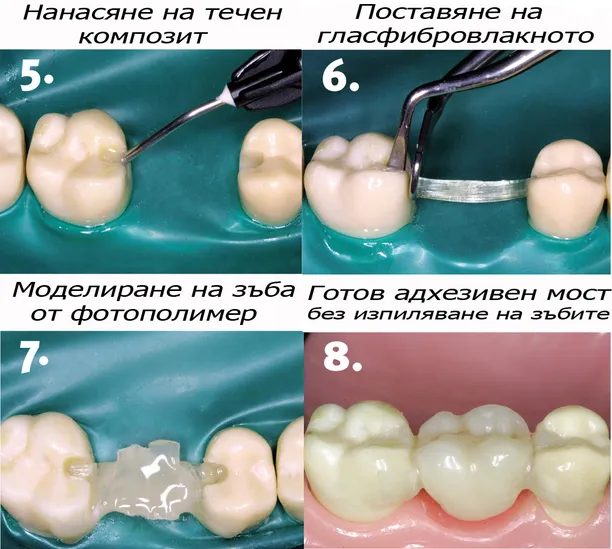
- The required number of glass-fibres of a given length are cut and bonded into the grooves of the supporting teeth with liquid light-curing composite, using a curing lamp.
- The missing tooth is modelled in photopolymer on the solid base of the fibre.
- After the desired shape is given, cleaning, polishing and fitting to the neighbouring teeth follow.
In this way, in one visit and without grinding down the supporting teeth, a highly aesthetic bridge is made that is biologically tolerated, strong and has excellent aesthetic qualities. If properly maintained and exactly made, this type of bridge lasts many years and can be adjusted and repaired in the mouth. If a decision is made to treat with implants, the bridge body is removed quickly and easily without affecting the neighbouring healthy abutment teeth.
How much does it cost?
An adhesive bridge without grinding costs about 400 – 600 €; the exact price is set after a consultation. All prices are in the Price list.
Frequently asked questions
For how many missing teeth can a bridge without grinding be made?
When one or two teeth are missing.
How long does a glass-fibre bridge take?
It is made in a single visit, which lasts about 4 – 5 hours.
How long does a ceramic adhesive bridge take?
Those made on a CAD/CAM system can be ready within 1 – 2 days, and those made in the dental laboratory take 5 working days.
What is a Maryland bridge?
An adhesive bridge of lithium disilicate ceramic for missing front teeth. It is held by 1 or 2 ceramic wings bonded to the inner side of the supporting teeth and is made in 1 – 2 days with the CAD/CAM system.
What happens to the bridge if implant treatment is chosen later?
The bridge body is removed quickly and easily without affecting the neighbouring healthy abutment teeth.