

A dental implant is a titanium root that replaces a missing tooth and carries a crown, bridge or denture. Placement takes about 30 – 40 minutes for one implant under local anaesthetic, and the implant heals for about 6 months before the crown is placed.
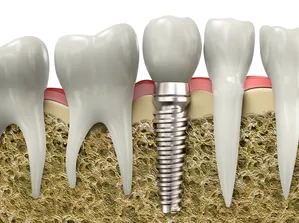
Placing dental implants is one of the most serious and innovative treatment methods in modern dental medicine. The method is entering widespread practice thanks to its exceptional functionality and convenience for the patient. Implants can be compared with natural teeth in chewing efficiency, aesthetics and need for care – caring for an implant is no different from caring for natural teeth. This is why, provided they are correctly placed and the prosthetic restorations made on them are well planned, implants last a long time in the oral cavity.
What is a dental implant?
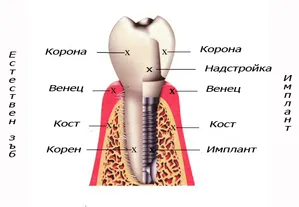
Implants are conical or cylindrical bodies that resemble a screw. They act as the root of the tooth and are made of special bioinert titanium alloys. They are held in the bone by their thread, and the bone grows into it and attaches to the surface of the implant.
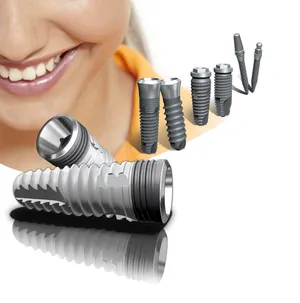
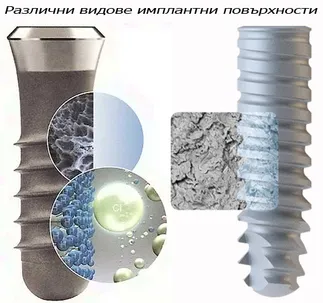
This process is called osseointegration and is key to holding the implant in the bone. It is very complex, because bone cells are thought to attach to various micro-roughnesses on the surface of the implant. That is why the titanium alloy on the implant surfaces is treated in a special way, to produce roughnesses of a precisely defined structure and size for the bone cells to osseointegrate with.
What does an implant restoration consist of?
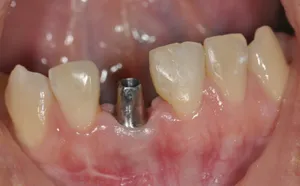
With classic conical implants, once the process of osseointegration is complete and the implant sits firmly in the bone, the tooth core (abutment) is placed. It is screwed onto the implant with a special screw and, unlike the implant, which is deep in the bone, it shows above the gum.
The implant-supported crown is made on it using the method for making standard crowns (read more). The crown can be of two types: cemented onto the abutment or screwed onto the abutment. An advantage of screw-retained implant crowns and bridges is that they can be removed and cleaned after a certain period of time.
What examinations are needed before implantation?
The procedure for placing implants is not complicated, but the precise planning of their positions is key to the strength and durability of the restoration. Before implants are placed, specific examinations are needed to confirm that the patient is suitable.
Contraindications for implantation are diabetes, active smoking, alcoholism, and other general and mental illnesses.
The most important examination, however, is the X-ray examination of the available bone. At the very first visit it is good to have a panoramic X-ray, which gives an approximate idea of whether there is enough jaw bone for an implant.
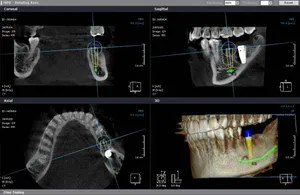
After that a computed tomography or 3D tomography of the jawbones is carried out, which shows the condition and amount of the bone with extremely high precision. The number, position, direction of placement and size of the implants are determined from it. It also shows us the position of important structures in the facial-jaw area, such as the maxillary (upper jaw) sinus and the canal through which the lower jaw nerve passes.
How is an implant placed?
Only after all the examinations have been carried out and the implant treatment has been fully planned does the placement begin. It takes about 30 – 40 minutes for a single implant (the visit takes 40 min to 1 hour) and about 3 hours for 6 or more implants. It is performed in the dental chair as a microsurgical operation under a local anaesthetic similar to that used for tooth extraction. The procedure is painless, and only some discomfort may be felt for a few days after implantation.
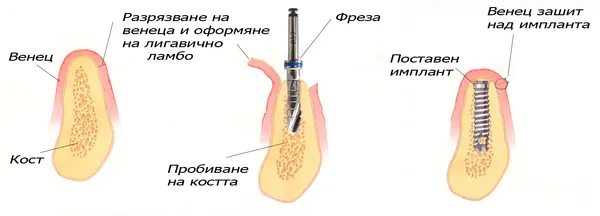
How the operation goes step by step – planning with a surgical guide, antibiotic preparation, the placement itself, the post-operative period and possible complications – is described in detail in How implant surgery is performed.
The placed implant is usually covered with the mucosa, which is sutured. This is so-called closed implantation, in which the implant is left for about 6 months to osseointegrate with the bone without being loaded. During this time a temporary restoration made of glass-fibre or a temporary denture is made.
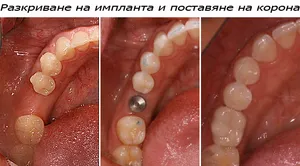
After six months have passed, the temporary restorations are removed and, with a very minor surgical intervention, the implants, which are by now firmly osseointegrated, are uncovered. Abutments (tooth cores) are placed on them, after which impressions are taken and the permanent restorations are made.
Immediate implantation and immediate loading
There is also another method, in which the implants are placed immediately after the tooth is extracted, in the space left by its root. It is called immediate implantation, and it requires a bone substitute to be placed to fill the bony socket around the implant.
In some cases the implant-supported crowns can be placed immediately after the implant is placed, without waiting for its osseointegration. This is immediate loading. Its positive feature is that the missing tooth or teeth are restored straight away, but there is a greater risk of implant failure.
How successful is implant treatment?
The success rate of implant treatment is about 95 – 96 %, and in some cases up to 98 %. It also depends a great deal on the patient’s care of their implants – regular cleaning and check-ups every 3 months, and giving up harmful habits such as smoking and alcohol abuse. With correct treatment and care by the patient, implants can last many years. Cases of implants lasting in the bone for 15 – 20 years have been described.
What can be restored with implants?
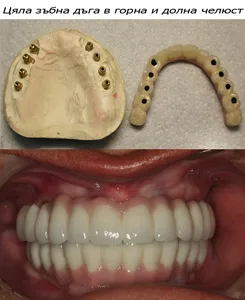
Implants can be used to restore a single missing tooth, as well as to make dental bridges and even entire dental arches in the upper and lower jaw. Another use is to hold entire dentures, especially in the lower jaw.
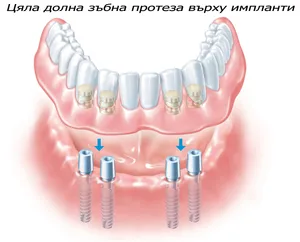
Placing 4 implants in the lower jaw can hold a whole acrylic denture in place even when the alveolar bone has completely resorbed, giving the patient comfort when eating.
What are the advantages and the drawback?
Implant treatment is the most modern and productive method of treating missing teeth. Its advantages are:
- convenience;
- aesthetics;
- preservation of the neighbouring teeth;
- protection of the bone from resorption;
- ensuring quality of life and proper, full nutrition.
The only drawback is the high cost of this type of treatment, which is due to the high quality of the branded implant systems and the need for a high level of qualification in the dentist carrying out implant treatment.
How much does it cost?
BTK implant placement (Italy) – mid range: from 600 €. Zimmer implant placement (USA) – high end: 900 – 1000 €. The price covers the implant placement only; the abutment and the crown are charged separately, depending on the material and type of crown. All prices are in the price list.
Frequently asked questions
How long does it take to place an implant?
About 30 – 40 minutes for a single implant (the visit takes 40 min to 1 hour) and about 3 hours for 6 or more implants. It is performed in the dental chair as a microsurgical operation.
Is placing an implant painful?
A local anaesthetic similar to that used for tooth extraction is given. The procedure is painless, and only some discomfort may be felt for a few days after implantation.
How long does it take for the implant to heal before the crown is placed?
With closed implantation the implant is left for about 6 months to osseointegrate with the bone without being loaded. During this time a temporary restoration made of glass-fibre or a temporary denture is made.
What is the success rate of implant treatment?
About 95 – 96 %, and in some cases up to 98 %. It also depends on the patient’s care – regular cleaning, check-ups every 3 months, and giving up harmful habits such as smoking and alcohol abuse.
When is implantation not recommended?
Contraindications for implantation are diabetes, active smoking, alcoholism, and other general and mental illnesses. Specific examinations are carried out before placement to confirm that the patient is suitable.
Does the implant price include the crown?
No. The price covers the implant placement only. The abutment and the crown are charged separately, depending on the material, the type of abutment and crown, and other factors.