

The treatment of broken and worn teeth is individual and depends mainly on the extent of the breakage or wear of the enamel or dentine. The methods for restoration are the same, but the choice is made according to the size and nature of the damage – from fluoride varnishes and bonding to a post, core and crown.
How are worn teeth treated?
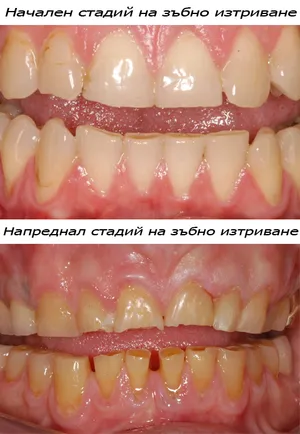
Treatment of worn teeth depends on how advanced the process is.
Early stage
In the early stage, with minimal involvement of the enamel, the worn parts of the tooth do not need to be restored. Only fluoride varnishes and gels are applied, which reduce sensitivity and strengthen the enamel.
Advanced stage
In the advanced stage of tooth wear, with involvement of the dentine, the height of the bite decreases. This is already a serious problem, and the worn parts of the teeth need to be restored.
- If the wear has not reached the pulp (nerve) of the tooth, restoration can be done by making an inlay (onlay, overlay) or placing ordinary or metal-ceramic crowns.
- If the wear has reached the pulp, endodontic treatment, placing a root post and building up the tooth (core/pinlay) are necessary, and only then is a suitable crown placed.
This restores the normal height of the bite, the anatomical shape of the teeth and normal chewing.
Wear caused by bruxism
When teeth are worn as a result of bruxism (teeth grinding), plastic splints are made, which are worn at night.
How are broken teeth treated?
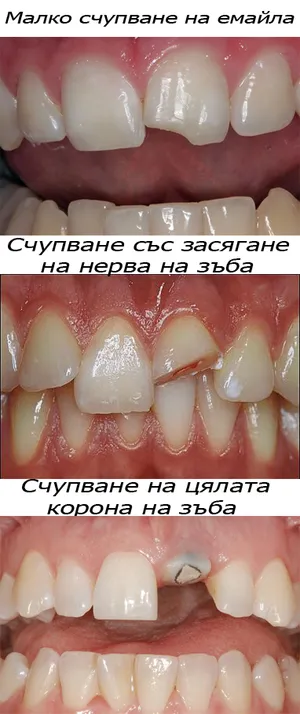
Treatment of broken teeth depends on whether the crown or the root is affected. An X-ray and a vitality test are required – these additional examinations determine the method and manner of treatment.
- Small enamel defects: the enamel is smoothed and polished with suitable rubber polishers and treated with fluoride varnishes.
- Small fractures that have reached the dentine: photopolymer fillings are used for restoration.
- Fractures of large parts of the tooth, without involvement of the pulp: parapulpal pins are placed to improve the retention of the photopolymer fillings, or an inlay is made.
- Crown fractures involving the pulp: root canal treatment is carried out and a photopolymer filling is placed, or a crown in the case of extensive destruction.
- A whole tooth broken: the tooth root is prepared, a post (metal or glass-fibre) is placed in the root canal and a tooth core is made, onto which a crown is placed.
- A fracture at the tip of the root: an apical osteotomy is performed.
- A vertical fracture, with the tooth split through the roots: the only treatment is extraction.
Restoration methods
- Bonding – a procedure for restoring small defects of the teeth.
- Placing a post in the root canal
- Building up the tooth (core/pinlay)
- Fabrication of a dental crown
How much does it cost?
Building up a tooth with a post and composite costs 80 – 100 €, and building up with a pinlay (cast post and core) costs 80 – 140 €. All prices are in the price list.
Frequently asked questions
What does the treatment of a broken or worn tooth depend on?
Mainly on the extent of the breakage or wear of the enamel or dentine, and on the nature of the damage.
What is required before treating a broken tooth?
An X-ray and a vitality test. They determine the method and manner of treatment.
What is done when teeth are worn by bruxism?
When teeth are worn as a result of bruxism (teeth grinding), plastic splints are made, which are worn at night.
What is done for a small fracture that has reached the dentine?
Photopolymer fillings (bonding) are used for restoration.
When does a broken tooth have to be extracted?
When there is a vertical fracture and the tooth is split through the roots – then the only treatment is extraction.