

Apical osteotomy is a microsurgical operation that removes a granuloma or cyst at the root tip of incisors and premolars. For multi-rooted teeth, hemisection is used – removal of the diseased root. Both are done under anaesthetic, after root canal treatment has already been carried out.
What is apical osteotomy?
Apical osteotomy is a surgical procedure performed in the treatment of granulomas and cysts on incisors and premolars. An important condition is that root canal treatment has already been carried out and the root canal of the tooth has been filled correctly.
The purpose of the operation is to remove the granuloma or cyst located around the root tip. After this soft tissue is removed, the empty space left in the bone is filled by naturally growing bone, and the tooth is completely healed.
What comes before the operation?
Before deciding on an apical osteotomy, an X-ray of the root is taken to establish the quality of the root canal filling and the changes in the periodontium (the size of the granuloma or cyst).
How does apical osteotomy proceed?
The operation is microsurgical and takes about 2 hours.
- Anaesthetic is given to numb the area to be worked on.
- A small incision is made in the mucosa over the root tip and the bone that holds the tooth is exposed.
- A small window is shaped in the bone with special bone burs, removing the surface layer of bone until the root tip and the granuloma/cyst are reached.
- The granuloma is cleaned out with special instruments called curettes, and then the tip of the root is cut off.
- The root filling at the cut is checked and, if necessary, sealed again.
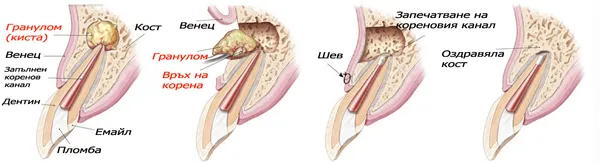
- A bone graft material is placed in the cavity formed in the bone and covered with the mucosa, which is sutured over it.
In most cases healing is complete, but in rare cases there may be recurrences (the granuloma forming again – if it was not cleaned out well).
What is hemisection and when is it used?
Hemisection is used in most cases on multi-rooted teeth, because their roots are close to important structures such as the maxillary sinus in the upper jaw and the nerve canal that supplies the lower jaw and the tongue. Being so close to them makes apical osteotomy an extremely difficult and uncertain method, with a high risk of damaging these structures. That is why hemisection is used for these teeth.
Hemisection is also used when there are many curved, impassable root canals and it is impossible to treat and fill them properly.
How does hemisection proceed?
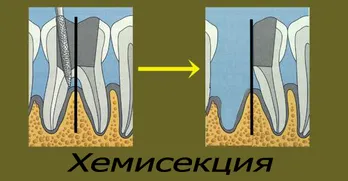
The method is useful because in multi-rooted teeth the granuloma or cyst has usually involved only one root, while the others show no changes in the bone. It is known that multi-rooted teeth remain functionally stable if one of their roots is removed. This is exactly what hemisection is: the diseased root, together with the adjoining part of the tooth crown, is cut off and removed. This is done under anaesthetic.
The remaining root or roots are used to shape a tooth build-up of a particular shape and size, on which a crown is made, and the tooth is functional again and indistinguishable from the others.
Frequently asked questions
What is apical osteotomy?
A surgical procedure in the treatment of granulomas and cysts on incisors and premolars, which removes the granuloma or cyst located around the root tip.
What is needed before an apical osteotomy?
Root canal treatment must already have been carried out and the root canal filled correctly. Before the decision, an X-ray of the root is taken.
How long does an apical osteotomy take and does it hurt?
It is a microsurgical operation and takes about 2 hours. First, anaesthetic is given to numb the area to be worked on.
When is hemisection performed?
In most cases on multi-rooted teeth whose roots are close to important structures, and also when there are many curved, impassable root canals that cannot be treated and filled properly.
Can the granuloma come back?
In most cases healing is complete, but in rare cases there may be recurrences (the granuloma forming again – if it was not cleaned out well).