

Bone grafting restores the lost tooth-supporting bone around loose teeth using the patient’s own bone or a bone substitute. The operation is a microsurgical periodontal one, takes place in four stages, and is done with anaesthesia given beforehand, painlessly.
When is bone grafting needed?
In more severe gingival recession, periodontitis and periodontal abscesses, the teeth become loose because of the loss of tooth-supporting bone. Bone grafting restores the normal level of the bone and reduces the mobility of the teeth.
What materials are used?
As with mucosal grafting, there are two options for obtaining a bone graft.
The patient’s own bone
It can be taken from different parts of the body (skull bones, pelvic bones, lower jaw). Because of the need for a second operation, the patient’s discomfort and other factors, this method is hardly ever used.
Bone substitutes
They come in the form of particles of various sizes (bone chips/granules) or blocks of bone.

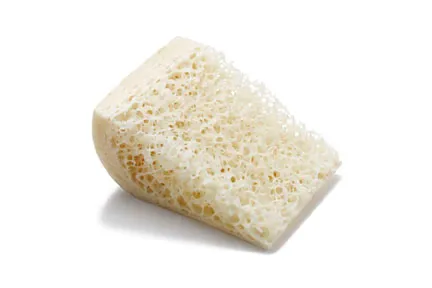
Granules or chips can be either allograft (from ground donor bone) or synthetic (hydroxyapatite). They are used to fill smaller bone defects. The dentist chooses the size and type of the granules based on the individual characteristics of the patient.
Ready-made blocks are recommended in cases of very large bone loss, because they:
- are more stable during the healing process;
- are less prone to physiological resorption (during healing the body breaks down excess bone);
- can be shaped exactly to the form of the bone defect and fully restore the original appearance and size of the alveolar bone.
The disadvantage of a bone block is its high price.
How is bone grafting done?
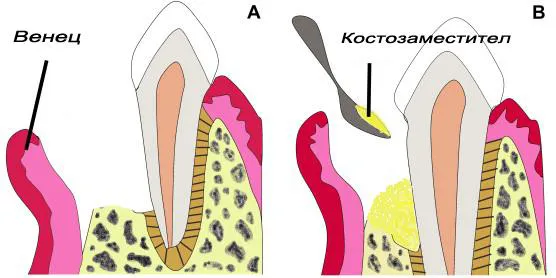
Step 1: Opening a flap and preparing the defect
A mucosal flap is opened (the gum is separated from the bone) and the site where the bone is missing is exposed. It is carefully cleaned and shaped into a suitable form – open curettage.
Step 2: Placing the bone substitute
The necessary amount of bone substitute is placed in the prepared bone defect.
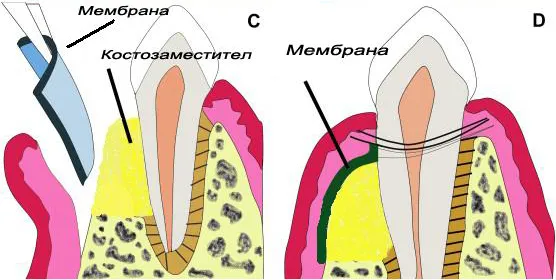
Step 3: The regenerative membrane
A regenerative membrane is placed – either a synthetic Teflon membrane or a natural resorbable dried pericardial membrane. It is very important because it provides guided bone regeneration (GBR). The membrane is placed and sutured between the gum and the bone and protects the bone substitute material until it turns into healthy bone.
Step 4: Suturing the gum
The gum is sutured, and it must cover all of the bone substitute material. If the available gum is not sufficient, mucosal grafting is used.
How long does healing take?
The mucosa (gum) heals in about 7 to 10 days, while the bone needs 3 to 6 months to recover fully.
How much does it cost?
Bone grafting costs 600 – 800 €. All prices are in the Price list.
Frequently asked questions
Is bone grafting painful?
No. Anaesthesia is given beforehand and the whole procedure is painless.
In how many stages is bone grafting done?
In four stages: opening a flap and preparing the defect, placing the bone substitute, placing a regenerative membrane, and suturing the gum.
How long does the bone take to heal?
The gum heals in about 7 to 10 days, while the bone needs 3 to 6 months to recover fully.
What kind of bone is used for grafting?
The patient’s own bone can be used, but this method is hardly ever applied. Bone substitutes are usually used – granules (allograft or synthetic) or ready-made blocks.