
At the clinic we treat patients with various dental and jaw deformities using aligners, braces and specialised orthodontic appliances. This page describes all the methods, systems and appliances we use, with their advantages and disadvantages, treatment times and prices.
Some of them are widely known (Invisalign aligners and braces), while others are specialised and are used in severe clinical cases: activators, lingual plates, and Klammt, Fränkel and Balters appliances.
What are the ways of straightening teeth, and how long do they take?
| System | Treatment time |
|---|---|
| Invisalign aligners | from 3–4 months to 2–3 years |
| Spark aligners | from 2–4 months to 2–3 years |
| Dentaline aligners | from 3 to 10 months |
| Metal, ceramic and sapphire braces | from 6 months in mild cases to 2–3 years in severe deformities |
| Damon self-ligating braces | from 6 months in mild cases to 2 years in more severe deformities |
What are aligners and how do they work?
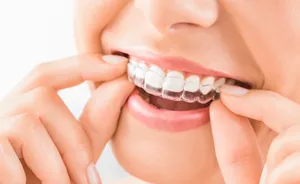
Aligners are clear, removable plastic trays, resembling whitening trays and bruxism splints. Placed over the teeth and moistened by saliva, they are practically unnoticeable to others. Their shape plays the main role in this – they follow the shape of your own teeth, with small exceptions. In mild and moderate cases they have no extra elements that hinder speech or injure the mucosa. In severe cases additional elements (attachments, buttons, elastics, micro-implants) are unavoidable, but they are worn for a short time and are usually in areas far from the smile line.
Aligners are worn 20–22 hours a day and are taken out for eating and hygiene, or at the patient’s discretion in certain circumstances. This span of time sounds alarming, but in practice it is not felt. Their main advantage over braces is that they are removable – if you have forgotten your toothbrush, you will not walk around with food stuck between the parts of the appliance.

Each tray has a pre-set altered shape, differing by fractions of a millimetre, which instead of copying your teeth comes closer and closer to their optimal alignment. The trays are changed after a set number of days, and the treatment plan shows how many steps (trays) are needed. That is why “more crooked” teeth need more trays, and small corrections need fewer.
What aligners do we offer?
Invisalign aligners
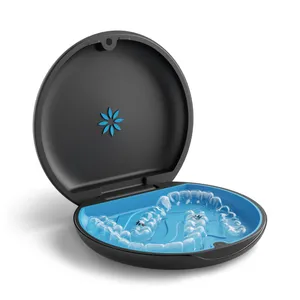
Invisalign is the first and most advanced aligner system in the world. It was created in 1997 in the United States and to this day it is the undisputed leader and pioneer in the field of invisible orthodontics. It is suitable for children as well as teenagers and adults.
The trays are transparent and made of a special material called SmartTrack, which makes it easier to move the teeth in the desired direction.
Another characteristic feature is the attachments – small triangular, rectangular, square or specifically shaped micro-elements that are bonded to the outer surfaces of some of the teeth. They are also completely invisible, but their role is extremely important: they make possible the specific tooth movements that other aligner systems cannot achieve. Together with the possibility of using orthodontic buttons and elastics, this makes it possible to treat patients with severe bite deformities with Invisalign.
Depending on how complex the case is, the packages are:
- Invisalign First – for children between 6 and 10 years of age.
- Invisalign Lite – for very mild crowding of the teeth and no bite problems.
- Invisalign Moderate – for greater crowding and no bite problems.
- Invisalign Comprehensive – for major deformities, both in the teeth and in the bite. The package provides an unlimited number of additional aligners within 3 years of the start of treatment.
The type of package is determined according to the patient’s specific needs. The treatment plan is made through a special computer simulation (ClinCheck), which shows the movement of the teeth and the expected final result in the form of a short video. The plan shows how many steps (trays) will be needed. One step of trays is worn for about 7 to 10 days, after which it is replaced by the next one, until the end of treatment.
- Treatment time: from 3–4 months to 2–3 years
- Price: individual, after an examination — depends on the package needed and the severity of the deformity; the aligner treatment analysis is 150 €
Spark aligners
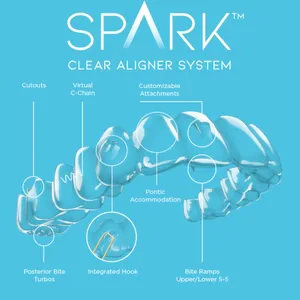
Spark is an innovative system created by part of the Invisalign team, who developed Spark after splitting off. At present Spark is part of the American company Ormco (the creators of Damon braces), a leader in orthodontics with over 60 years of experience. The aligners are suitable for children, teenagers and adults.
Spark has the same treatment capabilities for severe orthodontic deformities as Invisalign. It is made of a new-generation material called TruGEN, which is significantly more transparent than the materials used in the other systems. It also uses attachments of different shapes and sizes for the specific tooth movements, as well as the elastics and buttons needed for severe bite deformities.
Advantages of Spark:
- greater potential for expanding the jaws, which makes it possible to reduce to a minimum the stripping (fine interdental filing) often used with the other systems;
- the possibility of combined treatment with Damon self-ligating braces;
- a noticeably lower price compared with Invisalign aligners.
Depending on how complex the case is, the packages are:
- Spark Junior – for children up to 10–11 years of age.
- Spark 10 – for mild tooth movements. Treatment lasts 2 months on average.
- Spark 20 – for mild tooth movements and mild changes in the bite. Treatment lasts about 5 months.
- Spark 35 – for moderately severe tooth movements with changes in the bite. Treatment lasts about 9 months.
- Spark Advanced – for the most severe tooth movements with bite problems. The package includes an unlimited number of aligners within 3 years.
The type of package is determined according to the patient’s specific needs. The treatment plan is made through a computer simulation, which shows how the teeth move and the expected final result, in the form of a short video. The plan shows how many steps (trays) will be needed. One step of trays is worn for about 7 to 10 days, after which it is replaced by the next one, until the end of treatment.
- Treatment time: from 2–4 months to 2–3 years
- Price: individual, after an examination — depends on the package needed and the severity of the deformity; the aligner treatment analysis is 150 €
Dentaline aligners
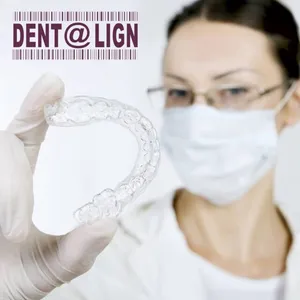
Dentaline (Dentalaign) is a Bulgarian aligner system. It is widely used for patients who need mild corrections in the position of the teeth but have no bite problems. Unlike Invisalign, it has no attachments.
In most cases stripping is used – a procedure that frees up the space needed for the teeth to be lined up. It is done with a small strip, saw or bur and turns the contact point of the teeth into a flat surface. The gaps that are freed up (on the order of a few tenths of a millimetre) are filled after some time as a result of the movement of the teeth. Stripping does not cause sensitivity and does not damage the teeth.
How does treatment with Dentaline proceed?
- First stage – taking impressions of the teeth (upper jaw, lower jaw and bite) and casting plaster models.
- Second stage – orthodontic analysis. The plaster models are sent to the laboratory, where they are digitised and, similarly to Invisalign, the treatment plan is created with special software that calculates every movement and every tilt of the teeth. Based on these calculations, the number of steps and the expected period of wearing the aligners are visualised. This stage takes about 2 weeks.
- Third stage – the plan is discussed with the patient, who is shown the expected final result and the number of steps. Unlike the simulation in Invisalign, this plan is static – a visualisation of the position of the teeth before and after treatment, with the final result and the number of months needed to achieve it.
- Fourth stage – confirmation by the patient, fabrication of the trays and the start of treatment. This stage usually takes about 2 weeks.
- Fifth stage – end of treatment, which finishes with the fitting of a retainer. It holds the teeth in their new position and protects them from shifting.
With Dentaline, each step consists of 3 trays of different hardness – the first is soft, the second is medium and the third is hard. They are identical in shape and are worn one after another in exactly that order, each for 10 days. Each step lasts one month. Treatment usually lasts several months until the desired result is achieved.
- Treatment time: from 3 to 10 months
- Price: aligner treatment analysis – 150 € / step – 420 € per month for both jaws
Other aligner systems
Yellow Line aligners
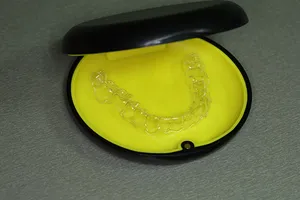
A French aligner system that, like Invisalign, uses attachments, stripping, orthodontic buttons and elastics. It can also handle more severe bite deformities. The treatment plan and treatment simulation are created with a computer model and artificial intelligence.
Impressions for analysis can be taken both by standard methods and with any intraoral scanner on the market. The system offers 3 packages depending on the complexity of the case – light, medium and comprehensive.
ClearCorrect aligners
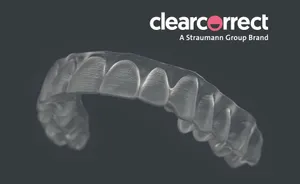
A Swiss aligner system. Similarly to Invisalign, it uses attachments and additional elements that assist tooth movement. The material is ClearQuartz – three-layered, with a softer inner part and a harder outer part. When fitted, ClearCorrect covers, besides the teeth, a slightly larger part of the gum, which sets it apart from the other systems. It offers several packages depending on the complexity of the case.
Sm;)lers aligners
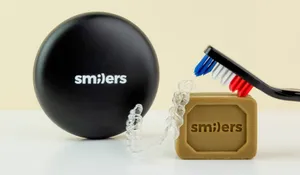
A French aligner system. Like the other systems, it uses attachments and stripping. The aligners are laser-cut only along the teeth and do not cover the gum.
All age groups are treated with this system. What is specific is that it is suitable for children over 12 years of age whose baby teeth have all been replaced. It offers three packages depending on the complexity of the case.
Clear X aligners

A German aligner system. The material is multilayered and self-repairs from slight damage.
What is specific is that patients have a device (a booster) into which the aligner is placed and modified. In this way two steps are obtained from one tray, worn for 2 weeks. There are different packages, and the time and price are determined individually after analysis of the specific patient.
How do we look after our aligners?
Looking after aligners is extremely easy. After you take them out for your oral hygiene, simply rinse them well with lukewarm water and soap.
It is best not to scrub them with a toothbrush – their surface gets damaged and micro-cracks form that hold more saliva, which leads to unpleasant sensations and a bad smell. Washing is done with lukewarm water because the plastic is thermoplastic and deforms at high temperature.
What is the difference between aligners and braces?
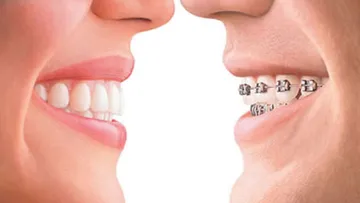
- Aesthetics. Difference number 1 is aesthetics, especially with metal braces. The drama among teenagers is most keenly felt.
- Sensations. A large proportion of patients with braces complain of toothache after “tightening”, tingling, numbness and so on. With aligners these sensations are reduced to a minimum, since the movements set in the trays are minimal.
- Eating. With braces, biting into food is forbidden, food is taken in small bites placed directly on the chewing teeth, and nuts, sticky and mushy foods are off the menu – you forget about chewy sweets, croquettes and crisps. Aligners are removable, that is, you take them out while eating.
- Hygiene. With braces, hygiene must be impeccable – brushing the teeth and the spaces between the brackets after every meal, wherever you are. Otherwise you risk walking around all day with food stuck between the braces.
- Comfort. Braces are an addition to the surface of the teeth, and patients often feel discomfort after they are fitted, while some report an injured mucosa. Aligners spare you this, because they cover the tooth surface perfectly.
What braces do we use?
Metal braces
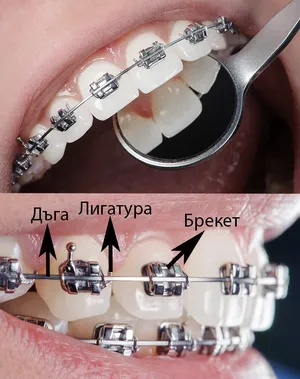
Metal braces are the gold standard and the most commonly used means of aligning teeth and correcting the bite in adult patients. They can correct all types of bite deformities and can even be used to bring impacted (unerupted) teeth into position.
Braces are a complex system for moving teeth, consisting of several elements:
- The brackets – small metal squares or rectangles that are bonded to a specific zone on the outer surface of the teeth. They are actually a static element and serve to attach to the teeth the second element – the archwire.
- The archwire – it is what moves the teeth to their correct positions and really carries out the orthodontic treatment. Archwires differ in material (nickel-titanium, titanium-molybdenum, steel and others), as well as in size, thickness and stiffness. They are changed continually throughout the treatment, thus moving the teeth in the desired direction.
- The ligatures – with standard metal braces, they attach the archwires to the brackets. They are metal (wire) or silicone – in the form of coloured elastic bands, with which an individual look can be given to the smile during treatment.
Besides the three main elements there are also additional ones:
- intermaxillary elastics and buttons – for correcting the bite and the position of the jaws;
- springs and chains – for closing, spacing and rotating teeth;
- mini-implants – for creating anchorage for tooth movements that would otherwise be impossible;
- headgear and facemasks – for correcting the position of the upper and lower jaw in relation to each other in severe clinical cases.
Treatment with braces is suitable for patients of all ages. In children the only condition required is that the permanent teeth have erupted. For adults, to start treatment all caries must have been treated, the gums must be healthy and there must be no active periodontal disease.
- Treatment time: from 6 months in mild cases to 2–3 years in patients with severe deformities
- Price: 100 € – treatment planning / 920 € for fitting the braces and 120 € per month during treatment
Ceramic and sapphire braces
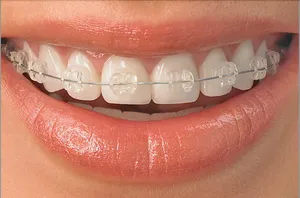
Ceramic and sapphire braces are transparent and therefore highly aesthetic – when bonded to the teeth they are barely noticed by others. This is their main, but also their only, advantage over metal ones. Their mechanism of action and the additional elements used to move the teeth are the same, and treatment is planned and proceeds in the same way.
Their drawbacks are that the materials are more brittle, so individual brackets break more often and additional visits are needed to replace them. In patients with insufficiently good hygiene a slight yellowing of the braces is seen over time, which however does not significantly affect their aesthetics.
- Treatment time: from 6 months in mild cases to 2–3 years in patients with severe deformities
- Price: 100 € – treatment planning / 1500 € for fitting the braces and 120 € per month during treatment
Damon self-ligating braces
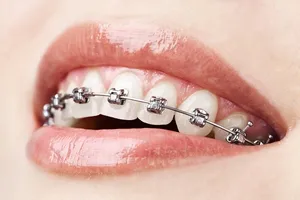
Damon is a specific braces system. Both metal Damon Q and transparent Damon Clear braces can be used. Their design is different – they are smaller than standard ones and have special clips on their outer surface that hold the archwire to the bracket.
This eliminates the need for ligatures, makes working with them easier and, thanks to fewer protruding elements, helps maintain better hygiene. Another advantage is faster tooth movement, which is also due to the design that allows the archwire to be fastened securely with the help of the clips.
- Treatment time: from 6 months in mild cases to 2 years in patients with more severe deformities
- Price: 100 € – treatment planning / 1500 € for fitting the braces and 120 € per month during treatment
Lingual braces
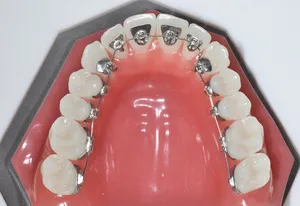
Lingual braces (on the side of the tongue and palate) are practically invisible, because they are bonded to the inner surface of the teeth. They are made individually for each patient through 3D printing. This means it takes longer to start treatment, and the price is noticeably higher compared with the other systems.
Their drawbacks are that hygiene is difficult because of the lack of direct visibility, and the cases that can be treated with them are limited. Because of these specific features and the high price, today this type of braces has been entirely replaced by aligners (Invisalign).
Mini-implants
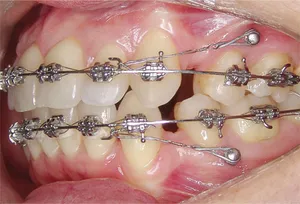
In treatment with braces there are tooth movements that need additional anchorage in order to be carried out. This is where mini-implants and all types of skeletal anchorage are used – small screws that are placed temporarily at precisely defined places in the jaw and serve as anchor points for specific tooth movements.
Unlike implants, which are placed where teeth are missing, orthodontic mini-implants do not osseointegrate (do not form a bond with the bone). Placing them goes almost unnoticed and quite often no anaesthetic is even needed. They can be placed anywhere in the mouth depending on the orthodontist’s goals. After the set goal has been achieved, the mini-implant is removed, which is almost as unnoticeable as the placement itself.
- Treatment time: individual, according to the time needed to move the teeth
- Price: placement of a mini-implant – 350 €
What specialised orthodontic appliances do we use?
Trainers
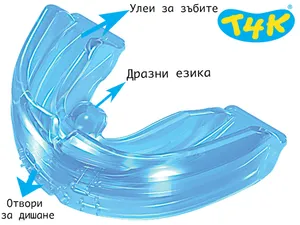
Trainers are preventive silicone appliances for correcting harmful habits: incorrect swallowing (so-called infantile swallowing), mouth breathing due to the inability to breathe through the nose, and thumb sucking. Wearing them is usually combined with special exercises for correct breathing through the nose and correct swallowing.
This protects children from incorrect eruption and positioning of the permanent teeth. Treatment is started at a very early age – after the age of 2 – and continues until about 8 years of age. At first, softer and smaller appliances are used, which are later replaced with harder trays adapted to growth. The appliance is worn at night (at least 8 hours) and for 2–4 hours during the day.
- Treatment time: individual, according to the specific patient
- Price: about 220 € per tray
Activators
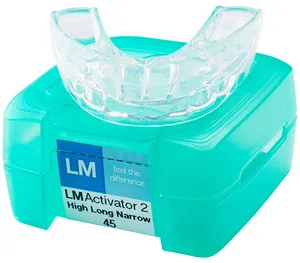
Activators are ready-made orthodontic appliances for childhood. They are most effective between 5 and 11 years of age – the period in which the permanent teeth erupt. Wearing them guides the permanent teeth to erupt and position themselves in their correct places, thus preventing orthodontic deformities and shifting of the teeth.
The old models were made of plastic and metal hooks, while modern ones are ready-made silicone appliances without metal elements. They come in different sizes and shapes and are chosen after measuring the child’s teeth and jaws with a special ruler. They are replaced after a certain period of time according to the growth of the jaws and are worn mainly at night (at least 8 hours) and for 2–4 hours during the day.
- Treatment time: individual, according to the specific patient
- Price: about 320 € per tray
Lingual plate
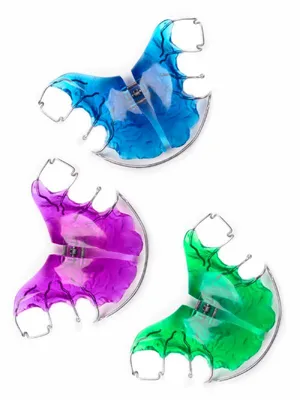
The lingual plate is the most classic and most widespread orthodontic appliance for treating dental and jaw deformities in children. It is a removable appliance that can be freely taken out during meals. It consists of a plastic part with a different colour and pictures depending on the patient’s wishes, clasps for attachment to the teeth, a front wire arch, springs and an orthodontic screw for expanding the jaw. It can be used in both the upper and the lower jaw.
The plate acts in several ways:
- Its main action is related to activating and accelerating the growth of the jaw – this is in essence the real orthodontic treatment. In this way enough room is created in the jaw for the permanent teeth to line up correctly, using the processes of growth, rather than moving the teeth in a jaw that has already stopped growing, as is the case in adults.
- The other main action is carried out with the front wire arch and the springs – to guide the eruption of the teeth in a certain direction and to move teeth that have erupted crooked to their correct places.
The most suitable age for treatment is between 7 and 12, because that is when the growth of the jaws is most intense and the effect is fullest. The appliance is worn constantly, day and night, and is taken out only for meals. Regular check-ups at the clinic are needed to activate the appliance and its clasps, as well as weekly turning of the expansion screw by the patient according to the orthodontist’s instructions.
The main and only drawback is that the action and effect depend greatly on how strict and motivated the patient is about wearing it.
- Treatment time: individual, according to the specific patient, until the jaws stop growing
- Price: about 420 € per lingual plate in one jaw
Expander – an appliance for rapid expansion of the upper jaw
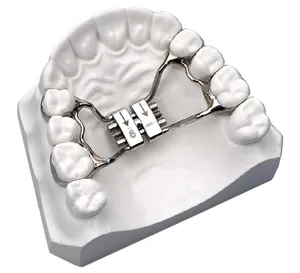
The expander is an appliance made of a metal alloy, orthodontic bands and a screw, which, like children’s appliances, is turned with a special key. Unlike lingual plates in children, the expander is used at a more advanced age and is applicable only in the upper jaw. It is fixed to the teeth with metal bands bonded with dental cement to the first molars, and in teenagers it also encompasses the first premolars.
It is used as part of comprehensive treatment with braces or aligners. It is activated more often and expands the jaw faster, but its way of working is different: the jaw is expanded by separation in the middle part of the palate – the palatal suture. In older patients – after 12–15 years of age – to obtain a good expansion effect, the expander needs to be stabilised with mini-implants to the palate – so-called skeletal anchorage. It is made individually for each patient and can even be 3D printed.
- Treatment time: about 7 months
- Price: about 320 € per expander
Klammt appliance
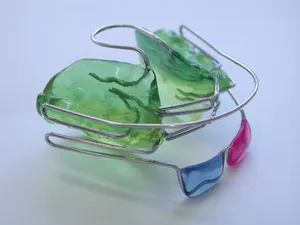
The Klammt appliance is a functional appliance. This type of appliance uses the strength of the muscles of the lips, cheeks and tongue to move the teeth and jaws. It sits freely in the mouth, encompasses both jaws and the patient bites down on it. It is made of wire elements and a plastic part that can be a different colour and even have pictures at the wish of young patients. It is worn continuously and taken out only during meals.
As a method of treatment the appliance is older, but it is particularly effective in children with a deep and open bite. It is recommended that the children have mixed dentition at the start of treatment, i.e. have both baby and permanent teeth in the mouth.
- Treatment time: individual, according to the specific patient
- Price: about 460 €
Balters appliance
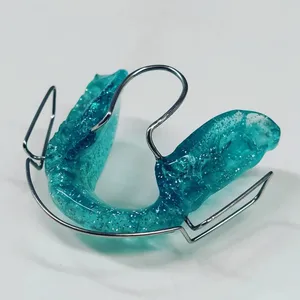
The Balters appliance is also a functional appliance. It sits freely in the mouth, encompasses both jaws, is worn continuously and is taken out only during meals. Like the Klammt appliance, it consists of wire elements and a plastic part that can be a different colour. It is one of the classic orthodontic appliances, but its use is still relevant.
Its main function is to change the incorrect position of the tongue both at rest and when swallowing. An incorrect tongue position when swallowing is a common harmful factor that is extremely important to diagnose in time in order to prevent future bite problems.
It is used mainly in childhood and is combined with exercises for correct swallowing, breathing and speaking, as well as a consultation with an ENT specialist and a speech therapist.
- Treatment time: individual, according to the specific patient
- Price: about 460 €
Fränkel appliance
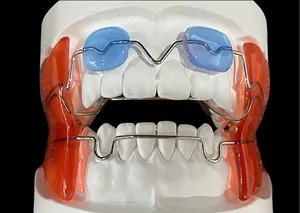
The Fränkel appliance, like the previous two, belongs to the classic functional appliances. It is also removable, sits freely in the mouth and encompasses both jaws. It is made of wire elements and a plastic part and is worn continuously except at mealtimes. It is suitable for children from 3 to 9 years of age.
This is a useful appliance with a combined action that can be used in almost all bite deformities. As with the other functional appliances, its only drawback is that it is bulky and not especially comfortable, and the results depend greatly on whether patients wear it regularly as prescribed.
- Treatment time: individual, according to the specific patient
- Price: about 460 €
How much does treatment cost?
The price depends on the chosen system and the complexity of the case – for each system it is given in the relevant section above. The full list is in the clinic’s price list.
Frequently asked questions
How long does treatment with braces and aligners take?
With braces – from 6 months to 2–3 years, with Invisalign – from 3–4 months to 2–3 years, with Spark – from 2–4 months to 2–3 years, and with Dentaline – from 3 to 10 months.
How many hours a day are aligners worn?
20–22 hours a day. They are taken out for eating and hygiene, or at the patient’s discretion in certain circumstances.
How do you look after aligners?
Take them out for oral hygiene and rinse them well with lukewarm water and soap. Do not scrub them with a toothbrush, because their surface gets damaged and micro-cracks form that hold saliva and cause a bad smell. The plastic is thermoplastic and deforms at high temperature.
What is the difference between Spark and Invisalign aligners?
Spark has the same treatment capabilities for severe deformities, but is made of a more transparent material (TruGEN), has greater potential for expanding the jaws (less stripping), can be combined with Damon self-ligating braces and is cheaper than Invisalign – the price of both is individual, depending on the case.
Are aligners suitable for children?
Yes. Invisalign is suitable for children, teenagers and adults (the Invisalign First package is for children between 6 and 10 years of age), Spark Junior is for children up to 10–11 years of age, and Smilers aligners are for children over 12 years of age whose baby teeth have all been replaced.
What are the conditions for fitting braces?
Treatment with braces is suitable for patients of all ages. In children the permanent teeth must have erupted; in adults all caries must have been treated, the gums must be healthy and there must be no active periodontal disease.
At what age are the specialised appliances used for children?
Trainers – from 2 to about 8 years of age, activators – best between 5 and 11 years of age, the lingual plate – between 7 and 12, and the Fränkel appliance is suitable for children from 3 to 9 years of age.