
Dental plaque is a sticky bacterial biofilm, and tartar is plaque that has hardened; it is removed professionally with an ultrasonic scaler, followed by polishing. The cleaning is painless or only mildly painful, and anaesthesia can also be given if the patient wishes.
What are dental plaque and tartar?
Dental plaque is a sticky bacterial biofilm that forms on the teeth. It can be light and unnoticeable, or dark and hard to remove. It is made up of uncleaned food debris populated by microorganisms, whose number increases over time.
If the plaque is not cleaned off, calcification processes take place in it over time and it turns into tartar.
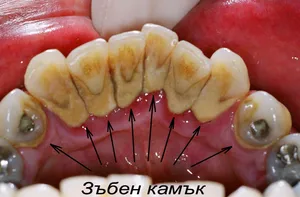
Tartar is a yellow to brown and even black deposit at the necks of the teeth, with a chalk-like surface texture, firmly attached to the tooth surface. It can be located above the gum and below the gum.
A characteristic of tartar is that it grows in the direction of the tooth root and over time “pushes” the gums back and exposes the tooth root.
Why must tartar be removed?
Tartar and plaque cause inflammation of the gums (gingivitis) and of the periodontium (periodontitis) and are a constant source of infection in the oral cavity. After a conversation about the harmful effects of tartar and plaque, it is essential to remove them.
What causes it to form?
There are many causes, but the more common ones are:
- poor oral hygiene;
- poorly made and overhanging fillings and crowns;
- orthodontic anomalies and appliances;
- medications for general diseases that change the pH of the saliva, and others.
How can I tell that I have tartar?
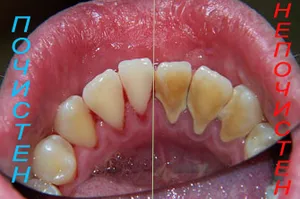
Patients can see for themselves a light to dark brown discolouration at the base of the necks of the teeth and notice rough surfaces on the teeth. During an examination at the dental clinic the tartar can be stained with special tablets or solutions and shown to the Patient.
How is tartar removed?
Cleaning can be carried out in one or several visits, depending on the amount of tartar deposited. There are manual methods (little used now) and machine methods (ultrasound).
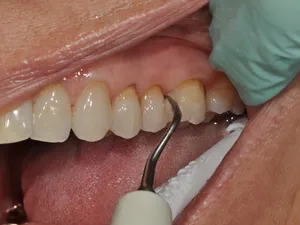
The ultrasonic method is innovative and painless or only mildly painful, and anaesthesia can also be given if the Patient wishes. It is performed with a special instrument that produces ultrasonic vibrations (an ultrasonic scaler). The scaler has a special tip that vibrates at a very high frequency. When the tip touches the tartar, it breaks it into small pieces, which fall away under the action of the vibrations.
During ultrasonic cleaning, all tooth surfaces are covered with a suitably chosen tip, a precisely set vibration frequency and measured movements. Besides the vibrations, the tip of the scaler sprays a fine jet of water or antiseptic solution, which washes away the broken-up tartar and provides a good working field.
After the tartar and plaque have been removed, the tooth surfaces are polished.
How often is tartar removed?
Tartar is removed once a year, every 6 months, or more often depending on how quickly it builds up.
- In mild inflammation (gingivitis), removing the tartar and prescribing antiseptic mouthwashes is enough for the Patient to recover.
- In more severe gum disease (periodontitis), tartar removal should be more frequent and combined with curettage.
How much does it cost?
Scaling + polishing – full mouth: 80 – 100 €; per tooth: 20 € per tooth. All prices are in the Price list.
Frequently asked questions
Does tartar removal hurt?
The ultrasonic method is painless or only mildly painful, and anaesthesia can also be given if the Patient wishes.
How often is tartar removed?
Once a year, every 6 months, or more often depending on how quickly it builds up. In periodontitis, removal should be more frequent and combined with curettage.
How many visits are needed?
One or several, depending on the amount of tartar deposited.
How does the ultrasonic scaler work?
The tip of the scaler vibrates at a very high frequency and breaks the tartar into small pieces, which fall away under the action of the vibrations. The tip also sprays a fine jet of water or antiseptic solution, which washes away the broken-up tartar.
What happens after the tartar is removed?
The tooth surfaces are polished.