

Periodontal curettage is a method for cleaning the periodontal pocket, used at all stages of periodontitis. It is performed under anaesthesia and is completely painless. There are two kinds – closed and open curettage.
What is curettage?
Curettage involves removing the gum tissue that has grown into the place of the resorbed alveolar bone (cleaning the periodontal pocket). It is carried out with special instruments called curettes.
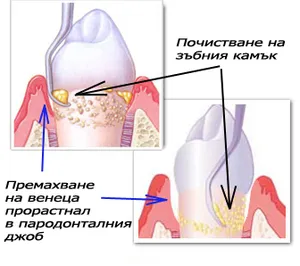
The whole procedure is performed under anaesthesia and is completely painless.
What kinds of curettage are there?
Closed curettage
The curette is introduced between the root of the tooth and the gum, and the tartar and the gum tissue at the bottom of the periodontal pocket are removed by touch, blindly. This method is used only for shallow pockets, because it is laborious and the results in deep pockets are uncertain.
Open curettage
Open curettage is more complex, but has a more reliable effect.
- A mucosal flap is raised (the gum is separated from the root of the tooth and from the bone) and the bottom of the periodontal pocket is exposed.
- Under direct vision, the tartar and the granulation tissue (gum) remaining at the bottom of the pocket are removed with a curette and the bone is exposed. It has sharp edges and hollows caused by its resorption in the inflammatory process.
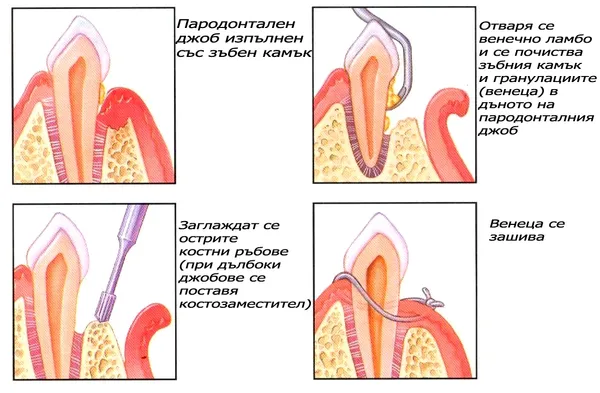
- These edges are smoothed with a special bur by filing away the surface layer of the bone until a healthy, smooth base is obtained.
- For shallower pockets without loose teeth, the procedure ends here and the flap is sutured over the cleaned bone. For deep pockets, a bone graft material must also be added (read more) to restore the level of the lost bone.
- After suturing, a temporary periodontal dressing may be placed, which aids healing and protects the surgical site.
What happens after healing?
After healing, slight exposure of the tooth roots is observed, but the gums are not inflamed and the progression of periodontitis has been stopped.
Frequently asked questions
Is periodontal curettage painful?
No. The whole procedure is performed under anaesthesia and is completely painless.
What kinds of curettage are there?
Two – closed and open curettage.
When is closed curettage used?
Only for shallow pockets, because it is laborious and the results in deep pockets are uncertain.
How does open curettage work?
A mucosal flap is raised, the tartar and granulation tissue are removed under direct vision, the bone is smoothed with a special bur and the flap is sutured. For deep pockets a bone graft material is added.
What is observed after healing?
Slight exposure of the tooth roots is observed, but the gums are not inflamed and the progression of periodontitis has been stopped.