
Teeth whitening is a cosmetic (aesthetic) procedure that removes stains from the teeth and makes them whiter and brighter. It can be done in the clinic, at home with individual trays, or — for teeth with the nerve removed — as internal whitening. Our team recommends home whitening consulted with your dentist, and the most important thing is not to risk your teeth with unproven methods.

A brilliant smile has been a symbol of beauty for centuries. Before modern technology developed, baking soda, lemon, salt and other natural remedies were used to reach maximum whiteness. Today, when there are high-tech and effective methods, it is useful to know their advantages and disadvantages, as well as the pros and cons of alternative natural remedies.
Among the most widespread ways of whitening among patients are whitening toothpastes, strips for home use, and professional systems in which the quantity and quality of the ingredients in the whitening agent are carefully calibrated to give the maximum effect with minimal risk of sensitivity. When used correctly and under the supervision of a specialist, these methods give a long-lasting effect and do not damage the teeth.
What should you know before whitening your teeth?
First: there are no more beautiful teeth than healthy ones!
Second: know what discolours your teeth, so that you can try to avoid it. The most common causes of a change in colour are:

- Daily consumption of coffee, fizzy drinks and wine.
- Smoking.
- Build-up of tartar.
- Incorrect oral hygiene — brushing the teeth incorrectly.
- Using chlorhexidine mouthwash too often.
- Bacterial infections.
- Use of certain antibiotics in early childhood.
- Fluorosis — a pathological condition caused by excessive fluoride intake in childhood. If you drink water with a raised fluoride concentration for a long time (for example bottled mineral water), fluorosis may appear. It shows as white, and later brown, spots on the teeth, destruction of the tooth enamel, or problems with the skeletal system.
Third: every person has a different colour and shade of teeth, which is genetically determined and set by the inside of the tooth — the so-called dentine. The possible effect of whitening is determined in line with the natural colour of the teeth.
What is teeth whitening?
Whitening is a chemical process based on the interaction between the active substances (contained in the whitening agent) and the stains that have penetrated the tooth tissue. The only substances at present with a real whitening effect on tooth enamel are peroxides — some form of peroxide is used in every whitening. It is a substance containing a single oxygen–oxygen bond or a peroxide anion.
The higher the concentration of peroxide, the faster and more powerful the action of the product, but also the greater the risk of sensitivity after the procedure and of damage to the tooth enamel.
Whitening can be carried out:
- in the dental clinic (office whitening);
- at home with special trays made by the dentist from an individual impression of the patient’s teeth.

In-office whitening systems use a higher content of the active ingredient — hydrogen peroxide at a concentration of 35 to 40%, which means a faster and stronger effect within about an hour and a half.
Home whitening systems contain a different substance — carbamide peroxide at a concentration of 10 and 16%. It breaks down more slowly and releases hydrogen peroxide at a concentration three times lower. This means the whitening time is longer — between 4 and 8 hours — but the risk of sensitivity and enamel damage is minimal.
There is a group of patients with very sensitive teeth who cannot use the standard methods. For them a special 5% carbamide peroxide whitening agent is used for about a month.
Which method do we recommend?
Our team recommends home whitening consulted with your dentist. This way the procedure is safe and controllable (you can stop it if sensitivity appears) and you use the easy and convenient way of whitening at home.
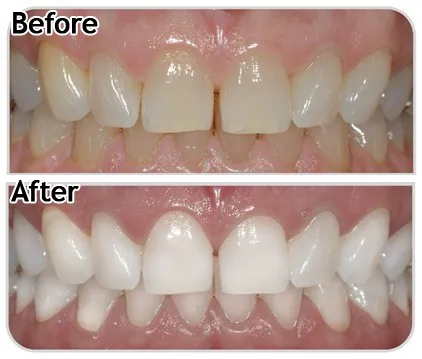
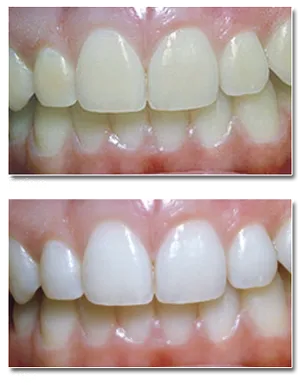
You probably will not get the Wow effect you can expect from in-office whitening, but the result is just as visible, lasting and brilliant, without risking the health of your teeth. The lack of a Wow effect is due to the fact that whitening happens gradually, in small steps. The lack of a reference point for the original colour of the teeth makes judging at home in front of the mirror inaccurate, while the difference is clearly visible in the clinic with the help of a shade guide.
What happens to your teeth during whitening?
Whitening is essentially a chemical reaction: the active ingredient is hydrogen peroxide. Once activated, it immediately breaks down into water and oxygen radicals, which penetrate the inside of the teeth. The radicals break up the pigment molecules accumulated in the enamel, and through diffusion these molecules are drawn back out.
The first step is ideal cleaning of tartar and plaque, so that the whitening agent can reach the surface of the teeth. The gums also must not be inflamed, so that the procedure proceeds in a controlled way. You should tell your dentist about your eating habits and how you maintain oral hygiene — on that basis they will analyse how you care for your teeth and choose the most suitable whitening system.
If these conditions are not met, the effect will be incomplete, because the gel does not reach the tooth surface and cannot act on the enamel.
What types of whitening are there?
According to the surface being whitened, there are two types of whitening: internal and external.
Internal whitening (for teeth with the nerve removed)
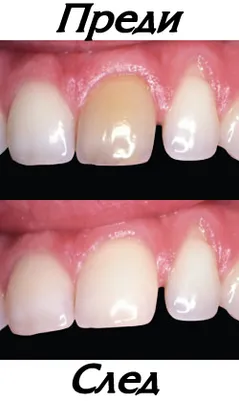
Internal whitening is a method for teeth with the nerve removed, most often for discoloured front teeth. Devitalised teeth change colour over time because of the removal of the nerve and because of the root canal filling pastes. The dentist places the whitening agent in the crown of the tooth itself and closes it with a temporary filling. The agent stays there for 3 to 7 days, and the procedure is absolutely painless.
Internal whitening is in many cases combined with external whitening. If the desired effect is not achieved, veneers or porcelain crowns are made. How it proceeds step by step – in Teeth whitening – internal.
External whitening
External whitening has an overall effect on the smile — it works not in the core of the tooth but on its surface. It starts with an examination that assesses the condition of the teeth, and the dentist decides on the type of whitening system:
- In-office whitening — in one day, in about 1.5 hours: the whitening agent is applied to the teeth and activated with light from the whitening lamp or with a laser beam. It is quick and has the so-called Wow effect, but afterwards the teeth are more sensitive and the effect is shorter-lived.
- Home whitening with individual trays — the gel is applied at home in trays made from an impression of the teeth, and the desired result is usually seen around day 10-12. The gel is gentler, the effect is longer-lasting and the price is significantly lower. We do not recommend ready-made trays.
How the two methods proceed step by step – in Teeth whitening – external.
How much does whitening cost?
- At-home whitening with trays: 200 €
- In-office teeth whitening: 200 €
- Internal whitening after root canal treatment (filling not included): 90 €
All prices are in the Price list.
Maintaining the result
After the procedure the dentist gives instructions on hygiene and on using special fluoride-containing toothpastes that strengthen the structure of the enamel. The effect is best with perfect oral hygiene.
To preserve the result, keep strict oral hygiene: do not smoke and limit drinks that stain the enamel — especially wine — as well as chocolate, soy sauce and so on. After in-office whitening, refresher procedures can be done every 6 months for a longer-lasting effect.
Home whitening methods — what should you know?
Some traditional methods used by our ancestors are still in use today. Here are the most widespread home ways — their advantages and disadvantages:
- Lemon juice. An easy and effective way to make your smile brighter, but frequent use has a destructive effect on the enamel. Acid harms teeth just as much as sugar: the acid has a low pH and breaks down and “melts” the enamel. Acidic foods are very harmful to children — their effect on the teeth is similar to ice left at room temperature. Citric and ascorbic acid have strong antiseptic properties that prevent infections in the oral cavity, but they can cause erosion of the teeth. If you drink water with lemon, drink it through a straw.
- Baking soda. One of the most popular home methods. According to some “internet experts” it is one of the most effective and cheapest ways to remove deposits, but with incorrect use or overdose you can seriously damage the enamel. Sodium bicarbonate is a white powder of small crystals that act as an abrasive and directly damage the enamel. Baking soda has no real whitening effect, only a cleaning one.
- Coconut oil. A relatively new fashion. The lauric acid in it helps the teeth get rid of the bacteria in plaque that make them yellower. There are no serious side effects, but the result can be called into question.
- Activated charcoal. A common suggestion, but it must be used for a limited time. With longer use you seriously increase the sensitivity of your teeth and reduce the protection against caries.
- Toothpaste. The easiest and most accessible way to change colour at home. We recommend asking your dentist which pastes are really effective and which merely take advantage of the advertising. Some manufacturers do not give full information about the composition or side effects. Most pastes advertised as “whitening” contain silica / hydrated silica — microparticles that act mechanically like sandpaper and wear away the enamel. This makes the teeth more prone to caries, premature erosion, sensitivity and a tendency to periodontal disease.
- Perhydrol (“hydrogen peroxide”). For home use, “hydrogen peroxide” is sometimes offered as the same one used in dental clinics. Using it without medical supervision can be dangerous.
- Strips. A popular, convenient and effective way to whiten teeth at home.
How are whitening strips used?
- Wash your teeth right before applying them.
- Peel the strip from its backing, align it with the gums and press for better contact with the teeth.
- Fold the rest of the strip behind the teeth to hold it in place.
- Follow the time stated on the box for keeping the strips on, and do not experiment with a longer interval.
- Do not swap the upper and lower strips — they are specially shaped; otherwise they cover a smaller area and are not as effective.
Most manufacturers of whitening strips claim they are harmless and contain the same substance dentists use. We advise you to ask your dentist whether this is true. Products containing peroxide above 0.1% are banned for home use and may be applied only by qualified specialists in a dental clinic. Using them at home can lead to burns of the soft tissues, gum recession, exposure of the necks and roots of the teeth, bacterial infections, higher sensitivity, food retention and even loss of a tooth.
In addition, check how many times a month or a year you can use the strips you have chosen — some of them can be used no more than 2-3 times a year!
Frequently asked questions
Will whitening damage my teeth?
The whitening agents used by your dentist do not destroy the tooth enamel — they draw the organic stains out of it and out of the dentine. The structure of your teeth will not be damaged if you consult a specialist and the procedure is carried out appropriately. If you act on your own at home, the risk is greater, especially without first talking to your dentist.
How much whiter will my teeth become?
The final result is influenced by the degree of staining, individual features of the enamel colour, the percentage of the whitening product, the application time and the use of light. The degree is measured on a shade scale and, depending on the scale used, the result can be from 2 to 5 shades.
How long will my teeth stay white?
If you maintain oral hygiene and follow your dentist’s advice, the effect can be permanent. Depending on the care you take, it may be a year or two, but also longer. Supervision by a doctor gives a better result and greater safety than alternative procedures.
Which whitening do you recommend — in-office or at home?
We recommend home whitening with individual trays, consulted with your dentist. It is safe and controllable, with a gentler gel and a longer-lasting effect. The advantages of in-office whitening are that it is done in a single visit and gives a wow effect.
Does internal whitening hurt?
No, the procedure is absolutely painless. It is carried out in the clinic on teeth with the nerve removed and the gel stays in the tooth for 3 to 7 days.