

Caries is treated in three main stages: cleaning the softened tooth tissue, placing an insulating base and placing a filling. With caries only in the enamel there is no pain and no anaesthetic is needed.
How is caries treated?
Step 1: Cleaning the softened tissue
Cleaning carious enamel is done with the high-speed handpiece and is painless. Cleaning carious dentine is done with a low-speed handpiece and is accompanied by pain of varying intensity.
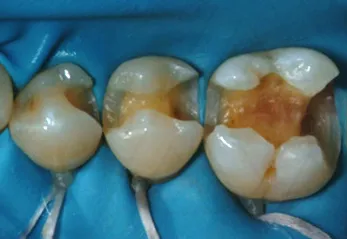
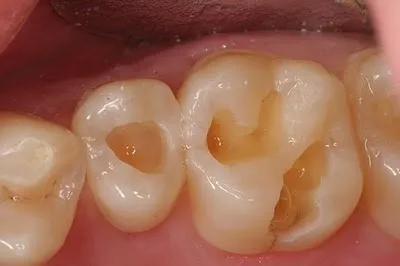
Properly cleaned cavities.
Step 2: The insulating base
The base is a layer of special cement placed over the dentine to insulate the dentine and the nerve beneath it from the filling.
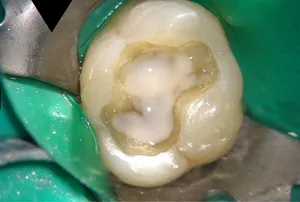
Step 3: The filling
The final stage is placing the filling. It can be made of different materials, and the choice is complex and is based on many criteria – strength, aesthetics, durability, colour, the location of the caries, and others.
Does caries treatment hurt?
With caries located only in the enamel there is no pain and no anaesthetic is needed. With caries that has also reached the dentine, pain of varying intensity is felt, and anaesthesia is given at the patient’s request.
What types of fillings are there?
The filling materials are photopolymer, chemopolymer, amalgam, glass ionomer cement and a laboratory-made filling. Details of each option:
- Photopolymer filling – fillings made of light-cured composite material are the most commonly used today.
- Chemopolymer filling – tooth-coloured fillings made of a lower-grade material than photopolymer ones.
- Amalgam fillings – mercury amalgam is the oldest material used for closing tooth defects.
- Glass ionomer cement fillings – a modern material that is entering more and more areas of dentistry.
- Inlays and onlays – laboratory-made fillings are called inlays (onlays, overlays).
What other methods are there for caries?
- Biological treatment – for deep caries, when a very thin wall remains between the nerve and the softened tissue.
- Remineralisation – a method for treating superficial caries.
How much does it cost?
A standard photopolymer filling costs 60 – 120 €. All prices are in the price list.
Frequently asked questions
How is caries treated?
In three main stages: cleaning the softened tooth tissue, placing an insulating base and placing a filling.
Does caries treatment hurt?
With caries only in the enamel there is no pain and no anaesthetic is needed. With caries that has also reached the dentine there is pain of varying intensity, and anaesthesia is given at the patient’s request.
What can a filling be made of?
Photopolymer, chemopolymer, amalgam, glass ionomer cement or a laboratory-made filling.
How is the filling material chosen?
The choice is complex and is based on many criteria – strength, aesthetics, durability, colour, the location of the caries, and others.