

Inlays, onlays and overlays are laboratory-made fillings that restore a badly damaged tooth and can spare it a crown. They are made in 2 visits to the clinic (with a laboratory) or in one visit with the CEREC system; ceramic ones are the best solution.
What are inlays and onlays?
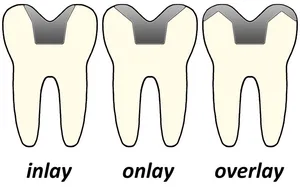
Laboratory-made fillings are called inlays (onlays, overlays) because they are made by the dental technician in the laboratory from an accurate impression taken by the dentist. They are the best and most durable fillings, because they fully restore the size, shape, colour and natural relief of the tooth.
When are they recommended?
Inlays are recommended for teeth in which caries has destroyed a large part of the healthy tooth tissue. In such teeth an ordinary composite or amalgam filling cannot give enough strength, which means the tooth has to be covered with a crown. Placing an inlay, onlay or overlay can avoid the need for a crown.
What types of inlays are there?
Depending on the material, inlays are composite, ceramic, metal or gold-ceramic.
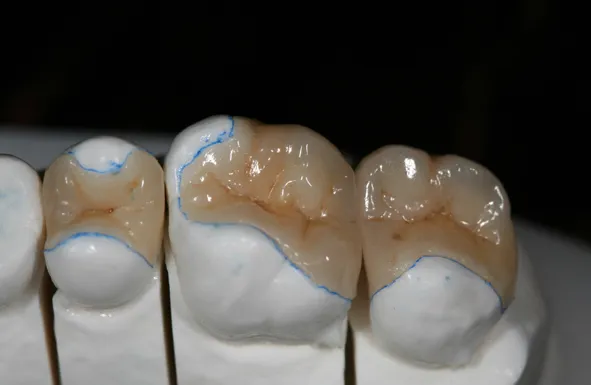
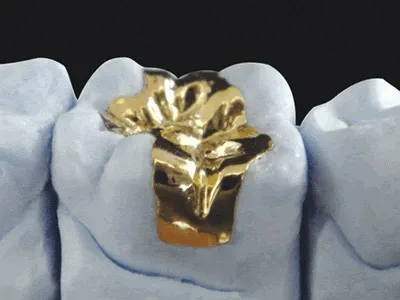
Ceramic inlay and gold inlay.
- Composite ones are the cheapest, but they are not strong enough and wear down and change colour over time.
- Metal ones are the strongest, but their colour differs considerably from the natural colour of the teeth.
- Ceramic ones are the best solution – they are strong enough, they do not wear down and they match the colour of the teeth completely.
What are the disadvantages?
The main disadvantages of inlays are that they are harder to make and cost more. Prices are in the price list.
How is an inlay made?
Making an inlay takes 2 visits to the dental clinic. Ceramic inlays can also be made in one visit with the CEREC system.
First visit
The old filling is removed or the caries is cleaned out down to healthy tooth tissue, the colour of the tooth is determined, a decision is made on the material for the restoration, and a silicone impression of the prepared tooth is taken. The impression is sent to the dental laboratory, and a temporary filling is placed on the tooth.
In the laboratory
The dental technician casts an exact copy of the prepared tooth from the silicone impression and starts making the inlay. When the inlay is ready, the patient is called in for the second visit.
Second visit
The temporary filling is removed and the inlay is tried in to check that it fits the tooth perfectly. If needed, slight corrections and adjustments are made. The laboratory-made restoration is then bonded into the tooth with special high-strength cements.
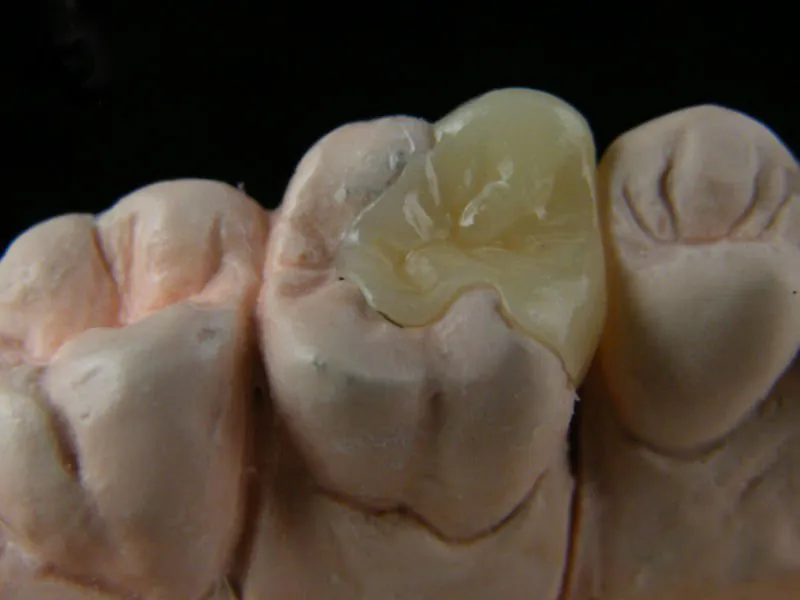
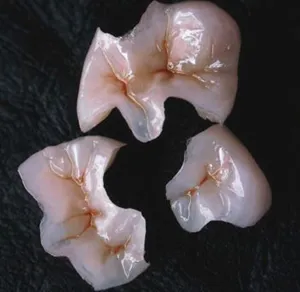
Composite inlay on a plaster model, and a ceramic inlay and onlay.
Frequently asked questions
What is an inlay?
A laboratory-made filling that the dental technician makes from an accurate impression taken by the dentist, and that fully restores the size, shape, colour and natural relief of the tooth.
When is an inlay recommended instead of an ordinary filling?
When caries has destroyed a large part of the healthy tooth tissue and an ordinary composite or amalgam filling would not give enough strength. An inlay, onlay or overlay can spare the tooth a crown.
How many visits does an inlay need?
Two, when the inlay is made in a laboratory: at the first the tooth is prepared and an impression is taken, and at the second the inlay is tried in and bonded. With the CEREC system a ceramic inlay is made in one visit.
Which material is best for an inlay?
Ceramic inlays are the best solution – they are strong enough, they do not wear down and they match the colour of the teeth completely.