

Caries is the most common disease of the teeth. It consists of darkening, softening and the formation of a hole in the surface of the tooth, which becomes deeper over time. At first it develops unnoticed and without symptoms, so it is best treated at an early stage.
In Bulgaria nearly 98% of people have at least one carious lesion, which is a sign of neglect of oral and dental health.
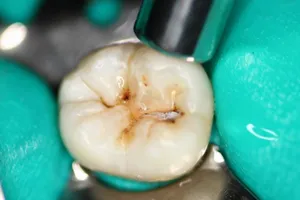
Why does caries develop?
There are three main and many secondary factors that matter for the development of caries. Caries can develop with various combinations of the main and secondary factors.
The three main factors are:
- the microorganisms in the oral cavity (S. mutans);
- the type of food eaten (carbohydrates);
- the strength of the enamel.
The secondary factors include skills and habits in cleaning the teeth, the protective action of saliva, genetic factors and others.
Microorganisms and food
Caries can be defined as an infectious disease, because it is caused by the bacterium S. mutans. It is a normal inhabitant of the human oral cavity, but under favourable conditions (eating sweet foods and carbohydrates and not cleaning the teeth) plaque builds up, which is the ideal environment for bacteria to live in. The number of microorganisms starts to increase, and this leads to the formation of caries.
S. mutans uses the carbohydrates in plaque, found in the greatest quantity in sweet foods and pastries, to feed itself. It processes them into acids, which are released into the environment around the bacterium. As is well known, tooth enamel is made of minerals that are susceptible to breakdown by acids. So with an increased intake of sweet foods and no or insufficient cleaning of the teeth, the bacteria release more acids, which break down the enamel and lead to the development of caries.
Strength of the enamel
The third important factor is the strength of the enamel. It depends on genetic factors as well as on a person’s lifestyle and diet. When nutrition in childhood was full and the child received food rich in vitamins and minerals, the enamel is built of high-quality crystals (fluorapatite crystals), which are more resistant to breakdown by acids, and caries develops with more difficulty.
Where does caries most often develop?
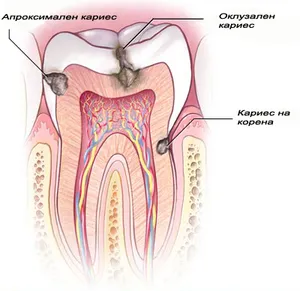
The development of caries is determined by the presence of uncleaned plaque in certain places on the teeth and by the condition of the enamel. In normally aligned teeth there are two main places where plaque builds up:
- the fissures on the chewing surface of the teeth – this is where occlusal caries develops (most common in children);
- the contact points between two neighbouring teeth – this is where approximal caries develops (most common in adults).
What are the symptoms and why is it dangerous?
Caries is a disease that is extremely dangerous for the tooth, because at first it develops unnoticed and without symptoms.
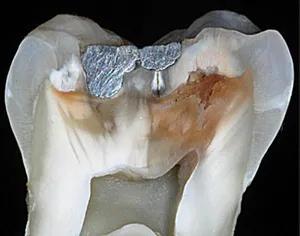
The diagram shows a cross-section of an extracted tooth that has an amalgam filling in the enamel. Next to it, a large secondary caries has developed in the dentine and has almost reached the nerve of the tooth. In this situation the patient has no symptoms, and the only thing they see in the mouth is the old amalgam filling. Caries like this can be found only at regular dental check-ups and with the help of an X-ray.
Enamel and dentine have different resistance to caries. Dentine is much more susceptible and breaks down much faster. This is why caries should be treated at the earliest possible stage.
The next picture shows a cross-section of an extracted tooth with approximal caries in the enamel that has reached the dentine. It is clear how in the dentine the caries has spread both in width and in depth towards the nerve. At the same time, the entrance of the caries in the enamel is relatively smaller and hides the true size of the destruction.
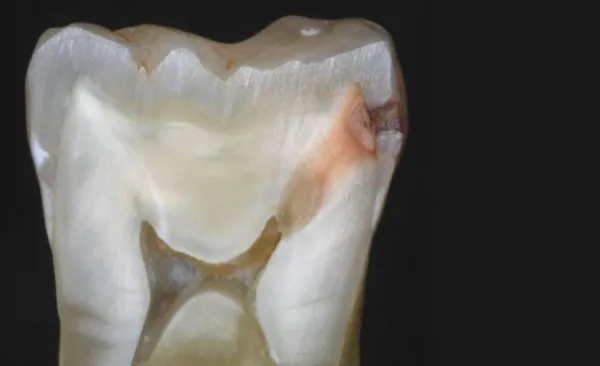
If such caries is left untreated, over time the destruction in the dentine becomes greater and greater, and when it is already very close to the nerve of the tooth, pain appears with cold and sweet things.
The onset of pain is an indication that the caries is very deep, and if the dentist is not visited, in time the carious destruction will reach the nerve of the tooth. Once the caries gets through the dentine, bacteria from the mouth will reach the nerve and acute pulpitis will develop, which will require devitalising the tooth.
How can it be prevented and how is it treated?
This is why regular visits to the dentist, perfect oral hygiene, proper nutrition and timely treatment of all carious lesions are extremely important. See treatment of caries.
Frequently asked questions
What is caries?
Caries is the most common disease of the teeth. It consists of darkening, softening and the formation of a hole in the surface of the tooth, which becomes deeper over time.
What are the main factors in the development of caries?
The microorganisms in the oral cavity (S. mutans), the type of food eaten (carbohydrates) and the strength of the enamel. Secondary factors are habits in cleaning the teeth, the protective action of saliva and genetic factors.
Does caries hurt?
Not at first – it develops unnoticed and without symptoms. Pain with cold and sweet things appears when the destruction is very close to the nerve of the tooth, and shows that the caries is very deep.
Where does caries most often develop?
On the chewing surface of the teeth (occlusal caries, most common in children) and at the contact points between two neighbouring teeth (approximal caries, most common in adults).
What happens if caries is not treated?
The destruction in the dentine becomes greater. Once the caries gets through the dentine, bacteria reach the nerve and acute pulpitis develops, which requires devitalising the tooth.