

Pulpitis is an inflammatory disease that affects the living tissue of the tooth (the pulp, the nerve). It most often arises from untreated caries, and its leading symptom is pain. The treatment method is chosen depending on the type of pulpitis, the degree of destruction of the tooth, the patient’s age and general condition.
What causes pulpitis?
There are many causes for it:
- untreated caries;
- trauma and fracture of the tooth crown;
- an advanced stage of tooth wear (abrasion);
- thermal damage during preparation for crowns, etc.
Pulpitis most often arises from untreated caries. Over time the caries deepens into the dentine and reaches the pulp. At this point both layers of the tooth – the enamel and the dentine – have been breached, bacteria begin to enter unhindered from the oral cavity into the cavity of the tooth and lead to inflammation of the nerve, which is irreversible and extremely painful.
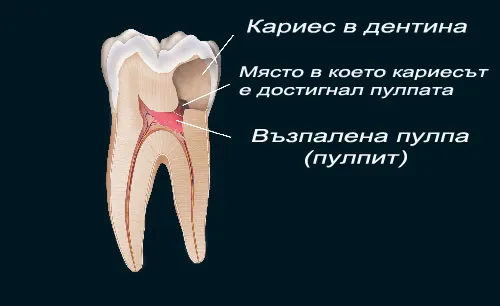
Pulpitis that has developed as a result of untreated caries.
What are the symptoms and types of pulpitis?
Pulpitis affects both baby and permanent teeth. It can be acute or chronic, serous or purulent. The leading symptom is pain.
Acute pulpitis
The pain is severe and may be either provoked or, more often, spontaneous. It grows worse in attacks at night. It may be throbbing, made worse by heat and relieved by cold (in purulent inflammation).
In most cases the pain is not localised to one tooth. It may spread from a tooth in the lower jaw to a tooth in the upper jaw and vice versa, but on the same side. With upper teeth the pain is directed towards the temple, and with lower teeth towards the ear.
In some cases the pain goes away (when painkillers are taken), but the tooth does not heal. If untreated, acute pulpitis turns into chronic pulpitis or periapical periodontitis (granuloma).
Chronic pulpitis
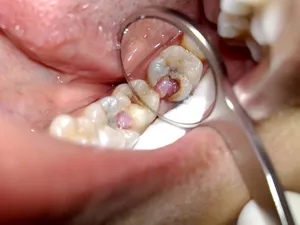
The pain is milder. It appears after eating, because the nerve of the tooth is already in direct contact with the oral cavity, and food and saliva reach it and irritate it. The tooth is usually open, with a large hole or a broken filling.
Under the effect of irritants (heat, cold) or when suction is applied to the affected tooth, the pain lasts for a long time. In young people there is a slightly sensitive soft tissue (polyp) in the hole of the tooth – granulomatous tissue (nerve) that has grown beyond the pulp and bleeds when touched.
Pulpitis in children’s teeth
In baby teeth, acute pulpitis occurs at an earlier age (3–6 years). It comes with severe pain during eating or at night. The child refuses to eat and drink liquids.
Chronic pulpitis is more common at school age. The pain is milder, and the child avoids chewing on that side.
How is pulpitis treated?
The treatment method is chosen depending on the type of pulpitis, the degree of destruction of the tooth, the patient’s age and general condition. See treatment of pulpitis and periapical periodontitis and root canal treatment.
Frequently asked questions
What is pulpitis?
An inflammatory disease that affects the living tissue of the tooth (the pulp, the nerve). It most often arises from untreated caries.
What does acute pulpitis feel like?
The pain is severe, more often spontaneous, and grows worse in attacks at night. It may be throbbing and in most cases is not localised to one tooth – with upper teeth it is directed towards the temple, and with lower teeth towards the ear.
Does pulpitis go away on its own if the pain stops?
No. In some cases the pain goes away when painkillers are taken, but the tooth does not heal. If untreated, acute pulpitis turns into chronic pulpitis or periapical periodontitis (granuloma).
How does chronic pulpitis show itself?
The pain is milder and appears after eating. The tooth is usually open, with a large hole or a broken filling, and under the effect of suction, heat or cold the pain lasts for a long time.
Does pulpitis occur in children?
Yes. In baby teeth, acute pulpitis occurs at an earlier age (3–6 years) with severe pain during eating or at night, while chronic pulpitis is more common at school age.