

A dental granuloma is a small focus of inflammation around the tip of the tooth root. It usually causes no pain and is most often found on an X-ray, so a timely check-up makes it possible to save the tooth.
Many patients come to the clinic saying: “It doesn’t hurt, so why should I get treatment?” The truth is that the absence of pain is precisely the treacherous side of a dental granuloma – it often lives “quietly” in the bone until it is too late.
What is a dental granuloma?
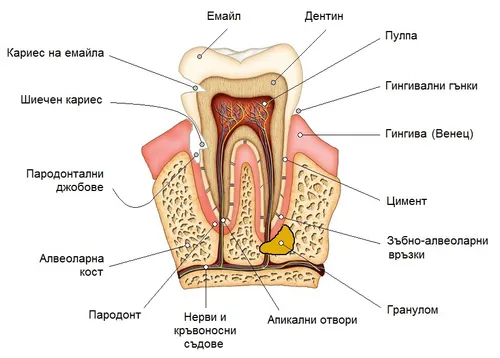
A dental granuloma is a small inflammatory formation. It develops at the tip of the tooth root after infection has passed through the root canals of the tooth.
Most often it is caused by a chronic infection that the body tries to “contain” by forming a capsule of connective tissue. Inside this capsule there are usually bacteria and toxins that continue to slowly destroy and dissolve the surrounding bone.
Why does a dental granuloma appear?
The main cause is an untreated or incompletely treated inflammatory process in the tooth. The most common situations are:
- deep caries that has reached the nerve and caused pulpitis, followed by necrosis of the dental pulp;
- incomplete or incorrectly performed root canal treatment, when bacteria remain in the canals;
- repeated trauma to the tooth – for example from heavy clenching of the teeth or a blow;
- sometimes the infection comes from neighbouring teeth or from the gums.
In most cases granulomas develop on devitalised teeth, because once the nerve has been removed the tooth has no sensitivity at all. This reduces the chance of noticing that an inflammatory process is under way.
Why is it dangerous?
A dental granuloma usually causes no pain in the early stages. This is its most treacherous feature – a person can live with it for months or years without suspecting anything.
However, if it is not detected and treated in time, the infection can spread:
- into the surrounding bone, causing an abscess;
- through the bloodstream to other organs (heart, kidneys, joints);
- it can even lead to loss of the tooth.
The larger the granuloma becomes, the harder and more expensive its treatment is.
What are the symptoms?
The symptoms are usually few, and a granuloma is most often found by chance on a follow-up X-ray.
Subjective complaints may include discomfort, a feeling of heaviness, and pain on pressure, when eating and when tapping the tooth. Teeth with granulomas often change colour.
Obvious symptoms appear when the chronic process developing in the bone becomes active. This flare-up is characterised by strong, constant, throbbing pain, sometimes not relieved by painkillers. The tooth feels foreign and “higher”, the mucosa becomes reddish-purple, swelling may appear in the area and a fistula (a small bump on the gum below the tooth) may form, from which pus can drain.
The general condition may be affected, with headache, swollen lymph nodes and raised temperature. If the tooth is open, an extremely unpleasant smell may be noticed.
How is a dental granuloma detected?
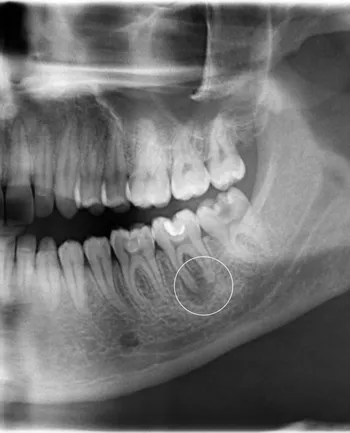
Dental granuloma on an X-ray.
Since it is often completely symptom-free, detection relies mainly on X-rays. On the X-ray, a dental granuloma appears as a dark spot around the tip of the root.
We usually find it:
- during preventive check-ups;
- when preparing for other treatment;
- when the patient comes for another reason and a granuloma is noticed on the X-ray.
Important: without an X-ray, diagnosis is often impossible. That is why regular preventive X-rays (once a year) are key – they can save a tooth before pain or swelling appears.
How is a dental granuloma treated?
Treatment depends on the condition of the tooth, the size of the granuloma and your general health. There are three main methods.
1. Therapeutic treatment – endodontic treatment
If the inflammation is in its acute phase, antibiotic treatment can be started to bring the symptoms under control before moving on to the main treatment. It is important to understand that the antibiotic alone does not cure the granuloma, and the infection must be removed from the root canal system of the tooth in order to succeed.
Endodontic treatment is used when the tooth is stable and can be saved.
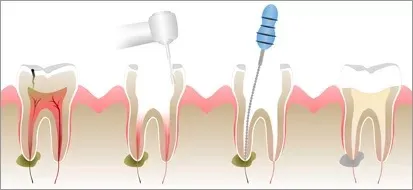
Tooth granuloma – root canal treatment.
It begins with removing existing fillings and crowns and locating the canals, which are opened, cleaned and disinfected with antiseptics. If necessary, medication is placed in the canal for a few weeks.
Once the infection is under control, the symptoms have gone and the canals are dried, they can be filled. It is important that the whole treatment takes place under perfect isolation (rubber dam), so that no microorganisms or saliva can get into the canals again.
This is often the gentlest method, especially if the granuloma is found in time and is small. A follow-up X-ray is needed at the 6th month to monitor the success of the treatment.
2. Surgical treatment (apical osteotomy)
It is suitable for large granulomas or when repeat root canal treatment is not possible or does not succeed. The surgeon makes a small incision in the gum, reaches the tip of the root and removes the granuloma together with the apical part of the root. The site is then cleaned and sutured.
Recovery is usually quick and the results are predictable.
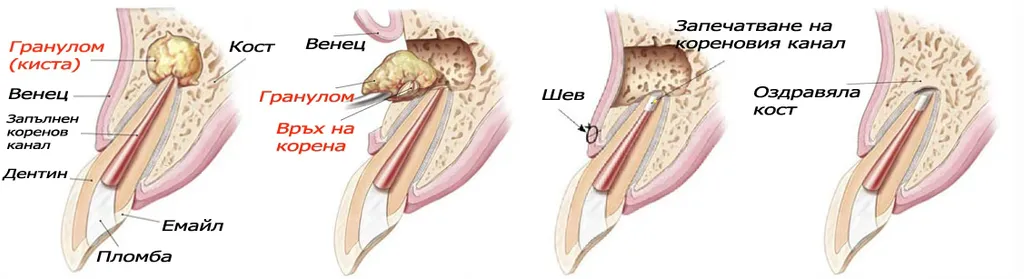
Surgical treatment of a granuloma.
3. Extraction (removing the tooth)
This is a last option, when the tooth is badly damaged or treatment is impossible. Sometimes a hemisection can also be done, when only one of the roots is affected by the granuloma. It is cut out and removed in order to preserve the integrity of the others.
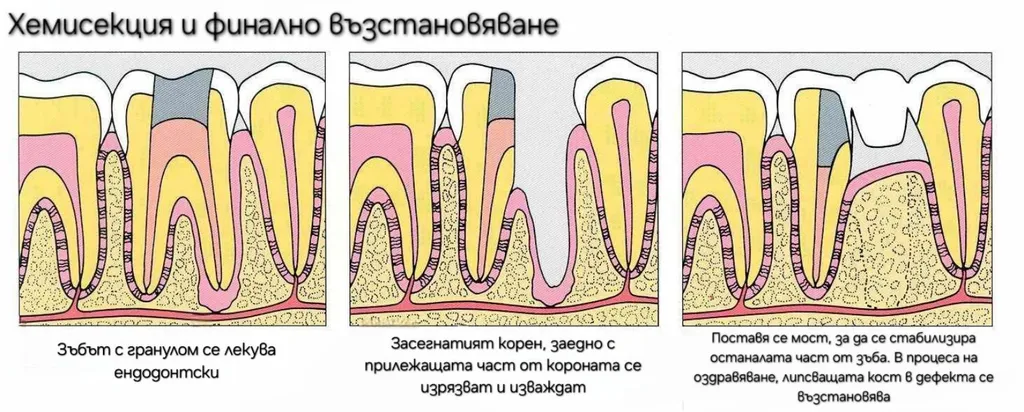
Granuloma treatment – hemisection.
Treatment prices are listed in the Price list.
What do you gain by treating it in time?
- You keep your own tooth.
- You avoid severe pain and swelling.
- You reduce the risk of complications for the whole body.
- You save time, money and more serious interventions.
How can you protect yourself?
- Regular preventive check-ups and X-rays – once a year.
- Treating caries and pulpitis at an early stage – before pain has appeared.
- Monitoring old root canal treatments – sometimes problems appear years later.
- Seeing a dentist promptly for any suspected discomfort.
A dental granuloma is like a silent fire – you cannot hear it or see it, but it slowly destroys the tissues. Your only protection is a preventive check-up with an X-ray. The earlier it is found, the easier and more painless the treatment.
Frequently asked questions
Does a dental granuloma hurt?
Usually not – in the early stages it causes no pain, and a person can live with it for months or years without suspecting anything. Strong, constant, throbbing pain appears when the chronic process in the bone flares up.
How is a dental granuloma detected?
Mainly with an X-ray, on which it appears as a dark spot around the tip of the root. Without an X-ray, diagnosis is often impossible.
How is a dental granuloma treated?
According to the condition of the tooth, the size of the granuloma and general health: with endodontic (root canal) treatment, surgical treatment (apical osteotomy) or, as a last option, extraction of the tooth.
Does an antibiotic cure a granuloma?
No. The antibiotic alone does not cure the granuloma – the infection must be removed from the root canal system of the tooth.
What happens if a granuloma is not treated?
The infection can spread into the surrounding bone, causing an abscess, through the bloodstream to other organs (heart, kidneys, joints), and can even lead to loss of the tooth.