

Loose teeth usually result from an injury or an inflammatory process and damage to the bone that holds the teeth. The most common inflammatory cause is periodontitis. With a loose tooth it is important to establish the cause – after an injury with an X-ray, while in periodontitis the treatment includes splinting of the teeth.
What can cause a loose tooth?
The roots of the teeth are firmly anchored in the bone of the upper and lower jaw (alveolar bone). When this bone is healthy and reaches the necks of the teeth, they are firmly fixed to it and immobile. When the height of the bone decreases, however, the tooth becomes more and more mobile.
- Injuries. The mobility can result from a fracture of the root of the tooth at various depths in the bone, or from a fracture of part of the alveolar bone itself, which makes it impossible to keep the tooth immobile.
- Inflammatory diseases (periodontitis). Over time the alveolar bone dissolves and the roots of the teeth are exposed more and more, which leads to gradual loosening of the tooth and even to its spontaneous loss.
Both the front (frontal) teeth and the back teeth (molars) can become loose. A loose tooth can be mobile to a different degree.
What are the degrees of tooth mobility?
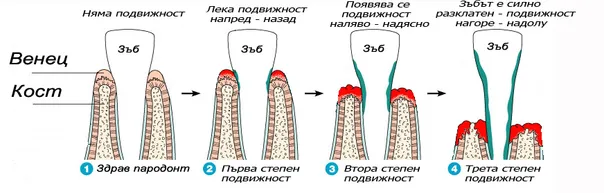
Three degrees are distinguished:
- First degree – there is movement only in the direction from the cheeks and lips towards the tongue.
- Second degree – to the first degree is added movement back and forth towards the neighbouring teeth.
- Third degree – movement is also seen in the vertical direction – the tooth moves up and down in the gum.
What are the symptoms?
Loose teeth may be accompanied by pain, inflammation of the gums or discomfort when eating. In periodontitis, as the stages advance, problems with eating and speech appear.
How is a loose tooth treated?
After a blow or injury
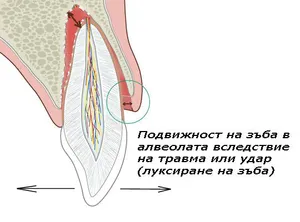
When the loosening results from a blow or injury and one or several teeth are mobile, an X-ray is needed to establish whether there is a fracture of the root of the tooth or of the bone. In milder injuries there may be only luxation of the tooth – loosening of the tooth in its socket without a fracture.
In periodontitis
In periodontitis, loosening develops over time, because the process of bone dissolving is slow. It starts imperceptibly, and if no measures are taken to treat the disease, the teeth fall out spontaneously.
The process works as a vicious circle: the mobility of the tooth in the alveolar bone that has arisen does not allow the bone to recover, and this leads to increasing mobility. That is why, at the dentist’s discretion, splinting of the teeth is applied, which immobilises them and creates conditions for recovery of the alveolar bone.
Frequently asked questions
Why do teeth become loose?
Usually as a result of an injury or an inflammatory process and damage to the bone that holds the teeth. When the height of the bone decreases, the tooth becomes more and more mobile.
What are the degrees of tooth mobility?
Three: first – only from the cheeks and lips towards the tongue; second – movement back and forth is added; third – the tooth also moves vertically, up and down in the gum.
What should I do if a tooth becomes loose after a blow?
An X-ray is needed to establish whether there is a fracture of the root of the tooth or of the bone. In milder injuries there may be only luxation – loosening of the tooth in its socket without a fracture.
How is loosening in periodontitis treated?
At the dentist’s discretion, splinting of the teeth is applied, which immobilises them and creates conditions for recovery of the alveolar bone.