
A healthy human dentition is made up of 32 teeth with a precisely defined place and position. The absence of even one tooth upsets the balance of the dental arches and, if it is not replaced within a reasonable time, leads to the teeth moving and to problems with chewing. Missing teeth are restored with implants, bridges or dentures.
Why are all the teeth important?
When all the teeth are present and correctly positioned, they are in a state of balance that best resists the chewing forces needed to chew food. It has been scientifically proven that the chewing forces exerted on the teeth are about 30 kg/cm2 for the front teeth and up to 80 kg/cm2 for the molars.
These are enormous loads, which must be neutralised by the teeth and the supporting bone, and that is possible only if all the teeth are present and in their correct places.
What are the consequences of a missing tooth?
When a single tooth is extracted, the balance of the dental arches in the mouth is upset. If it is not replaced within a reasonable time, irreversible processes of tooth movement begin, known as the Godon phenomenon.
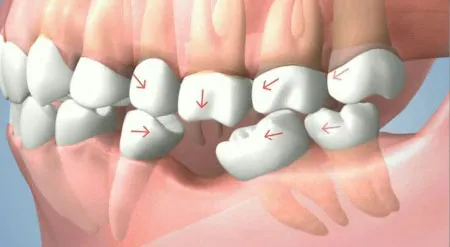
This phenomenon develops over a long time. At first it affects the teeth next to the extracted one, and later it involves the whole segment of teeth. The teeth move in such a direction as to fill the empty space in the row. The teeth to the left and right of the extracted tooth tilt towards the empty space, and the opposing tooth has nothing to touch and erupts freely towards the extracted tooth.
The movement of the teeth upsets the balance in the chewing apparatus, which in turn causes new problems:
- impaired chewing;
- difficult cleaning;
- loss of contacts between the teeth;
- incorrect loading of the teeth, leading to their loosening;
- loss of supporting bone;
- devitalisation of teeth.
In the toothless area chewing is difficult, and the patient begins to chew on the opposite side, which overloads it and starts problems there too.
Other consequences of tooth movement
Because the teeth move, cleaning in the area becomes difficult, which leads to increased build-up of plaque and tartar, which in turn lead to the development of caries and periodontal diseases.
Loss of the contacts between the teeth leads to increased mobility of the teeth and the development of gingivitis. Increased mobility, together with incorrect loading of the teeth when chewing, leads to their loosening and to dissolving of the supporting bone.
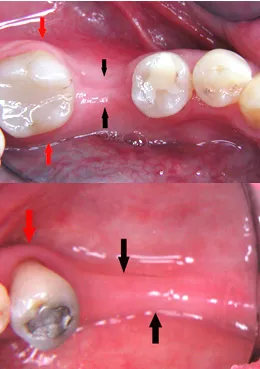
Loss of bone, in turn, leads to being unable to chew and to the gradual loss of the healthy neighbouring teeth as well. Besides the bone around the neighbouring teeth, the bone at the site of the extracted tooth also dissolves, which makes treatment in these cases even harder.
This leads to a vicious-circle process which, in the end, over time leads to the loss of all the teeth and the dissolving of the alveolar bone.
How is a missing tooth treated?
Various methods from prosthetics are used to prevent the Godon phenomenon:
- for a single missing tooth or several – implants or conventional bridgework with metal-ceramic bridges;
- for one or two missing teeth – bridges without grinding down the teeth;
- for several missing teeth where bridgework is not possible – partial dentures;
- when all the teeth are missing – complete dentures.
Frequently asked questions
How many teeth does a healthy dentition have?
A healthy human dentition is made up of 32 teeth with a precisely defined place and position.
What is the Godon phenomenon?
An irreversible process of tooth movement after a tooth is extracted that is not replaced within a reasonable time. The neighbouring teeth tilt towards the empty space, and the opposing tooth erupts towards it.
What problems does a missing tooth cause?
Chewing is impaired, cleaning becomes difficult, contacts between the teeth are lost, the teeth are loaded incorrectly and loosen, the supporting bone dissolves and teeth may be devitalised. Chewing on the opposite side overloads it.
How is a missing tooth restored?
With implants, with bridgework (metal-ceramic bridges, or bridges without grinding down the teeth for one or two missing teeth), with partial dentures for several missing teeth, or with complete dentures when all the teeth are missing.
Why should a missing tooth not be replaced late?
Loss of bone leads to being unable to chew and to the gradual loss of the healthy neighbouring teeth as well, and in the end the process can lead to the loss of all the teeth and the dissolving of the alveolar bone.