

Metal-ceramic crowns and bridges are a metal framework with tooth-coloured ceramic veneering — the most commonly used way to restore defects of the teeth aesthetically and functionally. When properly made and maintained, they can last over 30 years.
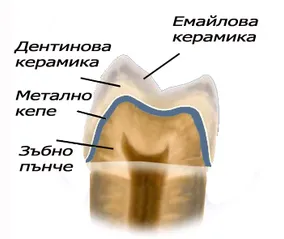
What are metal-ceramic crowns and bridges?
Metal-ceramic crowns and bridges have wide indications. They are made from metal alloys and ceramic masses that bond both chemically and mechanically.
Special enamel and dentine ceramic masses (tooth-coloured porcelain) are applied over metal copings that cover the prepared tooth stumps. The metal copings can be made of ordinary metal (Cr-Ni alloy) or gold.
What are their advantages?
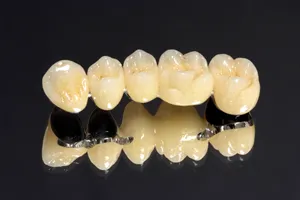
Metal-ceramic restorations are highly aesthetic and offer excellent biological tolerance, stability, strength and durability. These bridges and crowns:
- fully reproduce the shape and size of natural teeth and restore their individual features;
- when properly made, do not irritate or cause inflammation of the gums;
- on vital teeth, protect the pulp (nerve of the tooth) from thermal irritation;
- do not create conditions for the formation of tartar;
- keep their colour: unlike veneered crowns made of plastic, with metal-ceramic the colour is permanent and does not change over the years;
- with a correct bite and a well-made restoration, are hard to tell apart from natural teeth.
Depending on the individual features of the teeth, tooth necks, incisal edges and other elements can be “painted”, and overall the patient can decide how his or her teeth should look.
When are they used?
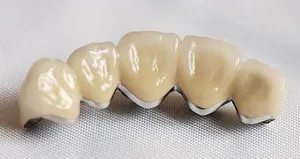
They are widely used in prosthetics when aesthetics is the main consideration and are the best alternative in terms of price versus quality. They are made both on vital teeth and on endodontically treated teeth, in congenital conditions with missing teeth (hypodontia, tilted or rotated teeth, diastemata – gaps between the teeth, enamel hypoplasia and others).
Metal-ceramics meets all functional and aesthetic requirements and is made for all dental defects where bridge prosthetics is possible.
Metal-ceramic bridges, like all bridges, are made after the age of 18, when the growth of the jaws has already finished. For dental crowns there are no such restrictions.
What are the disadvantages?
The only drawback of metal-ceramics is the higher price of the restoration and the brittleness of the ceramic masses. Only all-ceramic crowns and bridges surpass it in aesthetics (read more).
For small chips of the ceramic, repair in place in the mouth can be attempted, while for large ones the restoration is removed and the ceramic is applied anew.
How is it made?
Making the restoration involves all stages of work, from preliminary preparation and planning to final cementation (read more).
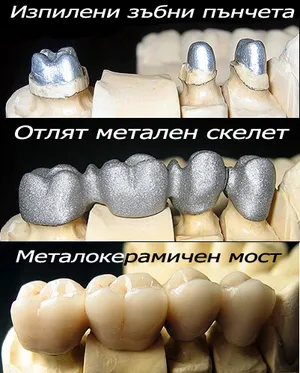
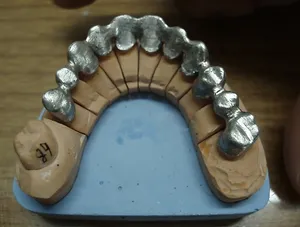
Characteristic stages for metal-ceramics are the metal try-in and the try-in of unglazed porcelain. At these, corrections are made to the metal framework, and then to the colour and shape of the teeth.
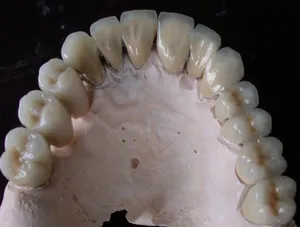
The metal framework before the ceramic is applied and the finished metal-ceramic restoration:
How much does it cost?
A metal-ceramic crown costs 250 €. All prices are in the price list.
Frequently asked questions
How long do metal-ceramic crowns and bridges last?
With proper fabrication and care they can last over 30 years.
What metal are the copings made of?
Of ordinary metal (Cr-Ni alloy) or of gold.
Can a metal-ceramic bridge be made for children and teenagers?
No. Metal-ceramic bridges, like all bridges, are made after the age of 18, when the growth of the jaws has finished. For dental crowns there are no such restrictions.
Does the colour of metal-ceramic change over the years?
No. Unlike veneered crowns made of plastic, with metal-ceramic the colour is permanent and does not change over the years.
What happens if the ceramic breaks?
For small chips a repair in place in the mouth can be attempted, while for large ones the restoration is removed and the ceramic is applied anew.