
A bridge on a glass-fibre support replaces missing back teeth without an implant and without surgery: the glass-fibre support rests on the gum and carries a fixed bridge. It is suitable when one of the supports of a classic bridge is missing — for example when molars have been lost.
How is a classic dental bridge made?
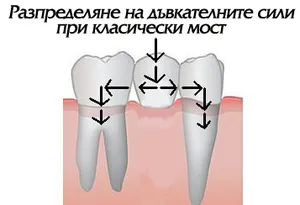
The fabrication of dental bridges follows the same physical principles that are used in bridge building. Two supports are needed at both ends of the structure to take the load of the middle part.
To make a classic dental bridge, at least two abutment teeth are needed – one in front of the missing tooth and one behind it. Arranged this way, the supports ensure an even load on the two supporting teeth, which take over the function of the extracted tooth.
This is the most favourable option for making a bridge and the most durable over time.
What is done when the back teeth are missing?
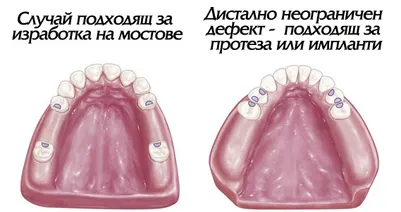
In many cases patients lose their back teeth (molars) and making a bridge is impossible, because one of its supports is missing. This results in a distal free-end defect in the dental arch.
Until recently, patients in this case had 2 alternatives – removable dentures or implants in place of the missing teeth.
Implants
With implants, the chewing load is taken by the implants themselves, in a way similar to natural teeth. Comfort is maximal and the feeling is like that of one’s own teeth.
Implant treatment, however, involves surgical procedures, carries a small but real risk of implant rejection, especially in smokers, and costs more, which makes many people avoid it. Read more about implants.
Removable dentures
The advantages of dentures are no surgical procedures, a simple fabrication procedure, easy maintenance and, not least, a very affordable price.
They do, however, have one main disadvantage – discomfort caused by being removable (movable in the mouth) and transmitting the chewing forces to the gum, which gives a feeling different from eating with bridges. Read more about dentures.
What is the ZX-27 glass-fibre support?
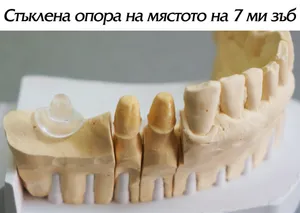
Besides these two options there is also a third – the so-called glass-fibre support (glass body) ZX-27. It is a special glass-polymer post that is made individually for each patient from an impression of their jaw.
The material used to make glass-fibre supports does not cause allergies, does not age, does not accumulate plaque and is biologically well tolerated.
What is the idea behind the glass-fibre support?
The glass-fibre support replaces the missing back tooth that is needed to carry the bridge. Unlike an implant, which is placed in the bone by a surgical procedure, the glass-fibre support simply rests on the gum. This spares the unpleasant sensations and the long waiting periods of implant treatment.
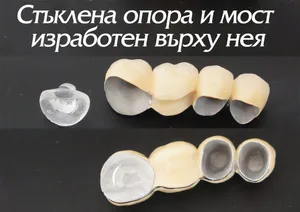
Once the glass-fibre support has been made, a classic bridge is placed on it and fixed by bonding. While chewing, the support transmits part of the load to the gum, but unlike a denture it is fixed and non-removable, and the feeling is that of eating with a bridge. In this way it combines the positive features of bridges – comfort – and of dentures – the way the chewing forces are transmitted.
When is a bridge on a glass-fibre support suitable?
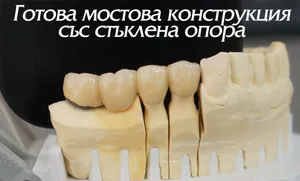
One basic rule is observed when making bridges with a glass-fibre support – there must be as many supporting front teeth as there are missing back teeth being restored.
The supporting teeth must be healthy and have no mobility, because they take most of the chewing forces. The glass-fibre support protects them from excessive overload by taking and transmitting part of the chewing load to the gum.
What are the advantages over implants?
Making bridges with glass-fibre supports is a very good alternative to implant treatment, because it provides:
- comfort similar to implants;
- high aesthetics;
- no surgical procedures;
- a price two to three times lower than the cost of implant treatment.
See clinical cases from our practice in the gallery of bridges made on a glass-fibre support.
How much does it cost?
A glass-fibre support costs from 250 €; the exact price is set after a consultation. All prices are in the price list.
Frequently asked questions
What is the ZX-27 glass-fibre support?
A special glass-polymer post that is made individually for each patient from an impression of their jaw. It replaces the missing back tooth that is needed to carry the bridge and simply rests on the gum.
Is surgery needed for a glass-fibre support?
No. Unlike an implant, which is placed in the bone by a surgical procedure, the glass-fibre support simply rests on the gum. This spares the unpleasant sensations and the long waiting periods of implant treatment.
How many supporting teeth are needed for a bridge on a glass-fibre support?
There must be as many supporting front teeth as there are missing back teeth being restored. The supporting teeth must be healthy and have no mobility.
Is a bridge on a glass-fibre support removable?
No. Unlike a denture, the glass-fibre support is fixed and non-removable, and a classic bridge is bonded onto it. The feeling is that of eating with a bridge.
What is the glass-fibre support made of?
Of a material that does not cause allergies, does not age, does not accumulate plaque and is biologically well tolerated.