

A bridge or crown made of metal and plastic is called a veneered crown or veneered bridge: a metal construction in which the plastic coating is applied only to the visible surfaces of the teeth, on the side facing the lips. Today it is practically out of use because of the unfavourable qualities of the plastic; in the past it was often used because of its lower price and quicker fabrication, mainly for patients who do not have high aesthetic requirements or cannot afford a metal-ceramic restoration.
How is a veneered bridge built?
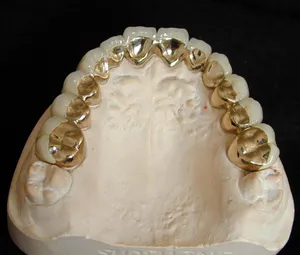
A veneered bridge is a cast metal construction with crowns, a pontic and a plastic coating. The metal alloys are biologically compatible, noble and resistant to friction and corrosion.
The plastic coating is applied only to the outer (vestibular – visible) side, with a protective metal rim. This rim is at the very top of the crown and protects the plastic from chewing forces.
With these bridges, more of the tooth has to be prepared on the vestibular side (towards the lips and cheeks) to leave room for the layer of plastic. To join the metal to the plastic, retention beads, rims or other retainers are made to ensure the strength of the construction.
What are the weak points of veneered crowns and bridges?
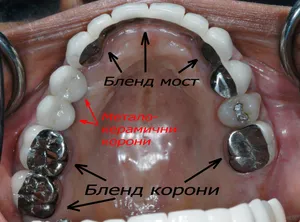
The weak point of veneered crowns and bridges is the connection of the aesthetic plastic part to the metal body, as well as the unstable colour of the plastic. Over the years it ages and changes.
Under load or mechanical friction (hard foods, hard brushes and rough movements when brushing) the plastic wears away and the appearance of the bridge is spoiled. The wax-up (the dental technician’s work) cannot always imitate all the details of the teeth.
If the plastic coating is defective or broken, corrections in the mouth are hardly possible. This requires removing the bridge and replacing the plastic in the dental laboratory, if possible; otherwise the construction has to be made again.
To avoid the disadvantages of the plastic and to improve the aesthetic and functional effect, after some time the construction is replaced with a new one or with a metal-ceramic one.
How is it made?
Making this type of bridge goes through the standard stages of making bridges and crowns:
- preliminary preparation;
- planning of the construction;
- preparation of the supporting teeth;
- taking impressions;
- fabrication in the laboratory;
- try-in (fitting);
- cementation.
For larger constructions (5 – 6 teeth, a whole front section or a whole jaw), the metal framework is tried in first and only then is the plastic coating applied. The method of making bridges and crowns is described in more detail in the section on making crowns.
How much does it cost?
A veneered crown or bridge with a plastic facing costs 250 €. All prices are in the Price list.
Frequently asked questions
What is a veneered crown or bridge?
A metal construction with a plastic coating only on the visible surfaces of the teeth on the side facing the lips, while the rest of the bridge is metal.
Who is this type of bridge suitable for?
Mainly for patients who do not have high aesthetic requirements or cannot afford a metal-ceramic restoration. Today, however, it is practically out of use because of the unfavourable qualities of the plastic.
What is the weak point of veneered crowns and bridges?
The connection of the plastic part to the metal body and the unstable colour of the plastic. Over the years it ages, changes and, under load or friction, wears away.
Can a broken plastic coating be repaired?
Corrections in the mouth are hardly possible. The bridge has to be removed and the plastic replaced in the dental laboratory, if possible; otherwise the construction is made again.