

A dental crown fully covers a defective or damaged tooth, takes in the neck of the tooth and protects it from further destruction. It restores the anatomical shape, function and aesthetics of the tooth and can be made both on a living tooth and on a tooth that has had endodontic treatment.
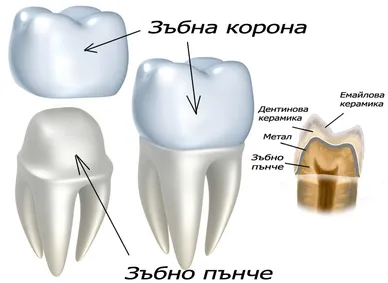
What is a dental crown?
A dental crown is used to treat defects and damage to the tooth. It is made from different materials:
- plastic (temporary crowns);
- metal (chromium-nickel alloy);
- gold;
- metal and plastic (veneered crowns);
- metal-ceramic crowns;
- all-ceramic (zirconia) crowns.
The different types of crowns are described in detail in the section “Fabrication of crowns and bridges”.
The disadvantage of a crown is that part of the tooth has to be prepared (ground down) and there is minimal irritation in the area of the gum.
When is a crown made?
Crowns are made for:
- tooth defects resulting from abrasion (wear) or fractures;
- wedge-shaped defects;
- change in the colour of the teeth where whitening is not possible;
- root canal treated teeth with thin walls, and so on.
The choice of a suitable crown depends on many factors – the location of the affected tooth, the patient’s wish for aesthetics and the patient’s financial means.
What types of tooth preparation are there?
Once a suitable type of crown has been chosen, we proceed to tooth preparation. In living teeth, anaesthesia is always given. There are two main types of preparation – with a margin (shoulder) and without a margin (feather-edge).
Preparation with a margin
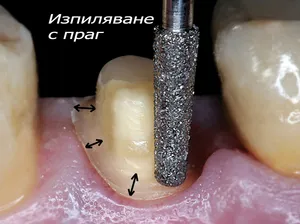
Preparation with a margin is carried out to ensure a suitable thickness of the crown edge and a correct transition between the crown and the hard tooth tissues. It is used for metal-ceramic crowns, veneered crowns and all-ceramic crowns.
Special burs with a precisely defined tip shape are used, which form a suitable margin. The advantage is that the crown edge fits tightly on the margin in the area of the neck and the crown cannot sink deeper and irritate the gums.
Preparation without a margin
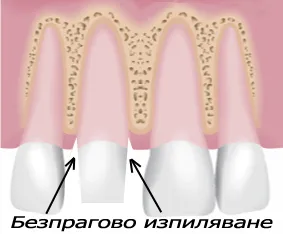
In preparation without a margin no margin is made; instead the bur goes in between the gum and the tooth and the tooth is ground down. It is used for all types of full-coverage crowns and is the older method. It is easier and does not require special burs.
The disadvantage is that the crown edge can go unhindered and unevenly deep into the gingival pocket and so irritate the gums. The advantage is that the deeply reaching edge provides a better splinting effect and greater stability for badly damaged roots.
How is a crown made?
Making a dental crown requires three or four visits, depending on its type.
First visit
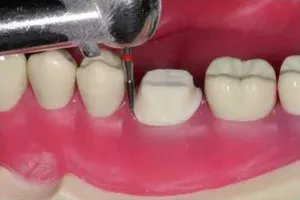
The tooth is prepared by the method decided in advance – with or without a margin. After that a temporary crown may be placed, at the dentist’s discretion or at the patient’s wish.
It is not recommended to take the impression at the same visit, because preparation usually injures the gum. The injured gum must be left 4–6 days to recover, and only then should the impression be taken. If this is not waited for, the finished crown may be short and may not fully cover the neck of the tooth, which is a gross error and requires the crown to be redone.
Second visit
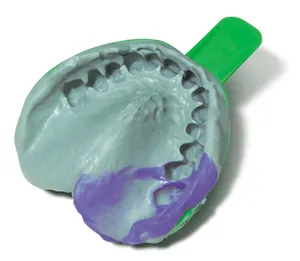
With a suitable impression tray, an impression of the prepared tooth stump is taken using silicone and a corrective (wash) material. After that the colour is determined using suitable shade guides (depending on whether the crown will be made of plastic or ceramic).
The impression is sent to the dental laboratory, where a plaster model of the tooth stump is cast. The crown is then modelled in wax and cast in metal, which is cleaned and polished.
Third visit
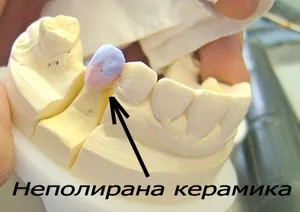
For ordinary crowns (metal and metal-and-plastic), the crown is fitted and cemented at the third visit. For metal-ceramic crowns, a try-in of the metal base is done, and in some cases a try-in of the applied but not yet polished ceramic.
After shape, colour and occlusion are agreed, the crown is finished (polished).
Fourth visit
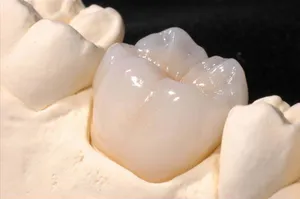
The metal-ceramic crown is cemented with a suitable cement, depending on whether the tooth is living or not. At the dentist’s discretion, the crown may be fixed with temporary cement and the patient eats with it for about a week; only if it feels good is it then cemented with permanent cement.
After cementing, the patient is given instructions on hygiene and eating. With a correctly made and well-fixed crown, the patient gets used to it in one to two days. This is the most commonly used way of restoring defects of the tooth crown.
How long does a crown last and how much does it cost?
The recommended period for replacing crowns is 8–10 years, but they stay in the mouth for a longer period too. What matters most is the strength of the teeth and periodontium and the maintenance of good oral hygiene.
The price depends on the type of material used and the method of fabrication. All prices are in the Price list.
Frequently asked questions
How many visits does a dental crown need?
Three or four, depending on the type of crown.
Is anaesthesia needed when the tooth is prepared?
In living teeth, anaesthesia is always given.
Why is the impression not taken on the day the tooth is prepared?
Preparation usually injures the gum, and it must be left 4–6 days to recover. Otherwise the crown may be short and may not fully cover the neck of the tooth, which requires the crown to be redone.
How long does it take to get used to a crown?
With a correctly made and well-fixed crown, the patient gets used to it in one to two days.
How long does a dental crown last?
The recommended period for replacing a crown is 8–10 years, but crowns stay in the mouth for longer. What matters most is the strength of the teeth and periodontium and good oral hygiene.
Related pages
- Fabrication of crowns and bridges – detailed information on the types of crowns (veneered, metal-ceramic, all-ceramic) and the advantages and disadvantages of the materials
- Treatment of broken or abraded teeth
- Placing a post in the root canal
- Construction of a tooth stump (pinlay)