

Veneers are thin shells 0.3–0.7 mm thick, bonded to the visible side of the front teeth. They correct the colour, shape and, to some extent, position of the tooth – making them is a strictly cosmetic procedure with only an aesthetic effect. They are suitable only for healthy, vital teeth.
What are veneers and when are they used?
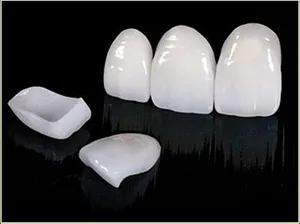
Veneers have no real functional effect. They are used to correct minimal defects of the teeth:
- colour – when whitening is impossible or gives a poor result;
- shape – a minimal change in the appearance of the tooth;
- position – a minimal deviation from the normal position of the tooth;
- diastema – closing the gap between the two front teeth.
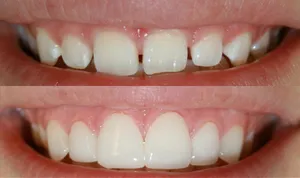
Veneers are normally made only for the six upper front teeth and the six lower front teeth (incisors and canines).
In its most basic form, a veneer is a shell 0.3–0.7 mm thick that is bonded to the vestibular (visible) side of the tooth. The tooth has first been ground down and prepared in a suitable way.
What types of veneer are there?
Depending on the material, veneers are of two main kinds – composite and ceramic (porcelain). There are also special veneers – no-preparation, partial and occlusal (read more).
Composite veneers
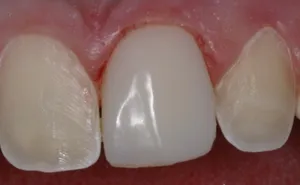
Composite veneers are made from filling material (a high-grade aesthetic photopolymer).
Advantages:
- lower price, affordable for most patients;
- made at the dental clinic in one visit;
- can be repaired directly in the mouth without being removed;
- very good aesthetics;
- gentler in terms of grinding down hard tooth tissue.
Disadvantages:
- lower durability and strength of photopolymer compared with porcelain;
- over time photopolymer changes colour and becomes more brittle, but it can be repaired.
Porcelain veneers
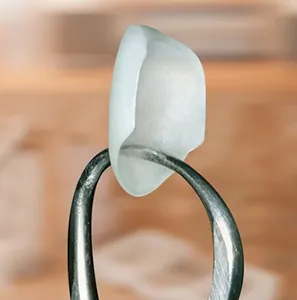
Porcelain veneers are the standard veneers: a ceramic shell made by the dental technician is placed on the ground part of the tooth. They are made over several visits to the dental clinic.
Advantages:
- the colour set with them stays unchanged for the whole life of the veneers;
- their life is about 10–15 years for porcelain and about 4–5 for composite.
Disadvantages:
- the high price puts them out of reach for many people;
- they cannot be repaired if they break – the whole veneer has to be replaced.
How are porcelain veneers made?
The procedure is similar to making porcelain crowns, the only differences coming from the fact that veneers are finer.
Stage 1: Planning and wax-up
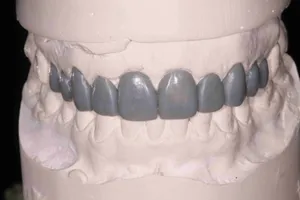
The first and most important stage is planning and making a wax-up – a wax prototype of the future veneers. With it the patient can see what the effect will be and how their veneers will look.
Stage 2: Grinding, impression and temporary veneers
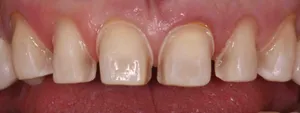
Once the patient has approved the look of the veneers, the teeth are ground down, an impression is taken and temporary veneers are made until the permanent ones are ready.
Stage 3: Bonding the permanent veneers
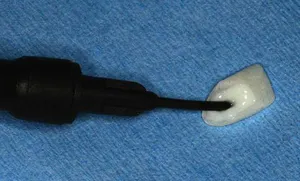
The temporary veneers are removed and the permanent ones are bonded on. Bonding is the other key stage in successfully placing veneers. Special adhesives are used, which must have not only exceptional strength but also high aesthetic quality.
If the material does not meet these requirements, either sufficient bond strength is not achieved and the veneers come off, or their colour changes because of the adhesive showing through and the desired aesthetic effect is not achieved.
Porcelain veneers can be made by the dental technician or with CAD/CAM technology. They are described under the making of porcelain (all-ceramic) crowns – read more.
Veneer or crown: which to choose?
One of the most important moments in aesthetic treatment is the choice of how to restore a given tooth – a porcelain veneer or a porcelain crown. Several indications and contraindications are taken into account:
- Vital teeth only. For endodontically treated teeth (with the nerve removed), all-ceramic crowns are made – read more. There are two reasons. First, endodontically treated teeth are considerably more fragile and brittle because much of the tooth tissue has been ground away. Second, they become discoloured after treatment, the discolouration being strongest around the root canal and decreasing outwards towards the enamel. If a veneer is made, the tooth is weakened further by the grinding and a good aesthetic effect is not achieved: the least discoloured layer (the enamel) has been removed, while the more strongly discoloured dentine beneath it remains and shows through the thin ceramic veneer.
- Healthy teeth only. Veneers are made on teeth that have no large fillings or cavities. For teeth that are not caries-resistant and have cavities or fillings, the better choice is a porcelain crown, which gives the tooth complete protection.
- No bruxism. With harmful habits such as bruxism and bruxomania (clenching and grinding of the teeth), veneers are absolutely contraindicated, because they are very thin and the risk of breaking and coming off is very high. The only solution is all-ceramic crowns, which are more durable.
- Normal bite. Veneers are made only when the upper teeth cover the lower ones. In an edge-to-edge bite (the upper and lower incisors touch with their cutting edges) or a crossbite (the lower teeth sit in front of the upper ones), all-ceramic crowns are used. Besides the aesthetics, they also correct the bite and bring it to normal or close to normal.
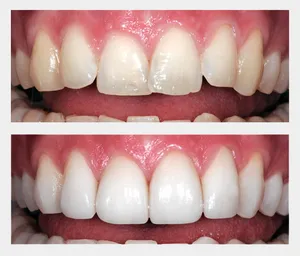
In summary, veneers are the gentlest method in aesthetic dentistry in terms of grinding down hard tooth tissue, but their indications are very narrow. They are applicable only to healthy teeth where the problems are purely cosmetic: a colour the patient finds unacceptable, minimal corrections to the shape and size of the tooth crown. The decision is made after a thorough analysis of the possibility of making them, the effect that will be achieved, and the patient’s conviction that they want to do it.
In all other cases – where the teeth are not completely healthy or veneers could not achieve a sufficient effect – all-ceramic crowns are used. Their main disadvantage compared with veneers is that more hard tooth tissue has to be ground away, but they have the advantage of greater strength, durability and a lower price.
How much do they cost?
A porcelain veneer costs 400 – 520 €. A composite veneer costs 100 – 240 €. All prices are in the price list.
Frequently asked questions
What are veneers?
Thin shells 0.3–0.7 mm thick that are bonded to the visible side of the ground-down tooth and correct its colour, shape and, to some extent, position. Making veneers is a strictly cosmetic procedure.
How long do veneers last?
Porcelain ones about 10–15 years, composite ones about 4–5. The colour of porcelain veneers stays unchanged for their whole life.
How many visits are needed?
Composite veneers are made at the clinic in one visit. Porcelain veneers are made over several visits.
Can veneers be made on a treated tooth (with the nerve removed)?
No. Veneers are made only on vital teeth. For endodontically treated teeth all-ceramic crowns are made, because such teeth are more fragile and the discoloured dentine shows through the thin ceramic veneer.
When are veneers not suitable?
With large fillings and cavities, with bruxism (clenching and grinding of the teeth) and with bite problems – an edge-to-edge or a crossbite. In these cases all-ceramic crowns are made.