
Besides standard porcelain and composite veneers – thin shells of ceramic or composite bonded to the outer side of the teeth to improve aesthetics – there are less well-known types that are made only by specialists: no-preparation veneers, partial veneers for closing a diastema, and occlusal veneers. All three are micro-invasive. For standard veneers, read here.
What special types of veneer are there?
1. What are no-preparation veneers?
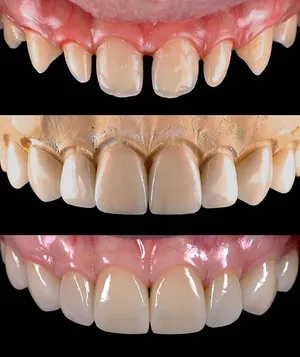
In the way they are made and in their materials they do not differ from standard porcelain and composite veneers. They are used in patients who have space between the teeth – with smaller teeth and a large jaw, with diastemas and gaps and an unaesthetic smile. The other case is an irregular shape of the lateral incisors – the so-called peg-shaped incisors.
The available space makes it possible to make the veneers without preparing the teeth, provided that the shape of the teeth allows them to be placed without obstruction. Often this is impossible because of undercuts. In that case veneers with minimal preparation are made – a subtype of no-preparation veneers in which only as much tooth structure is prepared as is needed to eliminate the undercuts and allow the veneers to be placed correctly.
Minimal preparation has nothing to do with the classic preparation for veneers. It is not done in depth and does not cover the whole outer surface, but is only in one area of the tooth, called the equator, which is the main obstacle to correct placement. For this reason temporary veneers are not needed, and the teeth, although slightly prepared, keep their shape and are not painful.
No-preparation veneers are made in 1 day with CEREC or in about 7 to 10 days by the dental laboratory. Their price is slightly higher than that of standard veneers because they are usually extremely thin and difficult to make.
2. What are partial veneers for closing a diastema?
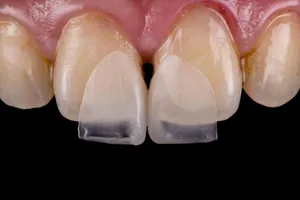
Unlike all the other types, partial veneers do not cover the whole outer surface of the tooth. They are made for patients with a diastema – the gap between the 2 upper central incisors.
These patients are not suitable for classic no-preparation veneers, because the gap is only between the front surfaces of the 2 central teeth, while their rear surfaces may be in tight contact with the lateral incisors. Partial veneers allow us to be micro-invasive again and not remove any tooth structure.
Making them requires exceptional skill on the part of the dental technician, because the veneers thin out to nothing and end in the area of the lateral 2/3 of the outer surface of the tooth – this hides the boundary between the veneer and the natural tooth. They are made only in the dental laboratory, by hand, and take about 10 days. Temporary structures are again not needed, because the teeth are not prepared.
This type of veneer is used only to change the shape of the teeth, without changing their colour. Their price is similar to that of no-preparation veneers.
3. What are occlusal veneers?
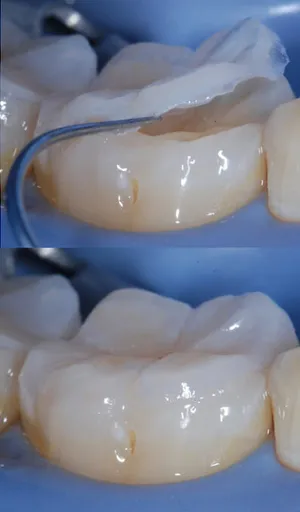
They are placed on the chewing (upper) surface of the back teeth. Unlike the others, their main role is not aesthetic but functional: they restore the normal shape of the teeth in patients whose chewing teeth have worn down as a result of clenching and grinding – bruxism. In this way the bite is restored, and this type of veneer is widely used in bite-raising procedures.
To make them, minimal preparation or smoothing of the chewing surface is done, so that it is sufficiently flat and there is sufficient distance from the opposing teeth to apply about 0.3 – 0.5 mm of lithium disilicate ceramic or composite. Special high-strength ceramics or composites and cements are used, to withstand the chewing forces.
They are made in the dental laboratory in about 7 to 10 days or with CEREC in one day. They are a micro-invasive alternative to standard full-coverage crowns. Their price is similar to that of standard veneers.
How long does it take and how much does it cost?
The time depends on the type: no-preparation and occlusal veneers take 1 day with CEREC or about 7 to 10 days in the laboratory, and partial veneers about 10 days. No-preparation veneers are slightly more expensive than standard ones, partial veneers cost the same as no-preparation veneers, and occlusal veneers the same as standard ones. Current prices are in the Price list.
Frequently asked questions
Are temporary veneers needed for no-preparation veneers?
No. Minimal preparation has nothing to do with the classic kind – it is not done in depth, does not cover the whole outer surface and is only in the area of the equator, so temporary veneers are not needed.
How long does it take to make the special veneers?
No-preparation and occlusal veneers – 1 day with CEREC or about 7 to 10 days from the dental laboratory. Partial veneers are made by hand only in the laboratory and take about 10 days.
When are partial veneers used?
For a diastema – the gap between the two upper central incisors – when their rear surfaces are in tight contact with the lateral incisors. Partial veneers change only the shape of the teeth, not their colour, and remove no tooth structure.
What are occlusal veneers for?
They are functional rather than aesthetic: they restore the normal shape of chewing teeth worn down by clenching and grinding (bruxism) and restore the bite. They are widely used in bite-raising procedures.
How much do the special veneers cost?
No-preparation veneers are slightly more expensive than standard ones because they are usually extremely thin and difficult to make. Partial veneers cost the same as no-preparation veneers, and occlusal veneers the same as standard ones. Current prices are in the Price list.