

The bruxism night guard is a thin removable appliance that protects the teeth from wear caused by clenching and grinding at night. It is made of soft foil about 2 mm thick, takes 3 to 5 days to make, and the impressions take about 30 min and are not painful.
What is bruxism?
Clenching and grinding of the teeth are very common nowadays. In professional language they are called bruxism and bruxomania. The main cause is the great nervous tension and stress that we experience during the day. This leads to strong clenching and grinding of the teeth at night, which we do not feel.
To find out that we have such a problem, either someone who has heard us has to tell us, or we have to go to a dentist.
What are the consequences of teeth grinding?
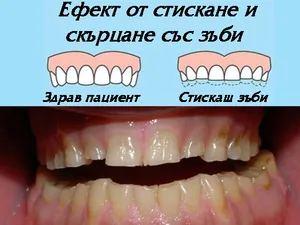
At the dental clinic the consequences are clearly visible – signs of tooth wear of varying degrees that do not match the person’s age. At first this wear is symptom-free and patients have no complaints.
In the advanced stages, complaints appear involving sharp pain when chewing, problems with eating and with the normal appearance of the teeth. In the final stage the teeth begin to break and are worn down to the gum.
These severe conditions are treated by raising the bite – with composite or with crowns.
What is the role of bruxism splints?
Patients with mild and moderate damage from night-time clenching and grinding are treated and protected with special splints. Bruxism splints have two main roles.
Therapeutic role
The splint changes the position of the lower jaw and so changes the state of the muscles responsible for clenching the teeth. They relax because the splint holds the jaws in a slightly open position, which is a person’s resting position. With regular wear over time, the harmful habit can even be eliminated.
Preventive role
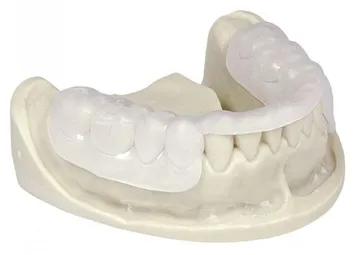
In almost all patients the splints are made of special soft foil about 2 mm thick. This provides a soft cushion that patients bite on between their teeth. This way, even if they clench or grind, the wear process stops.
So a completely micro-invasive procedure provides a special removable appliance that protects us from the severe consequences, and the treatments, of tooth wear.
How is the night guard made and how long does it take?
Making the bruxism splint takes about 3 to 5 days under standard timelines. In urgent cases it can also be made the same day with a rush order to the laboratory.
To make the splint, impressions of the upper and lower jaw and a bite registration are needed. This takes about 30 min at the clinic and is not painful.
The night guard costs 150 €. All prices are in the Price list.Will I get used to sleeping with the night guard?
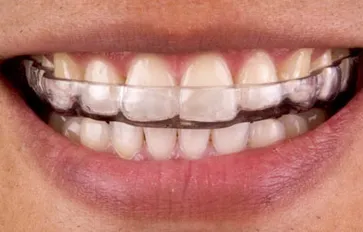
One of the main concerns of patients is whether they will be able to get used to sleeping with the splints. The answer is yes, because they are very different from boxing mouthguards.
Anti-bruxism splints are much finer and much easier to tolerate, because they are made of foil up to 2 mm thin and cover only one jaw, sitting mainly between the teeth themselves and only a little to the sides of them.
Is the night guard useful with bridges and crowns?
Anti-bruxism splints are also highly recommended for patients with metal-ceramic or zirconia bridges. With them they play the role of night guards, protecting against fracture of the ceramic or zirconia as a result of night-time clenching of the teeth.
A special variety of anti-bruxism splints are anti-snoring devices.
Frequently asked questions
What is a bruxism night guard?
It is a thin removable appliance made of special soft foil about 2 mm thick that protects the teeth from wear caused by clenching and grinding at night.
How long does it take to make the night guard?
About 3 to 5 days under standard timelines, and in urgent cases it can also be made the same day with a rush order to the laboratory.
How are the impressions taken and does it hurt?
Impressions of the upper and lower jaw and a bite registration are taken. This takes about 30 min at the clinic and is not painful.
Will I be able to get used to sleeping with a night guard?
Yes. The guards are much finer than boxing mouthguards, are made of foil up to 2 mm thin, cover only one jaw and sit mainly between the teeth themselves.
Is a night guard useful with ceramic or zirconia bridges?
Yes. With metal-ceramic or zirconia bridges it plays the role of a night guard, protecting against fracture of the ceramic or zirconia from night-time clenching.