
Crowns, bridges and inlays made of all-ceramic (IPS e.max) and zirconia are a metal-free alternative to metal-ceramic: highly aesthetic, very strong and reliably bonded. At Ralev Dental Clinic some of them are made in a single visit.

We have a system, innovative on a worldwide scale, for making crowns, veneers, ceramic fillings (inlays), onlays, overlays and endocrowns from pure ceramic in a single visit to the clinic, with no need for temporary crowns and without waiting the standard one-week period for the restorations to be made. Read more about CEREC.
What types of crowns and bridges are there?
Dental crowns are of two main kinds: full crowns (full-coverage) and partial crowns (endocrowns, inlays, onlays, overlays, as well as veneers). These names are easily explained to the patient by classifying them according to the extent of the damage to the tooth being restored.
Full-coverage crowns
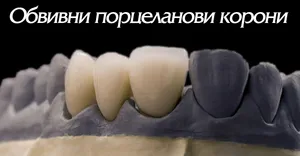
These are the classic crowns, in which the tooth is prepared down to the gum in the form of a stump, onto which the crown is cemented. It covers the stump completely and restores normal shape, function and a natural aesthetic appearance.
Full-coverage crowns are made both on teeth with the nerve removed and on living teeth. They are the universal, safest and most commonly used option for restoring large areas of tooth destruction and replacing missing teeth (making bridges).
Full-coverage crowns are used almost always in making dental bridges: at least two crowns are made on the teeth next to the missing one, and the missing tooth is attached to them.
Endocrowns
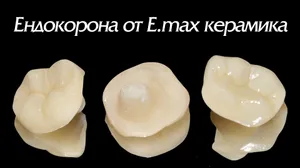
These are crowns made for teeth with the nerve removed. They are partial crowns, because the tooth is not built up and is not prepared as a tooth stump. More about them below.
Overlays
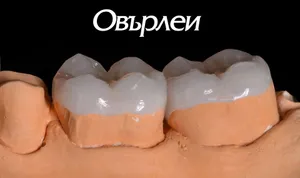
These are half-crowns, made on living teeth, which cover the entire chewing part of the tooth but do not reach the gum and do not require any healthy part of the tooth to be prepared.
Inlays and onlays
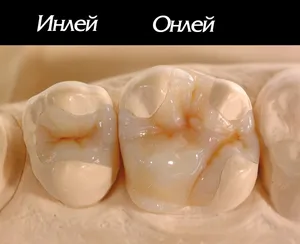
These are the smallest prosthetic restorations. They are the equivalent of fillings and are used to treat dental caries and small areas of tooth damage.
Veneers
There are two main kinds of veneers:
- classic veneers – made on the outer visible surface of the front teeth and used for aesthetic correction of the appearance of the teeth;
- occlusal veneers – made on the chewing surface of the back teeth (premolars and molars) and applicable for raising the bite and for correcting worn teeth.
Read more about classic veneers.
Dental bridges
These are complex constructions used to restore one or more missing teeth. They can be of different sizes – from 3-unit bridges (restoring one missing tooth) to 16-unit constructions restoring the teeth of a whole jaw. Kinds of dental bridges:
- conventional – the missing tooth is attached to the neighbouring teeth by full-coverage crowns;
- inlay – the missing tooth is attached to the neighbouring teeth by two inlays;
- adhesive – the missing tooth is attached to the neighbouring teeth with glass fibre and composite (read more).
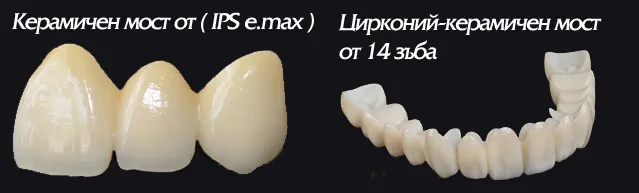
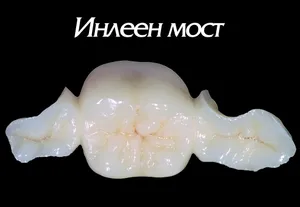
These are the main kinds of prosthetic restorations of teeth. They can be made of different materials, and this is where the main difference between them lies.
What materials are crowns and bridges made of?
According to the material, crowns, bridges and partial crowns are of two main kinds: metal-containing and metal-free. The metal-containing ones are metal crowns, veneered crowns, and metal-ceramic crowns and bridges.
Metal and veneered crowns
These are classic crowns and bridges used in the past. They are still found today but are made less and less often, because they are unaesthetic and have a grey or golden colour. Read more.
Metal-ceramic crowns and bridges
Until recently these were the most commonly used and widespread constructions for treating missing or damaged teeth. They are made of a metal base (coping), which gives strength, and a ceramic coating, which gives aesthetics and makes them hard to tell apart from natural teeth. Metal-ceramic is reasonably priced for Bulgaria. That, however, is where its advantages end.
The disadvantages of metal-ceramic crowns and bridges are:
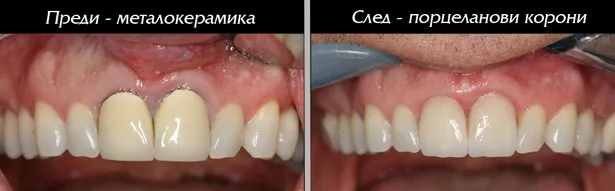
- A grey metal margin at the base of the crown, which reaches the gum or goes beneath it (in shoulderless crowns). After a time, metal ions are released from this margin, enter the gum and discolour it – a greyish discolouration of the gum under the crown results.
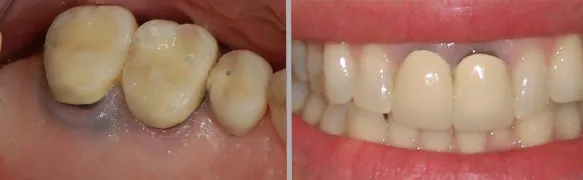
- When the gum recedes from the edge of the crown, the greyish metal margin appears, which worsens the aesthetics.
- Metal ions can also cause oral galvanism. The saliva in the oral cavity is an electrolyte, and when there are amalgam fillings, metal or metal-ceramic crowns made at different times in the mouth, an exchange of ions can occur between them, which may lead to mucosal damage and unpleasant sensations such as burning or a metallic taste in the mouth.
- In some cases allergies develop to the metal alloy used to make metal-ceramic crowns and bridges.
- Cementing is done with cements that bond only macromechanically to the crown and the tooth, which under certain circumstances can lead to the crown coming loose.
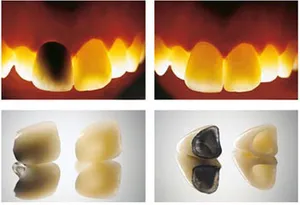
- The metal coping inside the crown does not let light through as natural teeth do, and in strong light a greyish shadow appears in the middle of the crown, which reduces its aesthetics (darkening of the crown).
- The bond strength between the ceramic and the metal coping is about 70 MPa, and in some cases chipping of the ceramic is seen.
All these disadvantages are avoided with metal-free crowns.
Zirconia crowns and bridges
With advances in technology, in recent decades a material has been sought to replace the metal coping in metal-ceramic crowns, to which their disadvantages are due. This material has to meet three conditions:
- it must be possible to make it in an extremely thin layer (0.3 mm coping thickness);
- the thin coping made in this way must not deform under chewing forces;
- it must be the colour of teeth.
The material that meets all three conditions is the mineral zirconium. In dentistry its compound, zirconium dioxide (ZrO2), is used.
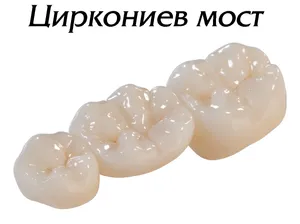
Zirconium dioxide and the crowns and bridges made from it are called, for short, zirconia in dentistry. It has many advantages and a single “disadvantage”.
Its advantages are:
- its colour is similar to the colour of natural teeth and the constructions made from it are highly aesthetic;
- it is the strongest material used in prosthetic dentistry – hardness of about 1000–1200 MPa – and is practically unbreakable even in patients who clench their teeth at night;
- it does not give the gums a grey discolouration as the metal in metal-ceramic does, does not cause allergies, does not lead to galvanism, does not retain plaque and does not change colour.
The “disadvantage” of zirconia, however, is its opacity. Natural teeth are made of two layers – enamel and dentine. The enamel is the surface layer and is largely transparent. The dentine lies beneath the enamel, is opaque and is in fact what gives teeth their colour. This configuration of enamel and dentine results in the natural colour and appearance of the tooth.
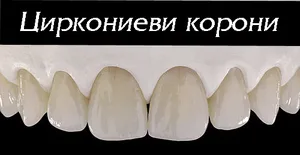
The colour of zirconia crowns and bridges matches the colour of natural teeth but is opaque, which makes the teeth look “artificial”. This effect is very popular and sought after among celebrities in the USA. Because of this “disadvantage”, zirconia crowns are used mainly on the back teeth, where they provide exceptional strength and high aesthetics.
Zirconia-ceramic crowns and bridges
The problem of opacity is solved by using zirconia as the base (coping), like the metal in metal-ceramic crowns, and covering it with ceramic on top. These are the so-called zirconia-ceramic constructions.
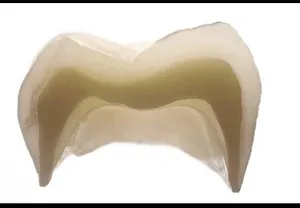
They combine the extremely high strength of the zirconia framework with the high aesthetics of the ceramic coating, which makes the artificial teeth practically indistinguishable from natural ones, while at the same time eliminating all the disadvantages of metal-ceramic that are linked to the metal in the crown and its grey colour.
The strength of the zirconia base allows large bridges of up to 16 teeth to be made – the maximum for one jaw. Zirconia-ceramic constructions are the best possible choice for prosthetic restoration in the back sections of the dentition and for missing teeth, because the zirconia framework is strong enough to withstand the load of chewing, while the ceramic coating gives perfect aesthetics.
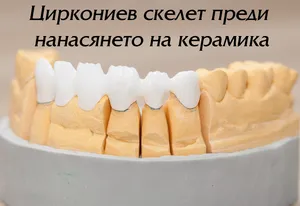
In summary, zirconia-ceramic crowns and bridges are similar to metal-ceramic ones, with the only difference that the metal coping is replaced by a zirconia one and all its disadvantages are eliminated – except one: adhesive cementing.
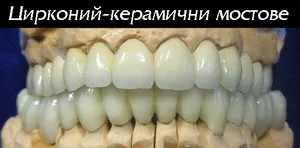
Zirconia, like metal, is attached to the tooth stump only macromechanically by the cement, as a result of which the bond strength is insufficient and these materials are suitable only for restoration with full-coverage (whole) crowns and bridges.
All-ceramic crowns (IPS e.max)
The search for a material that comes as close as possible to the qualities of natural tooth tissue and at the same time bonds firmly to the patient’s teeth led to the introduction into dentistry of lithium disilicate ceramic (porcelain) – IPS e.max. The material must have:
- sufficient strength – to withstand chewing forces;
- very high aesthetics – to look completely natural and not differ from natural teeth in colour, shade, transparency and translucency.
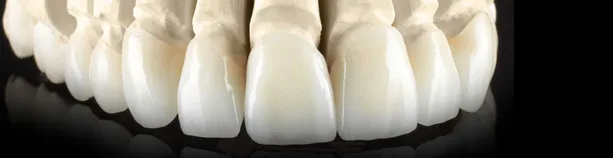
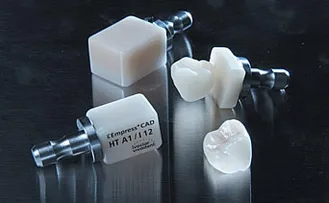
IPS e.max ceramic is by nature a pressable ceramic. It comes in two varieties: pressed into blocks, from which the crown is milled by a special CAD/CAM machine, and in standard powder form, which is mixed with a liquid, then applied in layers and processed in a special furnace.
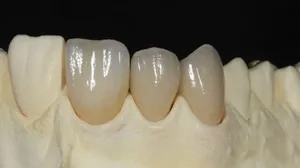
Lithium disilicate ceramic meets all the requirements for materials in prosthetic dentistry and comes as close as possible to the qualities of natural teeth.
It provides optimal aesthetics. It has different degrees of transparency, which gives the teeth a natural, “living” look. Its colour can be modified with special stains, so that even in patients with a non-standard tooth colour, restorations indistinguishable from natural teeth are achieved.
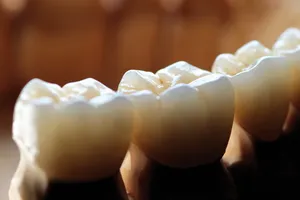
On crowns and veneers made of IPS e.max ceramic, spots and cracks specific to the teeth of the individual person can be “painted”, imitating natural teeth as closely as possible.
It has sufficient strength. Its modulus of elasticity is about 400 MPa, whereas for metal-ceramic it is about 70 MPa and for zirconia crowns about 1000 MPa. All types of single crowns can therefore be made from it, as well as three-unit bridges in the front teeth area, without needing metal or zirconia as the base of the crown.
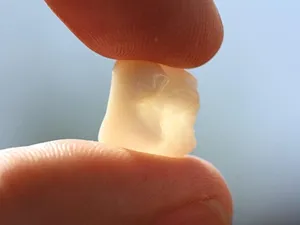
The third and most important advantage is the possibility of adhesive cementing. In adhesive cementing the inner surface of the crown and the tooth stump are treated with special substances that prepare the surfaces for bonding with the cement, and after bonding an exceptional strength of the connection is obtained: “tooth stump – cement – crown”.
Microinvasive ceramic restorations
The qualities of all-ceramic (IPS e.max) make it possible, besides standard crowns and bridges, to make microinvasive ceramic restorations of the teeth – endocrowns, inlays, onlays, overlays and veneers.
Endocrowns
They are a microinvasive alternative to standard full-coverage crowns. In teeth with the nerve removed, when only a small part of the natural tooth remains, a post has to be placed in the root canal and a tooth build-up made, which is prepared suitably and a full-coverage crown is placed on it.
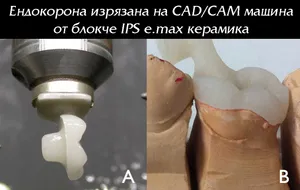
The natural tooth is thus ground from two sides at once – from the inside, in its core (to remove the nerve), and from the outside all the way round (to give it the conical shape of a tooth stump).
With endocrowns, after the root canals have been treated and filled, no post is placed and no tooth build-up is made. The remaining healthy parts of the tooth are shaped and smoothed suitably (with no undercuts), to preserve the natural tooth as much as possible. An impression is taken of the tooth shaped in this way, and the all-ceramic (IPS e.max) endocrown is made in the dental laboratory or with the help of CAD/CAM.
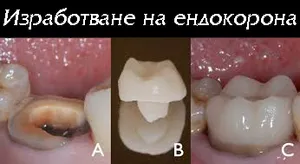
Endocrowns have a specific shape and at the base reach deep into the interior of the tooth. They are placed and bonded inside the tooth by adhesive cementing to its walls, and the space where the nerve was is used as an additional retention chamber. This is where their name comes from – they are bonded inside the pulp chamber.
Endocrowns made in this way are microinvasive – they preserve the natural tooth as much as possible, without it having to be ground down. Their aesthetics and strength are similar to those of full-coverage crowns.
Another advantage is that even after some time, if there is a problem with the tooth or the endocrown, a standard crown can be made, unlike the reverse, which is impossible.
Inlay, onlay, overlay
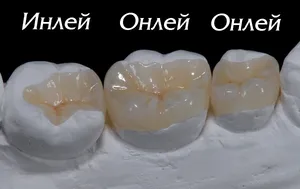
Unlike endocrowns, inlays, onlays and overlays are made on living teeth. The difference between the three is only the extent of the damage being restored with them. They are an alternative not only to crowns but also to photopolymer fillings, surpassing them in strength and aesthetics. Read more about inlays.
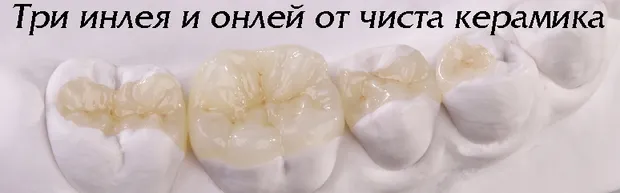
In conclusion, lithium disilicate ceramic (all-ceramic) and zirconia constructions have qualities as close as possible to those of natural teeth, practically have no serious disadvantages, and have already replaced metal-ceramic as the main material for making crowns and bridges worldwide. The crowns and bridges made from them have very high strength, optimal aesthetics and reliable bonding, and in addition they allow microinvasiveness.
How are ceramic crowns made?
Crowns and bridges of pure ceramic can be made on both vital and devitalised teeth. They are made in two ways.
In the dental laboratory
This is the standard way of making crowns in the dental laboratory, but instead of a metal coping, the coping that is made is zirconia.
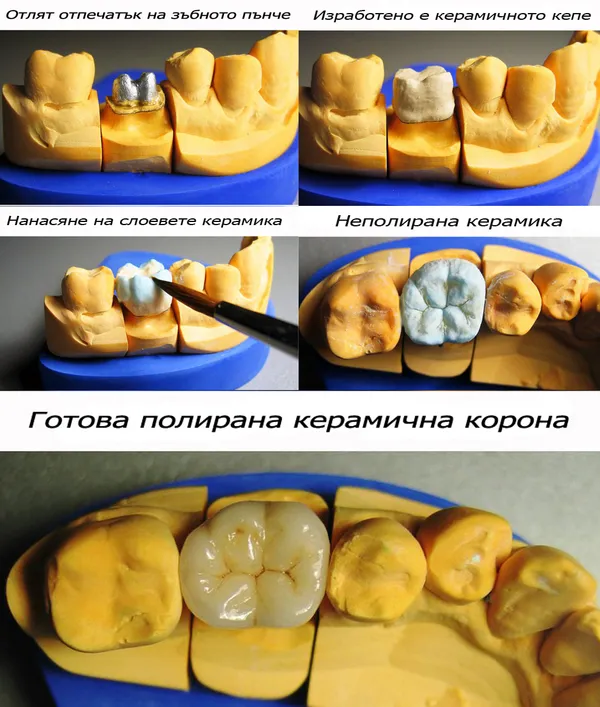
With CAD/CAM technology
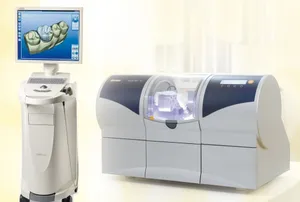
The crown is made from a special block of IPS e.max ceramic, which a special robot mills to the required shape. After the tooth is prepared, the impression is taken not with silicone but with a special 3D camera, which turns it into a 3D computer model of the tooth stump.
Then, with the help of special software, the crown is modelled and milled by the robot from the chosen ceramic block. A crown milled in this way is extremely accurate.
Only a final try-in is done in the patient’s mouth, at the unpolished ceramic stage, after which the restoration is stained and polished.
How are ceramic crowns fixed in place?
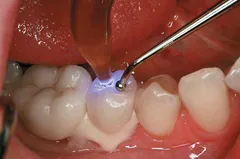
IPS e.max crowns are cemented adhesively (see above): the bond is exceptionally strong, and the possibility of the crown coming off and falling out is reduced to almost zero. They are bonded with special high-strength cements, which also come in different colours and are dual-curing (self-curing and light-curing under the light of the curing lamp).
How is the type of restoration chosen and how much does it cost?
The choice of which type of crown or bridge is best for restoring a given defect is made by the dentist and recommended to the patient, who is also offered the option of a different type of construction, but the dentist’s recommendation is the deciding factor.
The question is different when choosing the material. The main factor in Bulgaria turns out to be the financial side, since because of the higher prices of the materials and the more complex fabrication technology, the price of these constructions is higher than that of metal-ceramic crowns and bridges.
However, price should not be the deciding factor when choosing the material. These constructions stay in the mouth for over 10 years, and making them is a planned procedure that can be scheduled months ahead.
Crown prices:
- all-ceramic crown (IPS e.max): 400 €;
- zirconia crown (full-contour zirconia): 300 €;
- zirconia-ceramic crown (metal-free): 460 €;
- CEREC ceramic crown (made in one day): 400 €.
All prices are in the price list.
Choosing porcelain or zirconia crowns is the right decision and a long-lasting investment in the health and beauty of your smile.
Frequently asked questions
What is the difference between a full-coverage crown and an endocrown?
A full-coverage crown completely covers a tooth prepared down to the gum as a stump. An endocrown is a partial crown for teeth with the nerve removed: the tooth is not built up or prepared as a stump, and the endocrown is bonded adhesively inside it.
What is the advantage of zirconia-ceramic crowns and bridges?
They combine the extremely high strength of the zirconia framework with the high aesthetics of the ceramic coating, while eliminating the disadvantages of metal-ceramic that are linked to the metal in the crown and its grey colour.
What are the disadvantages of metal-ceramic crowns and bridges?
A grey metal margin at the base of the crown that can discolour the gum, possible oral galvanism and allergy to the alloy, cementing that is only macromechanical, darkening of the crown in strong light, and a bond strength of about 70 MPa between the ceramic and the coping, where the ceramic sometimes chips.
What is the largest bridge that can be made with zirconia?
The strength of the zirconia base allows large bridges of up to 16 teeth to be made – the maximum for one jaw.
How long do all-ceramic and zirconia crowns and bridges last?
These constructions stay in the mouth for over 10 years, and making them is a planned procedure that can be scheduled months ahead.
How are all-ceramic crowns made?
In two ways: in the dental laboratory, like standard crowns but with a zirconia instead of a metal coping, or with CAD/CAM technology – the crown is milled from a block of IPS e.max ceramic using a 3D model from a special camera.
Can they be placed on devitalised teeth?
Yes. Crowns and bridges of pure ceramic can be made on both vital and devitalised teeth.