

Chemopolymer fillings are tooth-coloured, but made of a material of a lower grade than photopolymer. Over time they change colour and darken, wear down faster and have to be replaced more often. Their main advantage is the lower price.
At our clinic we do not place chemopolymer fillings – it is an outdated technology. We fill teeth with photopolymer (composite).
What are chemopolymer fillings?
These are tooth-coloured fillings made of a material of a lower grade than photopolymer fillings. They are aesthetic, but after a while they change colour and darken.
What are their drawbacks?
- Faster wear. They wear down faster than other fillings, which makes more frequent replacement necessary, especially on chewing teeth.
- Inexact contours. They set within a fixed time of 2 – 3 minutes, which makes it impossible to model the contours of the biting surface perfectly. In many cases the finished filling has a flat surface that does not match the anatomical one.
- Poor polishability. Because of the large size of the material’s particles, the natural shine of the teeth cannot be achieved when polishing it.
- Free monomers. During polymerisation a certain amount of free unpolymerised monomers remains, which has an adverse effect on the pulp (nerve) of the tooth.
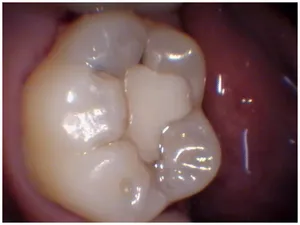
The photo shows an incorrectly modelled filling made of chemopolymerising composite.
What is their advantage?
The main and only advantage of chemopolymer fillings is their lower price.
What do they look like over time?
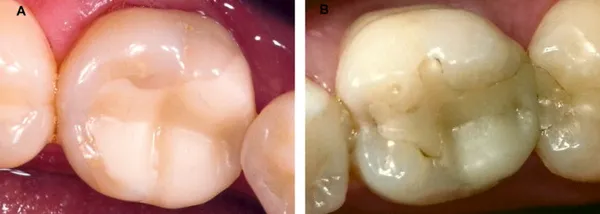
The photo shows a well-made chemopolymer filling and old, discoloured chemopolymer fillings.
Frequently asked questions
What is a chemopolymer filling?
A tooth-coloured filling made of a material of a lower grade than photopolymer fillings. It is aesthetic, but after a while it changes colour and darkens.
How long does a chemopolymer filling take to set and why is this a problem?
It sets within a fixed time of 2 – 3 minutes, which makes it impossible to model the contours of the biting surface perfectly. In many cases the finished filling has a flat surface that does not match the anatomical one.
What are the drawbacks of a chemopolymer filling?
It wears down faster than other fillings, which makes more frequent replacement necessary, especially on chewing teeth. It polishes poorly, and during polymerisation free unpolymerised monomers remain, which have an adverse effect on the pulp (nerve) of the tooth.
What is the advantage of chemopolymer fillings?
The main and only advantage is their lower price.