

Aesthetic restoration is the most modern and highest class of restoration for a tooth destroyed by caries. It rebuilds the tooth structure layer by layer – surface anatomy, shape and chewing function – and comes closest to nature.
Why does a tooth have surface anatomy?
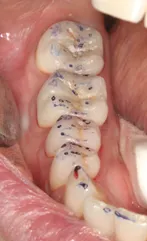
The main function of the teeth is chewing. It takes place when the upper and lower teeth touch and press against each other mechanically. The points where the teeth touch are called occlusal contacts.
The teeth touch one another at many small points, not on single large flat surfaces. And the contact points when the teeth are closed and when chewing do not coincide. All this is due to the specific surface anatomy and shape of the teeth created by nature, which are extremely important both for proper chewing and for the longevity of the teeth.
What happens with caries?
When caries develops, the upper and side surfaces of the tooth are destroyed, and with them the occlusal contacts disappear and the tooth stops taking part in chewing. At that point urgent measures are needed to treat the caries, otherwise the tooth may have to be extracted.
The treatment consists of cleaning out the damaged, discoloured and softened part of the tooth and placing a filling. The filling can be of several kinds, and the highest class is the aesthetic restoration, which fully restores the specific surface anatomy, shape and structure of the teeth.
How is it different from an ordinary filling?
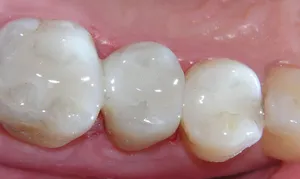
Standard fillings for treating caries are made of amalgam, chemopolymer or photopolymer — their types and differences are described in Treatment of caries. The most commonly made today are photopolymer fillings: the material is hardened with a special blue light, so the dentist has enough time to give the tooth the right shape and surface anatomy.
With all standard fillings, however, there is a single material and its mechanical properties are the same throughout the filling, which does not correspond to the anatomical structure of the tooth. This is where aesthetic restorations come in.
What is an aesthetic restoration?
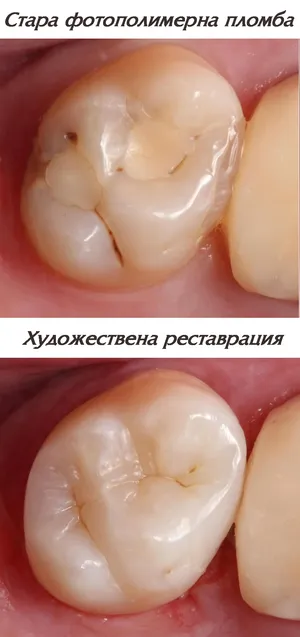
Aesthetic restorations of front and back teeth are the most modern and highest class of restorations. They are fundamentally different from ordinary photopolymer fillings, which simply fill the defect in the tooth with a homogeneous material with uniform mechanical properties.
An aesthetic restoration is the layer-by-layer rebuilding of the tooth structure destroyed by caries, which brings us as close as possible to nature and its perfection.
What are teeth made of?
As is well known, teeth are made up of 2 main layers – dentine and enamel. They have different mechanical and visual characteristics.
- Dentine is a layer about 2 – 3 mm thick that makes up the inside of the tooth. It is less hard and more elastic than enamel, thanks to its larger amount of organic component. Its colour determines the colour of the tooth.
- Enamel is a layer about 1 to 1.5 mm thick in the different areas of the tooth and covers the dentine on all sides. It is harder, owing to its higher mineral content. It is also a highly transparent layer – the colour of the dentine shows through it, which gives teeth their characteristic appearance.
Built by nature in this way, teeth are the perfect tool for chewing food. We should not forget their other function either – the smile, which gives a person beauty and radiance.
What materials are used?
Special materials are needed for this type of restoration. They are again light-cured, but they differ from classic photopolymers in composition, mechanical and optical properties. 3 kinds of materials are used – dentine masses, enamel masses and stains.
- Dentine masses are applied to the inside of the tooth and restore the dentine layer lost to caries. They have the modulus of elasticity, density and colour of natural dentine and create an ideal base for applying the next layer (the enamel masses), which replaces the enamel of the tooth.
- Enamel masses are placed on the surface of the tooth in the areas of lost enamel. They differ from dentine masses in being more transparent (translucent) and harder. Their hardness is similar to that of natural enamel, so they wear evenly in relation to the other teeth.
- Stains are applied to the surface of the restoration and give it a unique and distinctive look, the aim being for the aesthetic restoration to become indistinguishable from the natural teeth next to it.
How long does it take and why is a rubber dam needed?
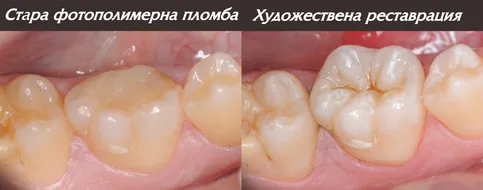
This type of restoration also differs from standard fillings in the time it takes to make – between 1 and 2 hours, compared with 30 to 40 minutes for ordinary ones.
This calls for the use of a rubber dam – a special latex sheet that protects the tooth being worked on from saliva. This way the dentist can work calmly and, with the help of special instruments, restore the micro-anatomy of the teeth and the correct occlusal contacts.
This ensures the best possible chewing, even loading of the restored tooth and the longest period of trouble-free function. Besides longevity, the other specific feature of aesthetic restorations is their beauty, especially in the area of the front teeth.
Frequently asked questions
What is an aesthetic restoration?
It is the layer-by-layer rebuilding of the tooth structure destroyed by caries using dentine masses, enamel masses and stains, which restores the surface anatomy, shape and occlusal contacts.
How does it differ from an ordinary photopolymer filling?
An ordinary filling fills the defect with a homogeneous material with uniform mechanical properties, while an aesthetic restoration rebuilds the tooth layer by layer – dentine, enamel and stains.
How long does an aesthetic restoration take?
Between 1 and 2 hours, compared with 30 to 40 minutes for ordinary fillings.
Why is a rubber dam used?
A rubber dam is a special latex sheet that protects the tooth being worked on from saliva. This lets the dentist work calmly and restore the micro-anatomy of the tooth and the correct occlusal contacts.
What are occlusal contacts?
They are the points where the upper and lower teeth touch. The teeth touch at many small points, not on flat surfaces, and this matters both for chewing and for the longevity of the teeth.