
Gum grafting covers the exposed tooth root in gingival recession. At Ralev Dental Clinic we use the tunnel technique with a gum substitute – microinvasive and bloodless, after which the patient is fit for work almost immediately. Where it cannot be performed, a classic periodontal operation is carried out.
Why is gum grafting needed?
The essence of the problem is the lack of enough soft tissue (gum) to cover the exposed part of the tooth root. Once it has receded, the gum no longer has enough volume to cover the whole surface of the root, and the human body cannot regenerate it on its own. The only possible treatment is to add tissue from another site.
Modern dentistry allows us to use either the patient’s own gum or a special gum substitute.
What is the tunnel technique?
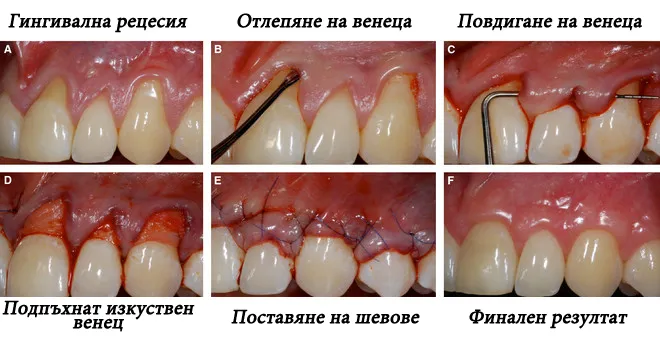
This is the most comfortable way for the patient to deal with gingival recession – a bloodless microplastic surgery:
- Using special micro-instruments, the gum around the area of recession is gently lifted a few millimetres away from the surface of the roots and teeth.
- The regenerative material is slipped under the lifted gum.
- Several stitches are placed to keep it from shifting.
Either the patient’s own gum or a gum substitute can be used. We prefer a substitute, because this way the patient’s discomfort is minimal and the procedure takes less time. With this technique the patient is fully fit for work and keeps their normal rhythm and way of life almost immediately after the correction.
What are the other treatment options?
The other options are classic periodontal operations. They are used when the tunnel technique cannot be performed.
First option: the patient’s own mucosa from the palate
The patient’s own mucosa is taken from a suitable site in the oral cavity – usually the palate – and placed over the exposed root surface. A piece of mucosa of about 1.5 cm2 can be taken from there.
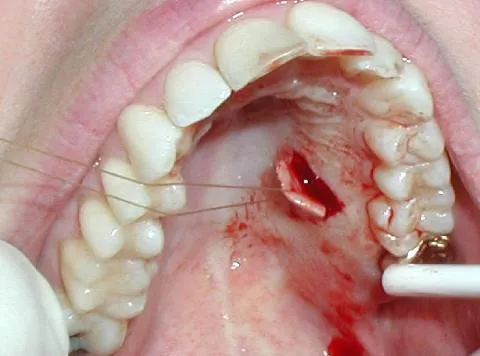
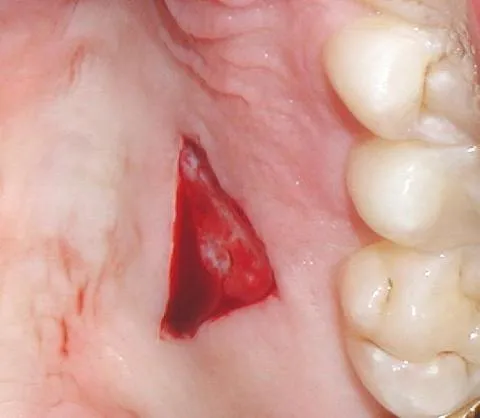
Taking a graft from the palate and the wound left at the donor site.
Advantages:
- the transplanted tissue comes from the patient and there is no rejection reaction;
- the cost of the operation is lower, because the patient’s own tissue is used and an artificial graft does not need to be purchased.
Disadvantages:
- taking the graft requires a second operation, which lengthens the working time, and the healing period is also longer;
- the site from which the graft is taken (the palate) remains an open wound and heals by secondary intention, which causes the patient discomfort for several days.
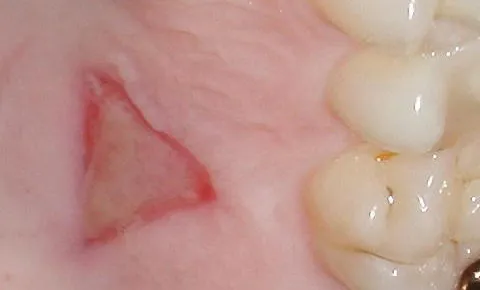
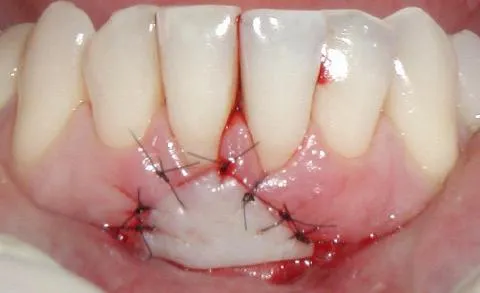
Healing of the donor site and the sutured graft covering the recession.
Second option: a biological matrix
A natural biological matrix is used, prepared in a special way (shaping and drying) to reduce the likelihood of rejection to a minimum.
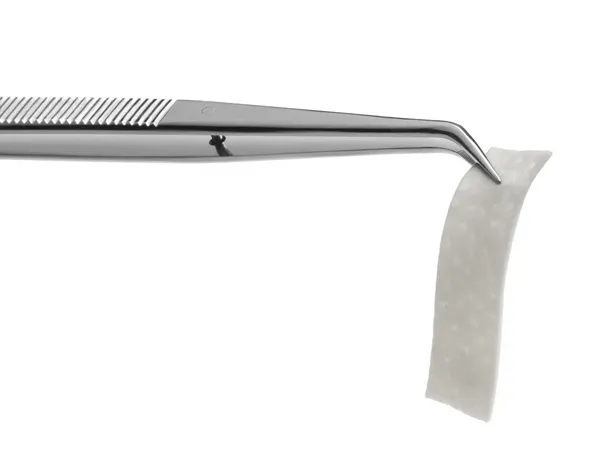
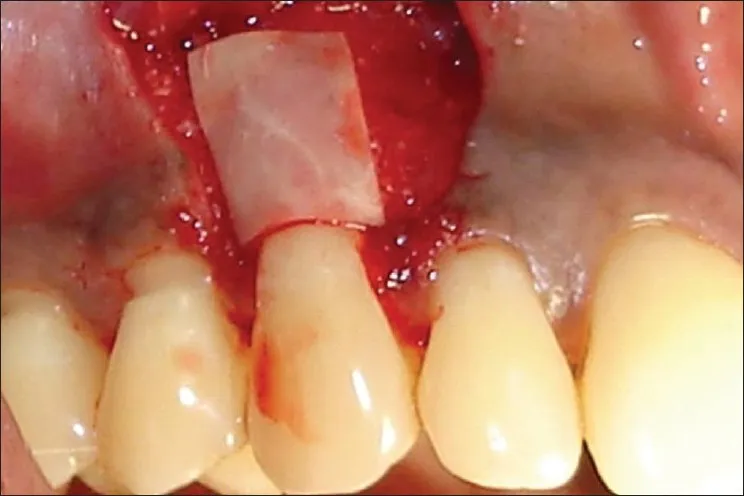
The biological matrix, prepared and in place.
The material (a dermal matrix) is placed and sutured directly over the exposed surface, and serves as a scaffold along which new tissue (gum) forms.
Advantages:
- no second operation is needed;
- the healing period is shorter and it is better tolerated;
- the operation itself takes half the time.
Disadvantages:
- the procedure is more expensive because of the high price of regenerative materials;
- a minor disadvantage is the minimal risk of rejection of the grafted material.
What does the result look like?
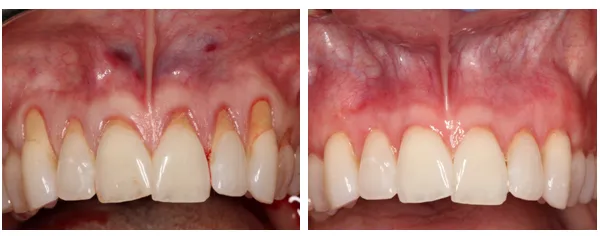
Before and after successful treatment of gingival recessions.
Frequently asked questions
What is the tunnel technique?
A bloodless microplastic surgery in which the gum around the recession is gently lifted, the regenerative material is slipped under it and several stitches are placed to keep it from shifting.
When can the patient return to their normal rhythm?
With the tunnel technique the patient is fully fit for work and keeps their normal rhythm and way of life almost immediately after the correction.
What tissue is used for the graft?
Either the patient’s own gum or a gum substitute can be used. At the clinic we prefer a substitute, because the discomfort is minimal and the procedure takes less time.
When are the classic operations used?
When the tunnel technique cannot be performed. There are two options: the patient’s own mucosa from the palate, or a natural biological matrix.
How much does gum grafting cost?
The price is determined only on site after a clinical and X-ray examination – according to the complexity, the quantity of materials required and the individual features of the surgical technique.