

Dental implants are recommended for one, several or all missing teeth – the solution closest to the natural state, without cutting down healthy teeth. Here we explain when we recommend them, how long they last, whether they are rejected, what guarantee there is and what the price depends on. Treatment from the start to the permanent crown usually takes between 4 and 8 months, and with standard implantation (the implant is placed 6 months after the tooth is extracted) about 1 year.
When will we recommend dental implants?
There are several typical scenarios for implant treatment among the majority of patients.
1 tooth is missing
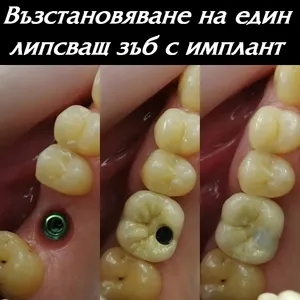
In most cases it is possible to make a bridge, but its drawbacks are that the 2 neighbouring teeth, or sometimes 3 – 4 teeth, have to be cut down, and they take on the additional chewing load of the missing tooth. There is also the problem of being unable to clean under the bridge with dental floss.
For patients who are missing a last tooth, a bridge is impossible because there is no rear support. In these two cases the most appropriate approach, and the closest to the natural state, can be achieved with a single implant.
The procedure, although it is a surgical one, is extremely quick – about an hour in the clinic at most, and many patients feel no pain at all after the implant is placed. The main advantage is that the neighbouring teeth are not cut down, are not loaded further, and conditions are created for proper cleaning – floss can be passed between the teeth and the implant.
2 teeth are missing
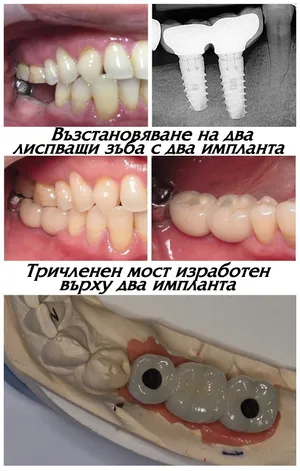
With two missing teeth next to each other, a bridge is even less favourable because more healthy teeth have to be involved. These cases are solved with implants – two implants and two crowns.
When the two missing teeth are the last in the row, the alternative to implants is a denture. Patients avoid it because of the feeling of a foreign body in the mouth and because it is removable.
3 teeth are missing
With three missing teeth next to each other, we can again place 2 implants, which are enough for a three-unit bridge. In some cases – with very soft bone in the back of the upper jaw and implants placed in the sinus – it is more favourable to use 3 implants.
All the teeth in the jaw are missing
When all the teeth in the jaw are missing, we can solve the clinical case in 2 main ways – with a bridge fixed on implants (the so-called Toronto bridge) or with a denture fixed on implants.
Bridge on implants: All on Four and All on Six
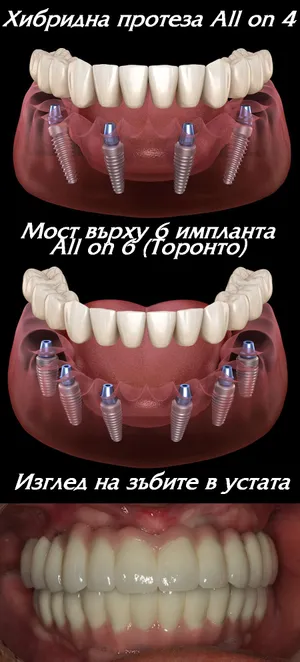
For a bridge on implants, Paulo Maló’s All on Four concept is extremely popular. It uses 4 implants placed in the jaw, on which a fixed bridge (hybrid denture) of 12 teeth is made.
In Bulgaria this concept is understood as economical, because of the small number of implants placed. In fact, its point is to allow fixed implant treatment in patients with extremely little available bone. This is why the rear 2 implants are placed at an angle of 45 degrees to the chewing plane – this is dictated by the anatomical features of the jaws.
When there are indications for All on Four, we use it. But when there is enough available bone in the rear regions of the jaw, we always prefer All on Six – 6 implants in the lower jaw at even distances from one another and 6 or even 8 implants in the upper jaw, again evenly distributed. The reason is the difference in bone hardness between the upper and lower jaw. In the softer upper jaw it is desirable to have more supports, so that the load is distributed evenly and the risk of overloading the implants and of their failure is reduced to a minimum.
This is why we are not especially fond of a fixed structure on only 4 implants in a jaw. The structures that result are at the limit of what the implants and the bone can bear, which can lead to a noticeably shorter lifespan of the treatment result.
Removable denture on 4 implants
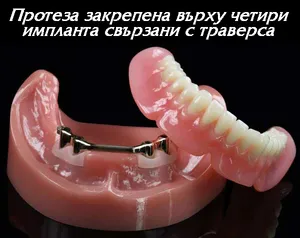
When we manage to find bone for 4 implants in the jaw, we usually prefer to restore with a removable denture fixed on the implants. The implants are connected to one another with a special bar, called a crossbar, which stabilises them, and the denture is attached to it. The denture is thus held stably in the mouth without any lateral movement.
In chewing, a bridge transfers all the chewing load to the implants, while the denture transfers a significant part of it to the gum. The implants are therefore less loaded, the risk of overloading is smaller and the structure lasts longer.
Removable denture on 2 implants
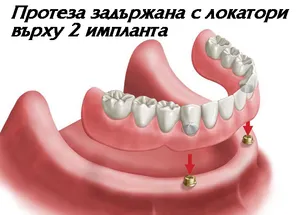
When there is available bone for only 2 implants in the jaw, restoration is again with a removable denture, but the implants are not connected with a crossbar. 2 implants could not withstand the load of the whole denture and it would loosen them.
A special type of retention elements is used – locators or special balls (ball abutments) to which the denture is attached. They have a precisely calculated retention force, so that with careless or incorrect biting they can detach from the denture and thus protect the implants from overloading and loosening. At the same time they hold the denture well in place and allow the patient to eat comfortably, even though the main chewing load is transferred through the gum.
How long do implants last?
The longevity of implants differs between patients and depends on many factors:
- the condition of the bone;
- the age of the body;
- harmful habits, such as smoking;
- the presence or development of diabetes;
- the maintenance of oral hygiene;
- the quality of the implant system itself;
- many others.
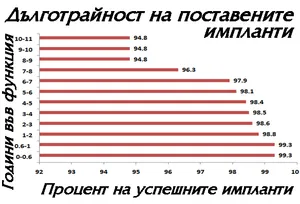
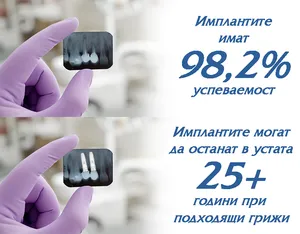
The expected time an implant stays in the mouth is usually over 10 years, but in our practice we have seen implants placed 19 years ago that are still functioning absolutely without problems. So the expected life of implants, with proper and timely maintenance, can be many years.
Are implants rejected by the body?
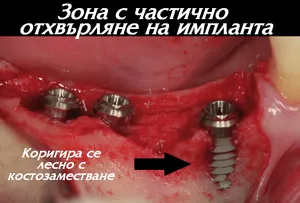
Nowadays more and more patients arrive at the clinic saying they do not want implants because they are rejected by the body. This is an entirely wrong claim, heard here and there or read on forums, and it shows a lack of knowledge of the details of implant treatment.
It is true that there is a small percentage of failure of implant treatment that can be called implant rejection. It is within 2 to 5 % of all implants placed and is usually seen in patients with very difficult conditions for implantation, bordering on the impossible, or in the presence of uncontrolled harmful habits.
Rejection is the failure of the osseointegration process to take place and shows itself in the first 4 to 6 months after the implants are placed, before they have had crowns made. It usually happens in patients with very poor bone quality, who do not follow the specific requirements after the operation, or as a result of overestimating the body’s ability to recover.
What is peri-implantitis?
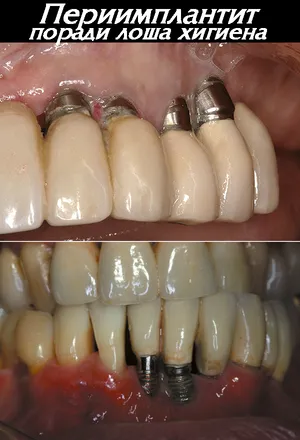
Any other problems with implant treatment that arise after this period and are associated with bone loss have nothing to do with rejection and non-acceptance of the implant by the body. They are due to the development of peri-implantitis.
This happens because of imperfections in the surgical technique or the prosthetics, wrong planning and the patient’s inability or failure to clean. The term “implant rejection” is very often used as an excuse for the shortcomings of cheap implant systems or for the lack of knowledge of the dentist placing the implants, and also to explain the development of peri-implantitis.
What guarantee is there for implants?
Patients very often ask about a guarantee for implant treatment. Here we have to distinguish between the guarantee of the implant itself as an inanimate object and the guarantee of the treatment itself.
Guarantee on the implant

With the Zimmer implant system, the company gives a lifetime guarantee on every implant it supplies that has been placed and on all the other parts connected to it. In the event of a problem with or breakage of the implant, ZIMMER Biomet replaces the old implant completely free of charge with a brand new one.
Every implant with a problem is returned, together with all the available information on its placement and function, to the head office of the company. There it undergoes thorough testing to find out what problem led to the failure of the treatment. The implant passport that every patient with a Zimmer implant receives after implantation serves as the guarantee card.
Guarantee on the treatment and success rate
Giving a guarantee for the treatment itself is a speculative and marketing act, driven not by medical but by economic principles. A person is not born with a guarantee card, and when we replace a part of them (carry out so-called transplantation) there is no way to give any guarantee of how the body will react and whether the person will follow the recommendations given for the care of the implant.
In this case we can speak of the success rate of implant treatment. However strange it may seem to some patients, it is extremely high, in the range of 95 – 98 %. By comparison, the success rate of root canal treatment of teeth is about 86 – 90 %, and of caries treatment about 90 % according to some studies.
Perfect personal oral hygiene, regular preventive check-ups for professional removal of tartar and plaque, and X-rays are of the utmost importance for the longevity of the treatment. In this way even the smallest problem starting to develop around the implant will be found in time and can be treated.
If these requirements are not followed, problems usually build up that the patient does not notice, because there are no painful symptoms. The result is fatal for the implant because of the patient’s neglect.
How much does implant treatment cost?

How much it costs to place an implant is perhaps the most frequently asked question on the internet. The answer, however, is never unambiguous and can never be given over the phone, however much some patients might wish it. It sometimes becomes clear in the course of the work itself, because the body is a living system and we have to take its reactions into account and adapt the treatment plan.
When price is the leading criterion in choosing where to be treated, the likelihood of making the wrong choice is very high. The extremes of the price range – very cheap or very expensive implant treatment – are better avoided. The most favourable is the middle price range.
This is because dental implantology, like everything in our modern world, is indirectly subject to the principles of the market economy. If we assume that every person values their work fairly, then no qualified professional in any field – even a cleaner – would work without being paid accordingly. The price of a dentist’s work is a fixed value for everyone in Bulgaria and depends on their qualifications.
The differences in the price of treatment come from several factors: the quality of the implant system, the luxury of the clinic, the time in which the treatment is completed, the presence of staff and their qualifications.
Whereas with expensive dental treatment you are paying only for the luxury and the compromise you make is financial, with cheap treatment you compromise yourself and your health and risk ending up in the category of “I have a problem with my implants”.

In Bulgaria, prices in the field of dental implantology range between about €360 and €2560 for an implant + crown, which means that the real market price of high-quality implant treatment is in the range between about €1020 and €1530 for a single implant with the crown included.
The time needed for a quality treatment – from start to finish and the placing of the permanent dental crown – is usually between 4 and 8 months. Any faster or slower treatment carries a risk of complications.
At the clinic, placing a Zimmer implant (high range) costs 900 – 1000 €, and a BTK implant (mid range) costs from 600 €. The price covers the implant placement only; the abutment and the crown are charged separately, depending on the material and type of crown. All prices are in the Price list.
Why choose our clinic?
We do not call ourselves a specialised implant clinic and we do not place implants on our patients at any cost. We are a clinic that deals with comprehensive treatment of diseases of the oral cavity.
When we look at a clinical case, we always aim to give the patient at least 2 possible prosthetic alternatives for restoring their smile. We always recommend the option that would give the best comfort and aesthetics, whether or not it involves placing implants.
When patients are pressed for time (living abroad) or do not have sufficient financial means, we try to adapt the treatment to their circumstances. Choosing a dentist is a matter of trust, and the success of the treatment is due to dedication and commitment on the part of both the dentist and the patient and, last but not least, a positive inner attitude.

Frequently asked questions
When is a single implant recommended instead of a bridge?
When 1 tooth is missing: a bridge requires the neighbouring teeth to be cut down and prevents cleaning with floss, and when the last tooth is missing a bridge cannot be made at all. A single implant does not cut down the neighbouring teeth and allows proper cleaning.
How long does an implant last?
The expected time is usually over 10 years, and in practice we have seen implants placed 19 years ago that still function without problems. It depends on the bone, age, harmful habits, diabetes, oral hygiene and the quality of the system.
Are implants rejected by the body?
A small percentage of failures – 2 to 5 % of all implants placed – can be called rejection. It is a failure of osseointegration to take place and shows itself in the first 4 to 6 months, before the crowns are made. Bone problems later on are due to peri-implantitis.
What guarantee is there for implants?
The Zimmer system gives a lifetime guarantee on every implant placed and the parts connected to it – in the event of a problem or breakage it is replaced free of charge with a new one. We do not give a guarantee for the treatment itself, but its success rate is 95 – 98 %.
How long does implant treatment take?
From the start until the permanent dental crown is placed, it usually takes between 4 and 8 months. Faster or slower treatments carry a risk of complications. With standard implantation (the implant is placed 6 months after the tooth is extracted), about 1 year passes from the extraction to the crown.