
Besides the quantity, the quality of the bone – its density and hardness – matters for implant placement. The bone of the jaws is classified into 4 density types, and type 2 is the most suitable for implants. The type of bone and the jaw determine how long we wait before loading the implants. With softer bone we use Versah burs.
What is bone density and why does it matter?
Another factor in implant treatment, no less important than the dimensions of the available bone, is its quality – its density and strength. The bone of the human jaws is classified into 4 different density types.
What are the bone density types?
Type 1 – the hardest and densest bone
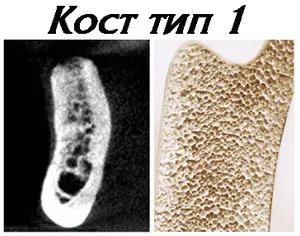
It can be compared with the hardness of oak. Patients with this type of bone have the best implant stability, but it is not the best bone for implant placement. Bone that is too hard and dense does not have a particularly good blood supply. The blood supply is needed so that osseointegration of the implant can proceed properly and new bone can form around it. In such patients osseointegration takes place after about 5 months – compared with patients with type 2 bone.
Type 2 – the preferred bone
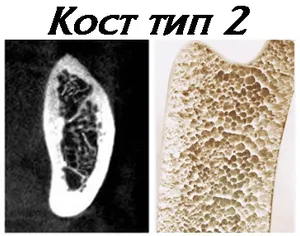
In hardness this type of bone can be compared with pine wood. It has a better blood supply combined with relatively hard bone, which makes conditions for implant placement favourable. Implants in it have good primary stability and a good blood supply and can be loaded after 4 months.
This is the preferred hardness and density of bone for implant placement. With it the results are best and most predictable, and the success rate is highest.
Type 3 – bone like cork
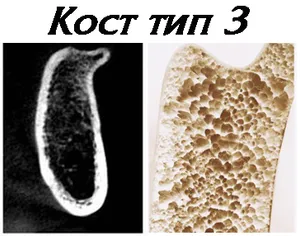
Its hardness is that of cork. The bone is softer than type 2, the blood supply is very good, but at least 6 months must be allowed for osseointegration before the implants are loaded. This is due to the lower primary stability of implants placed in this kind of bone.
If Versah burs are used, or if additional time is allowed after implant placement, the quality of the bone improves significantly and the success of implant placement is similar to that in type 2 bone.
Type 4 – the softest bone
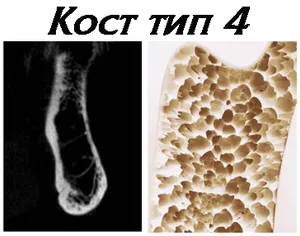
This is the softest bone – it can be compared with polystyrene foam. It is not particularly favourable for implant placement because of the low primary stability of the implants. With it, at least 8 months must be allowed for osseointegration.
It is advisable to place additional implants so that the chewing load is distributed evenly over the bone. Gradual loading of implants placed in such bone leads to an improvement in its strength. Type 4 bone used to be a challenge for implant treatment, but now, with the help of Versah burs, such cases are easily solved.
What are Versah burs?
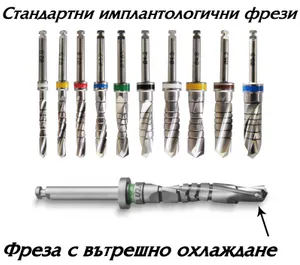
Burs are the instruments used to drill the bone so that the implant can be placed. The standard burs from the surgical sets resemble a wood drill bit. They are extremely sharp and have a special design that ensures effective removal of bone chips and also reduces the heat produced when drilling the bone.
In high-end implant systems, such as Zimmer, the standard burs have special internal cooling as well as the external. The whole bur is hollow at its core, and at its tip there is an opening through which chilled saline solution passes and directly cools both the tip of the bur and the bone in depth. This is extremely important for the success of treatment, because overheating of the bone is one of the main causes of implant failure.
For patients with hard bone, this type of bur is sufficient for safe and predictable implant treatment. This is not so for patients with soft bone, or bone that is insufficient in quantity.
How do Versah Densah burs work?
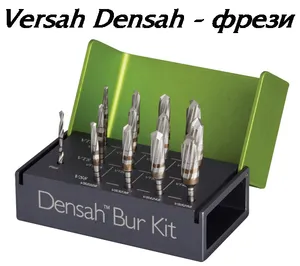
It is precisely with soft bone that the revolutionary Versah Densah burs are most useful. They are a special kind of bur that does not cut the bone but spreads, condenses and displaces it – this is due to their innovative design. Unlike all other burs, they rotate counter-clockwise.
They are used with special movements which, instead of cutting the bone, lead to its compaction. This dramatically improves its quality and makes implant placement possible and predictable in areas that in the past were best avoided because of the loose bone and the low primary stability of implants placed there.
Versah burs for thin bone and sinus lift
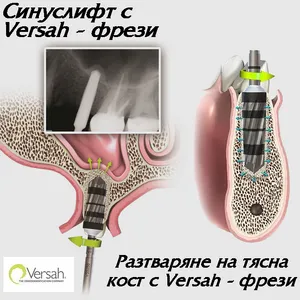
Versah burs are also extremely useful in patients with thin bone. Thanks to their ability to bend and displace it, implants of a favourable thickness can be placed by simply widening the thin area – without losing bone, as used to happen when there were only standard burs.
Another exceptional advantage of Versah is for patients who need a sinus lift (placing bone graft material in the sinuses). In the past the sinus was entered with special instruments called osteotomes, which break and lift the lower bony wall of the sinus, and bone graft material was placed in the opened space. With Versah burs, thanks to their ability to displace the bone, breaking the floor of the sinus is avoided and it is lifted without needing to enter the sinus and without adding bone graft material.
How do the upper and lower jaw differ?
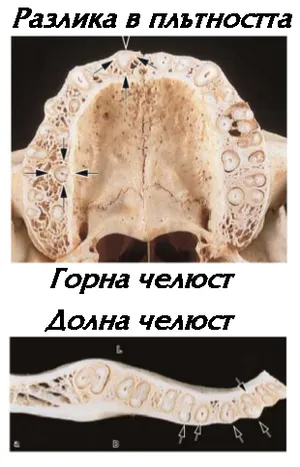
The bone of the upper and lower jaw differs in composition and strength. The upper jaw is fixed immovably to the skull and is built mainly of soft cancellous bone. The lower jaw is attached to the skull in a movable way and moves, is loaded and twists when chewing. For that reason it has to withstand different loads and is built of much more hard compact bone and only a little soft cancellous bone.
This is why implant treatment in the upper and lower jaw differs:
- Number of implants. To replace all the teeth with a bridge construction, a minimum of 4 implants can be placed in the lower jaw, while the same treatment in the upper jaw requires a minimum of 6.
- Time for integration and loading. In the upper jaw it is 6 months, and in the lower 4. This is determined by the composition of the softer bone of the upper jaw.
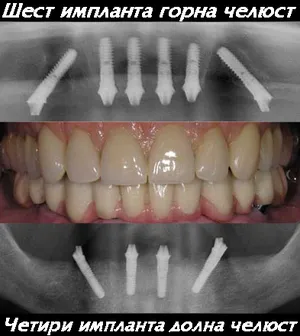
Keeping to these timeframes and the number of implants is of the utmost importance for the success of the implant treatment.
Why should implant treatment not be rushed?
A person is a biological object, and knowing the biological features of the body is important in order to understand that rushing implant treatment and shortening timeframes without justification can lead to treatment failure. Messages of the kind “implant treatment of the whole mouth in just one or 3 days” should be viewed with a degree of scepticism. In some clinical cases it may work, but the likelihood of problems is much greater.
Frequently asked questions
How many bone density types are there?
The bone of the human jaws is classified into 4 different density types – from type 1, the hardest and densest, to type 4, the softest.
Which bone is the most suitable for implants?
Type 2 – in hardness like pine wood. It has a better blood supply combined with relatively hard bone, the results are best and most predictable, and the success rate is highest.
How long do we wait before loading the implants, depending on the bone type?
With type 1, osseointegration takes place after about 5 months; with type 2 the implants can be loaded after 4 months; with type 3 at least 6 months must be allowed; and with type 4 at least 8 months.
What are Versah burs?
A special kind of bur that does not cut the bone but spreads, condenses and displaces it, rotating counter-clockwise. They improve the quality of the bone and make implant placement predictable in soft bone, and in a sinus lift they allow the floor of the sinus to be lifted without entering the sinus and without bone graft material.
How does implant placement differ between the upper and lower jaw?
The upper jaw is built mainly of soft cancellous bone. In the lower jaw a minimum of 4 implants can be placed for a bridge construction replacing all the teeth, and in the upper a minimum of 6. The wait is 4 months in the lower jaw and 6 months in the upper.