
How much bone there is in the jaw determines how the implant will be placed. With sufficient bone volume the operation is technically easy and quick. With insufficient volume there are solutions – a sinus lift in the upper jaw, bone grafting with membranes, Versah burs for thin bone and short implants for little height. Below is what we apply and when.
How do we proceed with sufficient bone volume?
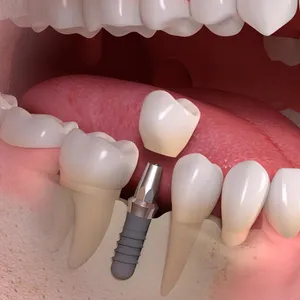
The procedure of placing an implant with sufficient bone volume is technically easy and quick. The implant is placed in the most favourable position for prosthetics – the one that matches the position of the roots of the extracted tooth and takes its anatomical place in the jaw.
In patients with such bone, the surgical wound, as a result of opening the gum, is small and the discomfort is minimal. Sometimes there is not even a need to take painkillers after the operation. If the patient follows the specific instructions after implant placement, the healing process goes smoothly and the implant is surrounded on all sides by a sufficient amount of bone.
In the second stage – prosthetics – the favourable prosthetic position of the implant allows the use of standard abutments, which also leads to a lower cost of the prosthetic work.
What do we do with sufficient bone volume but an unfavourable position of the implant?
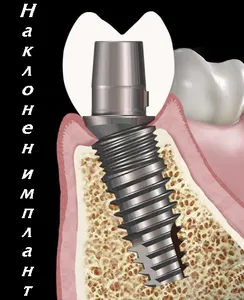
In many cases the available bone is sufficient in volume, but the position of the implant in it is not prosthetically correct because of the anatomy of the bone itself. The implant is then tilted, but this is not a problem for its function and durability.
The implant procedure proceeds in the same way, but special 3D-printed guides are used to give us the desired position. The surgical incisions, post-operative discomfort and recovery do not differ from the standard ones.
The difference is in the second phase – prosthetics. Depending on the tilt, the following are used:
- special angled abutments, which can correct angulations of 15 to 30 degrees;
- Multi Unit abutments – two-part abutments that allow screw-retained crowns to be made; they can be used with several tilted implants;
- custom abutments – made using special CAD/CAM technology and specific in shape and size to the particular tooth; they can also be made of zirconia for front teeth or for higher aesthetic requirements.
In this way, with tilted implants their direction is straightened and the tooth again takes the best prosthetic position. This ensures the most correct function and self-cleaning of the implant–tooth complex.
What do we do with insufficient bone volume in the upper jaw?
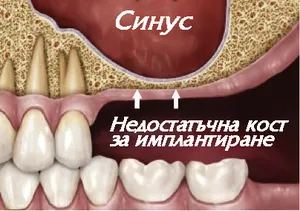
A very common finding when planning implants in the upper jaw is a lack of bone in the area of the back teeth, because of the maxillary sinus located above them. The dilemma is then whether to place implants to the side of the sinus in an unfavourable prosthetic position or to carry out bone grafting in the sinus – the so-called sinus lift.
According to the concept of prosthetically driven implantology, the best option is for the implants to be in a good prosthetic position. This requires bone grafting in the sinus, which comes in 2 main types – lateral and crestal.
Lateral sinus lift
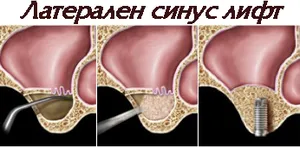
The lateral sinus lift is a separate bone grafting operation and is done when there is less than 4 mm of bone under the sinus. Artificial bone is placed in the sinus and left for about 6 months to integrate. After that, in the bone created in this way, the implants are placed in a favourable prosthetic position and the procedure goes well and easily for the patient.
Crestal sinus lift
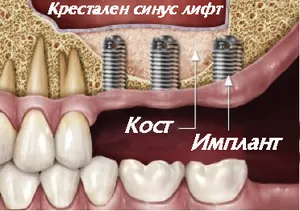
The crestal sinus lift is used more often and is much easier for the patient, because it does not feel like a separate procedure. The bone in the sinus is placed through the hole for the implant without opening the sinus itself, and the implant is placed immediately afterwards – this saves the patient 6 months of time.
One of the newest discoveries in implantology is the Versah burs, which are used in crestal sinus lifts. Their main idea is that they do not cut the bone but bend and displace it. In this way the bone is raised above the sinus by a few mm, without the need for a bone graft material or entering the sinus.
What is bone grafting (guided bone regeneration, GBR)?
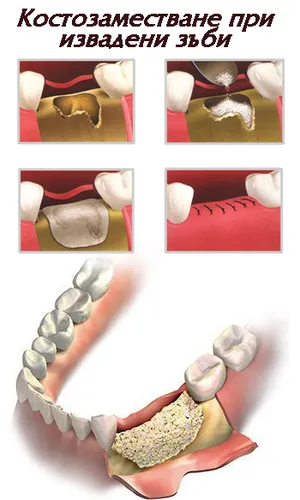
When there is an extracted tooth or insufficient bone volume in areas outside the sinus, and an implant needs to be placed, augmentation – the so-called bone grafting procedure – has to be carried out. It is a separate operation that prepares the bone for implant placement. It is usually done after the extraction of teeth with inflammatory processes (cysts, granulomas) that have led to resorption of the bone around the tooth. In this way we aim to preserve the volume of the available bone, which would otherwise be lost as a result of the inflammatory and healing process.
The guided bone regeneration procedure is done between the 20th and 25th day after the tooth extraction. This wait is necessary because the bone around the extracted tooth is inflamed, and placing a bone graft material at that moment would lead to it becoming infected and rejected. Another advantage of delayed bone regeneration is that in the meantime, within 10 – 20 days, gum tissue forms in the area of the removed tooth, which then provides enough soft tissue to cover the bone graft materials and membranes. When there is no inflammation in the jaw, bone grafting procedures can be carried out immediately.
After an augmentation procedure, a waiting period of between 4 and 6 months (depending on the type of bone graft material used) is needed before the implant is placed.
Bone grafting at the time of implant placement
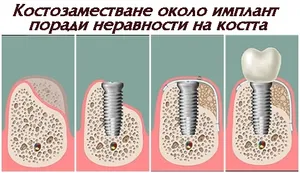
Very often bone grafting also has to be done at the time of implant placement itself. In many cases, after a tooth extraction, the bone is uneven – when the implant is placed, usually one of its sides is in the bone, while on the other side the bone falls short by a millimetre. To create the best possible conditions for successful implant treatment, it is a good idea to do local bone grafting around the implant. A bone graft material is placed before the gum is sutured, and it is covered with a membrane.
What are bone graft materials and membranes, and why do they matter?
Bone graft materials and membranes are no less important than the implant itself for the success of implant treatment.
Bone graft materials
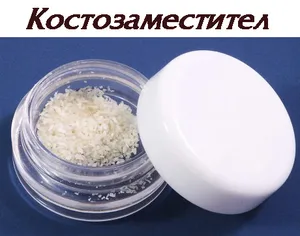
Bone graft materials are particles used to restore lost bone volume. They are a bone or synthetic material of a certain shape and size. They are non-living materials that have no organic components. They serve as a scaffold on which the body’s cells form their own bone in the place where it has already been lost. This happens through a complex process of osseointegration that takes place in the bone graft material and leads to the building of new bone.
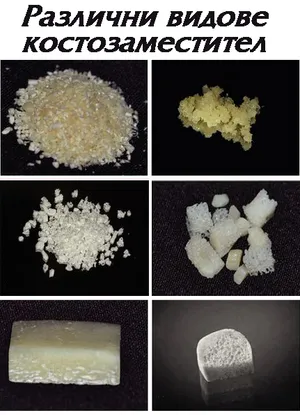
Bone graft materials come in 3 main types, each with its own advantages and disadvantages:
- Human – they are converted most completely into natural bone and are accepted by the body best and fastest. They are the most expensive, because of the difficult process of obtaining them.
- Animal – with qualities in between the other two types.
- Synthetic (artificial) – hydroxyapatite inorganic particles. They are the cheapest, but with the worst quality of the bone formed. Their only advantage is that they are not broken down by the body and the volume of the bone built is preserved to the greatest extent.
The choice depends on the particular patient and the condition of the bone, the area and the volume of the grafting. We prefer to use a high-grade human bone graft material, which gives the best results.
Membranes
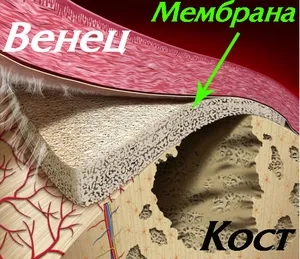
Membranes also come in several types – pericardial, collagen, titanium and combined. They are of great importance for the success of bone grafting procedures. Their main role is to separate the bone graft material from the gum. This is necessary because the formation of bone tissue takes between 4 and 6 months, while the formation of gum takes between 10 and 20 days. If the bone graft material is left under the gum, not covered with a membrane, the faster cells of the gum tissue enter it and gum forms there instead of bone, and the bone grafting is not fully successful.
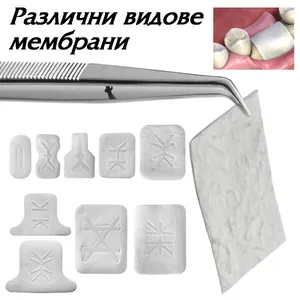
Besides protecting the bone graft material from the faster growth cells in the gum, the membranes must let through the blood and nutrients coming along the blood vessels to it. This property – both protecting and letting through – gives them a key role in providing the bone necessary for successful implant treatment.
An important point is stabilising the membrane under the gum: it must be immobile so that the process of bone formation can proceed correctly. Titanium and hybrid membranes are of this kind. Their main advantage is that they stabilise the bone graft material very well. Their drawbacks are the high price and the impaired nutrition of the gum, leading to more difficult healing. Sometimes titanium micro-pins are also used to stabilise the membranes to the bone – micro bone nails that are particularly useful in large bone grafts.
What do we do with thin bone?
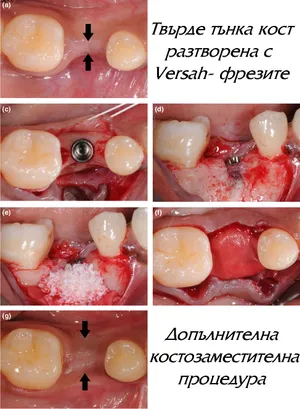
Bone thickness is also important when placing implants. There are cases where, after the tooth is extracted, the available bone has sufficient height but remains thin and sharp. This is a problem because there is not enough bone in the horizontal direction to place the desired size of implant.
In the area of the front teeth, special narrow implants can be used, but in the area of the back teeth a larger size is needed to withstand the chewing load. We then use Versah burs, with which we expand the bone enough to be able to place the required size of implant. In many cases the bone expansion is combined with a bone grafting procedure to ensure a sufficient thickness of at least 1.5 mm of the bone layer around the walls of the implant.
With the help of these burs, patients do not experience discomfort and do not need to wait 6 months for the bone graft materials to integrate, as when bone grafting is done at a separate visit before implant placement.
What do we do when the bone is not high enough?
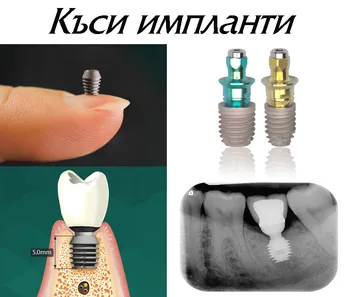
The biggest problem for implant treatment is when there is not sufficient bone height in a toothless area – these are usually difficult and neglected cases. Then there are 2 options:
- conventional prosthetics with bridge constructions or with removable dentures;
- if the patient is highly motivated and wants implant treatment – short implants. These are a specially developed new generation of implants with dimensions of 5 – 6 mm respectively (compared with 8 – 16 mm, most often 10 – 12 mm, for standard implants). They are, however, noticeably thicker than standard implants and require wide bone.
Even for cases with extremely little available bone there are ways to carry out implant treatment, but it is more difficult, longer and there is a greater likelihood of problems later.
How much does bone grafting cost?
Bone grafting costs 600 – 800 €. All prices are in the price list.
Frequently asked questions
What is a sinus lift and when is it needed?
Bone grafting in the sinus when there is a lack of bone in the area of the back teeth in the upper jaw. The lateral one is a separate operation with less than 4 mm of bone under the sinus – the implant is placed after about 6 months. The crestal one is done through the hole for the implant and the implant is placed immediately, which saves 6 months.
How long do we wait after bone grafting before placing an implant?
Between 4 and 6 months, depending on the type of bone graft material used.
Why is bone grafting after a tooth extraction done between the 20th and 25th day?
The bone around the extracted tooth is inflamed, and a bone graft material at that moment would become infected and be rejected. Meanwhile, within 10 – 20 days, gum also forms, which then covers the bone graft materials and membranes.
What types of bone graft material are there?
Human, animal and synthetic. We prefer a high-grade human bone graft material, which gives the best results.
What do we do with thin or low bone?
With thin bone we use Versah burs, often together with bone grafting, so that at least 1.5 mm of bone remains around the walls of the implant. With little height, short implants of 5 – 6 mm are used, which require wide bone.