
A dental implant can be placed at different times after the tooth is extracted: standard (6 months after the extraction), early delayed (about 20 – 24 days after extraction of an infected tooth) or immediate (straight away). At the clinic we mainly use standard and early delayed implantation.
What types of implantation are there?
Implants can be placed at different times after the extraction of a tooth or teeth. There are four types: standard, delayed (early and late), immediate, and immediate with immediate loading.
What is standard implantation?
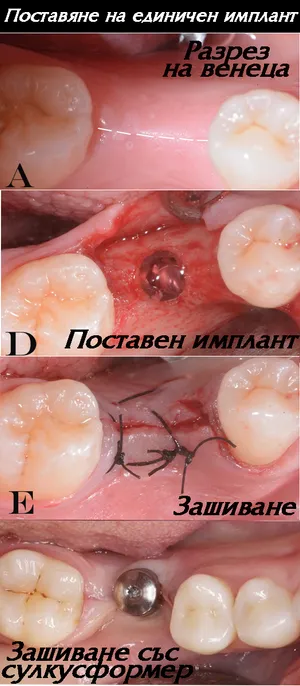
Standard implantation is the classic method. With it, the operation to place the implant takes place 6 months after the tooth is extracted.
In that time the gum and the bone where the tooth was extracted have fully healed, the conditions are as favourable as possible, the procedure goes safely and predictably, and the recovery period for the patient is easy. This is due to the very small incision in the gum – usually no more than 10 – 12 mm, and only in the area between the two missing teeth.
The day after the operation, patients in most cases tell us that having the implant placed was easier and less painful than the tooth extraction itself. The only drawback is that the time to restore the tooth – from its extraction to the permanent crown – is about 1 year, but the risk of problems and of implant failure is minimal.
Closed and open implantation
Standard implantation can be of 2 main types – closed and open:
- Closed – a cover screw is placed on the implant and the gum is sutured tightly over it, covering it completely.
- Open – a healing abutment (gingiva former, a special smooth abutment) is placed on the implant and the gum is sutured around it, but the healing abutment remains visible above the gum. This gives direct access to the implant and a second surgical procedure to uncover it is not needed.
Open implantation is suitable for patients with good bone, excellent oral hygiene and no harmful habits such as smoking.
What is delayed implantation?
The next type is delayed implantation. It can be early or late.
Early delayed implantation
It is used when an infected tooth is extracted but there is enough bone and an implant can be placed. In such cases, however, there should be no rush: the bone around the infected tooth is also infected, and about 20 – 24 days are needed to clear the infection. After that we can proceed with implantation.
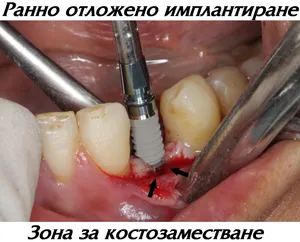
With this type of implantation it is usually necessary to add bone at the sides around the implant, which fills the bone defects left by the extraction. The gum has had time to heal, and this gives good conditions to close the surgical wound. In this way the implantation is successful and the patient’s comfort in the post-operative period is similar to that of standard implantation.
A drawback of the method is that the procedure is slightly more expensive, because bone graft materials have to be used. In return, the treatment takes about half the time needed for the standard method.
Late delayed implantation
It is used for larger infections in the jaws, but it is close to the standard method.
What is immediate implantation?
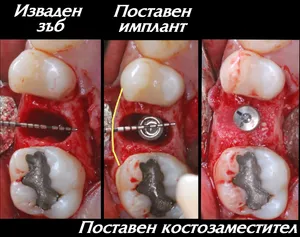
The third type is immediate implantation. It is used mainly for broken teeth or roots left in the bone to which patients react straight away. In this case there is no infection in the bone and it is possible to place the implant immediately.
After the tooth is extracted, the implant is placed in the socket left in the bone by the root of the tooth. An important condition is that it can be stabilised and anchored to the walls or the base of the socket. The gaps around the implant are filled with bone graft material, and such material is also built up around it. A membrane is then placed to separate the bone graft material from the gum.
A particular feature of immediate implantation is that there is a shortage of gum with which to close the wound left after the extraction. This means somewhat more specialised surgical techniques have to be used to provide gum to cover the bone graft material and the membrane.
Immediate implantation is more demanding in terms of surgical technique, but if it is carried out for the right indications and the patient strictly follows the requirements for post-operative wound care, the result is excellent. The advantages are full preservation of the jawbone and a waiting period shortened by 6 months.
What is immediate implantation with immediate loading?
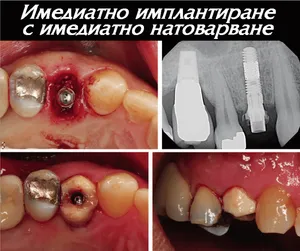
The fourth type is immediate implantation with immediate loading. It is a risky method, justified only when placing a single implant or when carrying out a full restoration with bridge structures on a minimum of 6 implants, and only in the lower jaw.
A single implant
When a single implant is placed immediately and it is possible to place the crown as well, the crown is placed right at the time of the operation and, together with the sutures, helps to close the wound. For single teeth this structure must not be used for eating in any way for at least 4 months, as this may lead to micromovements of the implant and prevent it from integrating. The method is usually used in patients with healthy bone who are extremely strict about following the post-operative instructions.
Completely toothless jaws
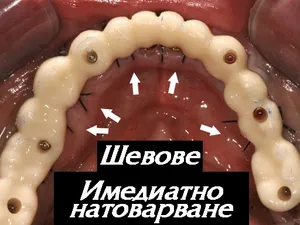
The other group of patients in whom we can afford immediate loading are patients with completely toothless jaws, in whom 6 or 8 implants are placed and a fixed bridge is screwed onto them. The implants are placed in the jaw, and on day 4 – 7 after the operation, when the swelling of the tissues has already gone down, they are splinted with a temporary structure.
It is important to know that even though the implants are splinted, only soft food should be eaten for the next 3 – 4 months. Attempts to chew hard foods can cause micromovements, which would lead to failure of the implants.
The advantage of the method is that the patient has their teeth fitted within a week of implantation. But it depends greatly on the patient’s own care of their teeth and on exact compliance with the instructions after implantation. The slightest neglect on the part of the patient causes problems.
Which types of implantation do we use at the clinic?
We mainly use standard and early delayed implantation, and sometimes, when the conditions are suitable and the patients cooperative, immediate implantation as well.
We avoid immediate loading, except in cases of full rehabilitation of the lower jaw with a minimum of 6 implants. In cases with 4 implants we prefer to load after the osseointegration process is complete. This avoids taking unnecessary risks and patients enjoy trouble-free implants.
How much does implantation cost?
Placing a Zimmer implant costs 900 – 1000 €, and placing a BTK implant costs from 600 €. The price covers the implant placement only; the abutment and the crown are charged separately, depending on the material and type of crown. All prices are in the Price list.
Frequently asked questions
When is an implant placed after a tooth is extracted?
It depends on the type of implantation: standard – 6 months after the extraction; early delayed – about 20 – 24 days after extraction of an infected tooth; immediate – straight away, in the socket left by the extracted root.
Which types of implantation do you use most often?
Mainly standard and early delayed implantation. Sometimes, when the conditions are suitable and the patients cooperative, immediate implantation as well. We avoid immediate loading, except in full rehabilitation of the lower jaw with a minimum of 6 implants.
What is the difference between closed and open implantation?
With closed implantation a cover screw is placed on the implant and the gum is sutured tightly over it. With open implantation a healing abutment is placed and remains visible above the gum, so a second surgical procedure to uncover the implant is not needed.
What is the advantage of immediate implantation?
Full preservation of the jawbone and a waiting period shortened by 6 months. It is used mainly for broken teeth or roots left in the bone, where there is no infection in the bone.
Can I chew straight away after an implant with immediate loading?
No. For a single tooth the structure must not be used for eating for at least 4 months, and in full restoration only soft food should be eaten for the next 3 – 4 months, to avoid micromovements that would lead to failure of the implants.