
Deciding whether to use implants is the first step towards successful implant treatment. We make it using the concept of prosthetically driven implantology: first we determine where the tooth should sit, and accordingly where in the bone the implant should go. Sometimes the best choice is conventional prosthetics with bridges or dentures.
What is prosthetically driven implantology?
Nowadays implant treatment, also called the placement of dental implants, is becoming more and more common, and more and more dentists offer it as a solution to the problem. This leads to many successful implant treatments, but also to many problems in patients with implants.
In our constant effort to improve as professionals, analysing such cases of rejection (problems with implants) allows us to find the causes of the problems and the ways to resolve them. In this way we reduce the risk of treatment failure to a minimum.
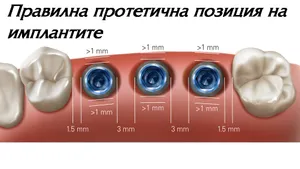
The experience gained and the analysis of successful and unsuccessful treatments have led us to the concept of prosthetically driven implantology. In it, the leading element is the complex prosthetic treatment – the replacement of the lost teeth – while the implants and their placement are one of the means needed to reach the final goal.
The main and leading element in this type of treatment is the prosthetic position of the tooth, which determines the position of the implant in the bone. In this way the closest possible reproduction of the natural state of the teeth is achieved, which is also the most balanced and therefore the most durable and trouble-free treatment.
How do we decide whether implants are needed?
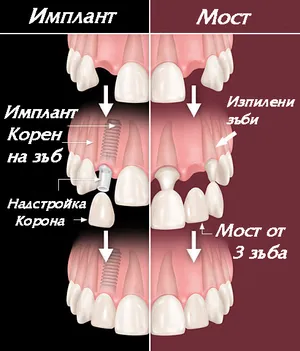
Deciding whether to use implants in the prosthetic treatment is the first step towards successful implant treatment.
When the conditions for placing implants are extremely unfavourable, implant treatment is difficult and uncertain, but not impossible. Such conditions are:
- extremely insufficient bone;
- harmful habits (smoking, poor oral hygiene);
- diseases – uncontrolled diabetes and others.
Such treatment is high-risk because of the complexity of the procedure, and there are many possibilities for problems afterwards. In such cases we prefer to carry out conventional prosthetics, but when the patient is highly motivated, nothing is impossible.
Our advice: “For the placement of implants to be successful, it must not be done at any cost. Sometimes it is best to rely on conventional prosthetics (bridges or dentures).”
What bone is needed for an implant?
The first condition for successful prosthetically driven implant treatment is to have bone of sufficient volume and good quality.
The most favourable cases are those where the bone at the site to be implanted is preserved in thickness and height. Then the implant procedure is easy and quick and the results are excellent – this is due to the correct positioning of the implant in the bone.
Such cases are usually rare. We often have to deal with a lack of a certain amount of bone.
Frequently asked questions
What is prosthetically driven implantology?
A concept in which the leading element is the complex prosthetic treatment – the replacement of lost teeth – while implants are one of the means of reaching the final goal. The prosthetic position of the tooth determines the position of the implant in the bone.
When is implant treatment difficult and uncertain?
When conditions are extremely unfavourable – extremely insufficient bone, harmful habits (smoking, poor oral hygiene) or diseases such as uncontrolled diabetes. Treatment is then difficult and uncertain, but not impossible.
Is placing an implant always the best choice?
No. For the placement of implants to be successful, it must not be done at any cost. Sometimes it is best to rely on conventional prosthetics (bridges or dentures).
Which cases are the most favourable for an implant?
Those where the bone at the site to be implanted is preserved in thickness and height. Then the procedure is easy and quick and the results are excellent. Such cases are usually rare – we often have to deal with a lack of a certain amount of bone.