
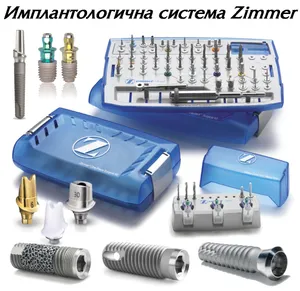
Implants come in three classes – high, mid and low range – which differ in the availability of spare components years later, the titanium alloy, the surface treatment and the instruments. At our clinic we use the high-range Zimmer and the mid-range BTK (Italy). Here we explain the differences between the Zimmer, Nobel and Straumann systems – the top 3 in the world.
What classes of implant systems are there?
There are many brands of implants on the market. They are mainly divided into 3 classes – high, mid and low:
- High range – the three best implant systems in the world: Zimmer (America), Nobel Biocare (Switzerland) and Straumann (Germany).
- Mid-range – many other companies, such as Dentsply Sirona, Bio Horizons, BTK, Bicon, Dentium and others.
- Low range – basal implants; we do not use them at our clinic.
At our clinic we use the high-range implant system Zimmer and the mid-range one – BTK (Italy). The two systems are similar to each other and, besides their similarities, they also have many differences.
Will spare parts be available years later?
The first and most important difference between implant systems is the availability of spare prosthetic components years later. This is indirectly related to the history, stability and economic situation of the manufacturer.
High-range implants are produced by companies with a very serious history in the production of dental implants. Zimmer is a company whose main activity is making implants for the whole human body. The large implant companies have huge budgets for research, development and introduction of innovations.
Another very important matter, which most patients do not realise, is the support of the different implant lines. With mid- and low-range systems, the manufacturer may go bankrupt a few years after the implants are placed, and the spare prosthetic components may disappear from the market. The patient then has a perfectly integrated implant but cannot use it, because the matching components cannot be found.
Companies such as Zimmer (founded in 1927), Straumann (1954) and Nobel (1981) have traditions and maintain the range of spare parts for years after production of the particular implant type has stopped.
What are high-range implants made of?
Another difference between the classes is the quality of the titanium alloy from which the implants are made. High-range implants are not made of pure titanium, because it has unfavourable mechanical properties and the implants would not be durable enough. This is why, when choosing a brand for our patients, we pay particular attention to the type of alloy.
The Zimmer system uses the highest class of biocompatible titanium alloy – Ti-6Al-4V (Grade 5). This is currently the strongest and most durable titanium alloy suitable for use in the human body. It is also used in orthopaedics for repairing the joints of the limbs and the spine.
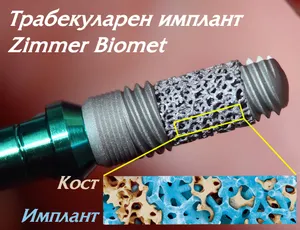
In recent years Zimmer has developed a new, unique dental implant combining two alloys – titanium Grade 5 and tantalum. This is the so-called trabecular implant – the first of its kind, with a structure similar to human bone. After it is placed, the bone grows into the body of the implant itself during osseointegration.
Why does the implant surface matter?
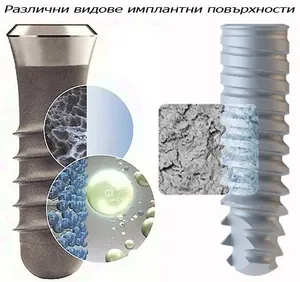
The methods of treating the implant surface are extremely important for the quality of an implant system: they determine whether bone cells will attach to the implant, that is, how osseointegration will proceed. Manufacturers keep them secret, because they are a key factor in the success of implant treatment. What surfaces there are and how the bone accepts the implant is described in detail in Osseointegration and implant types.
What makes the Zimmer system different?
Hollow burs with double cooling
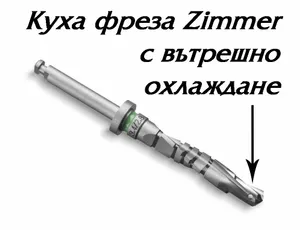
With other companies the burs for drilling the bone are solid, with external cooling. With Zimmer the bone cooling is double – both external and internal.
The burs are hollow inside and, through a special system of openings at their tip, a cooling solution is sprayed which runs through the whole bur, cooling it and flooding its tip. In this way it cools all the surrounding bone extremely effectively.
With burs that have only external cooling, the solution reaches only the surface zone of the bone and the cooling is not as effective. And human bone is extremely sensitive to overheating, which can lead to implant failure. This is one of the main differences between Zimmer and all other systems.
Friction Fit connection
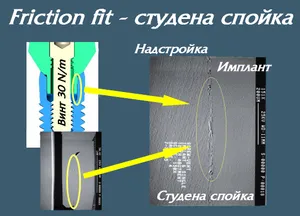
Another main advantage of Zimmer implants is the so-called Friction Fit connection – the connection between the implant and the abutment. In standard systems it is made by means of a special micro-screw. Over time it has been found that, as a result of chewing, the screw loosens and the abutment starts to unscrew from the implant and move.
The Friction Fit connection is based on a deliberately built-in difference in the angles of the walls of the hexagon of the implant and of the abutment. When the abutment is tightened with the screw at a precisely defined torque (30 N·cm), a cold weld is formed. We can safely remove the screw and the abutment cannot be taken out of the implant without a special instrument. This removes almost 100% of the likelihood of the screw unscrewing from the implant and the abutment becoming loose.
Passport and lifetime guarantee
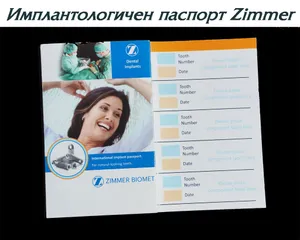
Every Zimmer implant has a passport, which contains absolutely all the information about the implant placed. If there is a problem, the patient can show the passport to the treating dentist anywhere in the world. This way the dentist learns the type of implant, compatible components can be found and timely help provided.
The passport is also a kind of warranty card. The Zimmer system is unique in that its implants have a lifetime guarantee: in the event of a problem, the defective implant is returned to the company, which provides a new implant free of charge in exchange for the old one.
How much does it cost?
Zimmer implant placement costs 900 – 1000 €. The price covers the implant placement only; the abutment and the crown are charged separately, depending on the material and type of crown. All prices are in the Price list.
Frequently asked questions
Which implant systems do you use?
The high-range system Zimmer and the mid-range one, BTK (Italy). The two systems are similar to each other and, besides their similarities, they also have many differences. We do not use low-range (basal) implants.
Which are the best implant systems in the world?
The three best are Zimmer (America), Nobel Biocare (Switzerland) and Straumann (Germany) – they make up the high range.
Why does the availability of spare prosthetic components years later matter?
With mid- and low-range systems the manufacturer may go bankrupt a few years after the implants are placed, and the spare components may disappear from the market. The patient then has a perfectly integrated implant but cannot use it. High-range companies maintain the range of spare parts for years after production has stopped.
Do Zimmer implants have a guarantee?
Yes – Zimmer implants have a lifetime guarantee. If there is a problem, the defective implant is returned to the company, which provides a new one free of charge in exchange. Every implant has a passport, which is also a kind of warranty card.