

Osseointegration is the process by which the body “accepts” the implant – bone cells attach to its surface. It takes place in several stages and is complete between the 4th and 6th month after placement, when the implant can bear chewing loads. Below are the stages and the types of implant surface and implant.
What is osseointegration?
The process of osseointegration is the so-called “acceptance” of the implant by the body. It is an extremely complex process that takes place at the cellular level in the bone in which the implant has been placed. Osseointegration is the attachment of bone cells to the surface of the implant. It takes place in several stages and is analogous to the healing of bone after a fracture.
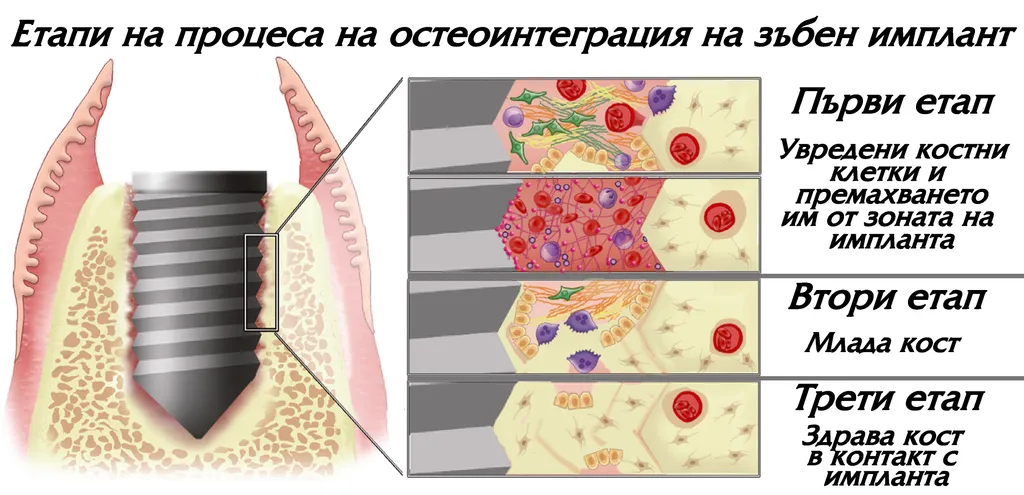
What are the stages of osseointegration?
First stage: immediately after placement
This stage begins immediately after the implant is placed. The bone cells around its surface are cut or crushed, and a repair reaction is triggered as a result of the injured blood vessels.
At this point the implant is mechanically stable in the bone, but over time the body begins to remove the damaged bone cells around its surface. This period lasts about 2 – 3 weeks and leads to a sharp decrease in the primary stability of the implant in the bone.
Second stage: formation of new tissue
It begins about 2 – 3 weeks after implant placement and lasts until about a month – a month and a half. In this stage the formation of new blood vessels, connective tissue and initial soft bone tissue begins.
Third stage: maturation of the bone
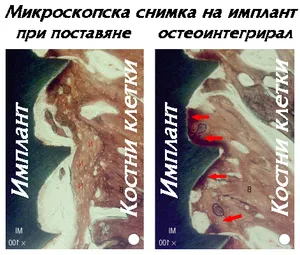
It begins about a month and a half after implant placement and lasts until the 4th – 6th month. New bone is formed, which gradually becomes stronger and stronger – the so-called maturation of the bone. When this process is complete, the implant is osseointegrated and can bear chewing loads.
Why should loading of implants not be rushed?
Knowing the biological side of osseointegration shows why it is preferable not to rush loading the implants. Even if there is good initial anchoring (primary stability) of the implant in the bone, by around the 2nd – 3rd week it is already lost and the implant may move under the action of chewing forces.
The slightest mobility of the implant in the bone before it has osseointegrated would lead to the healing process not taking place and to rejection of the implant. This, however, is not real rejection, but overestimation and ignorance of the body’s capabilities on the part of the clinician, or failure to follow the post-operative instructions on the part of the patient.
What types of implant surface are there?
Another important factor for good osseointegration is the surface of the implant – both its shape and its type.
Implant thread
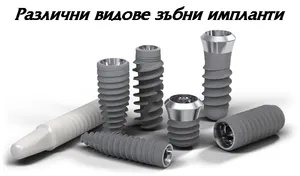
Modern implants are screw-shaped and have a thread that differs in size and character.
- Implants with a coarse thread are more aggressive to the bone. They achieve better primary stability, because the larger turns of the thread hold more firmly in the bone.
- Implants with a finer thread have lower primary stability, but are gentler, and in addition they have a stronger implant body because of its larger size.
The choice of which implant to place is made by the clinician depending on the quality of the bone.
Alloy
Another important feature besides the design of the thread is the alloy the implant is made of. There are different types of titanium alloys. The main difference between them is their quality and strength. In low and mid-range implant systems weaker and not so good titanium alloys are used, which usually leads to mechanical problems – such as fracture of the implant.
Surface treatment
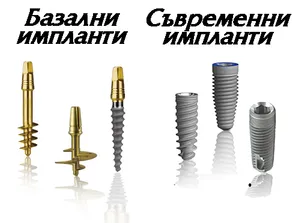
The treatment of the implant surface is of key importance for the course of osseointegration. In the past, implants had a smooth surface and large thread turns, which led to purely mechanical retention in the bone, like a wood screw. In our time, such implants are the so-called basal implants – there is no osseointegration process with them, and for this reason they are rarely used worldwide.
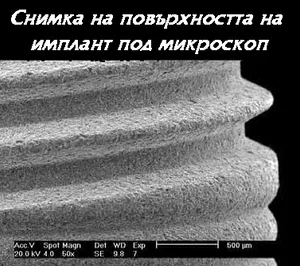
Modern implants have a roughened surface, which is made by a special technology using sandblasting and special acid etching. This leads to the formation of micro-roughness on the surface of the implant. It is important that this micro-roughness has precisely defined size and characteristics, in order to create the best possible conditions for bone cells to attach to it. Besides sandblasting and etching, some systems also apply bioactive layers onto the titanium alloy.
High-end implant systems have specific surfaces, whose characteristics are patented and ensure a more reliable and better course of osseointegration, and hence a minimal risk of implant rejection. Manufacturers keep their surface treatment methods secret, because they are a key factor in the success of treatment. How the brands differ is described in Types of implant systems.
Trabecular implants
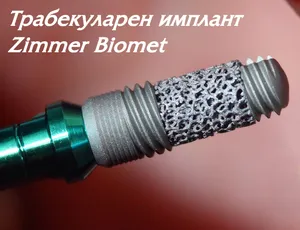
In recent years, as a new development, the company Zimmer created the so-called trabecular implants. In them there is a fundamental difference in design. Their middle part is made not of titanium but of tantalum and does not have the shape of a screw; it resembles human bone – a porous tantalum mesh, similar to foam rubber.
This revolutionary design allows bone cells to attach not only to the surface of the implant, but also to penetrate into the implant itself. This ensures full integration of the implant in the bone and a more stable implant–bone connection. Trabecular implants are particularly useful in patients whose bone has insufficiently good characteristics – soft and with large cavities.
Zirconia implants
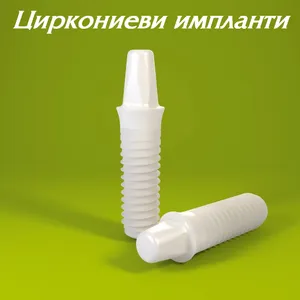
There are also so-called zirconia implants. They are, however, rarely used – mainly in patients who have a negative attitude towards titanium implants. They have many drawbacks, which make them not particularly reliable:
- the brittleness of the material – frequent fractures of such implants are observed;
- because of this they need to be made thicker, which further limits their use – only in patients with sufficient bone thickness;
- they are mostly one-piece implants and do not have the benefits of two-piece ones and their rich prosthetic possibilities.
There are also modern developments of hybrid titanium-zirconia implants, which, however, are still in the process of being tried and tested.
What types of implants are there?
Dental implants are of two main types – one-piece and two-piece.
One-piece (basal) implants
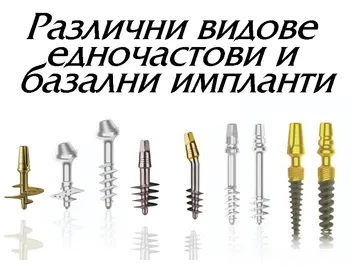
One-piece implants are the oldest generation. They include the so-called basal implants. They are a single body divided into three zones: an intra-bone part with a thread, a smooth and thin middle part (the neck), and a third, wider part, which is shaped like a tooth stump and remains above the gum after implant placement.
With these implants it is never clear exactly where the line of the soft tissues, which shrink after implant placement, will be. Once placed, the implants stay in their position, and when the gum shrinks around them, it very often turns out that the crown cannot reach it. Undercut areas form in which the neck of the implant is visible and plaque accumulates. This makes both hygiene and aesthetics difficult.
Another feature is that they are made of softer alloys so that they can be bent. This is necessary because there is no way for all the implants in the jaw to be positioned perfectly parallel – the required parallelism is achieved precisely by bending at the neck. Because of the weak alloy, their number in the jaw needs to be noticeably larger – at least 8 – 10 per jaw, so that they can withstand the chewing load. For the reasons listed, this type of implant is almost never used.
Two-piece implants
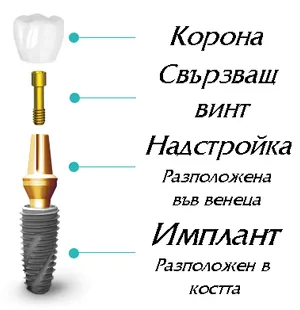
Modern implants are two-piece. They have an intra-bone part – the implant itself – and a second part called an abutment, which plays the role of the tooth stump. The two are connected with a special screw. In this way the height of the soft tissues (the gum) can be controlled and taken into account.
With them there is a very wide variety of prosthetic possibilities, and so-called screw-retained crowns can be made, which allow easy and quick removal for cleaning or adjustment.
Two-piece implants are of two main types – bone level and tissue level.
Bone-level implants
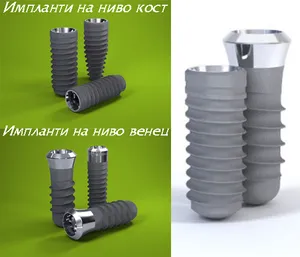
With bone-level implants the connection between the implant and the abutment is at the level of the bone and the whole implant is submerged in it. They are roughened over their entire surface and osseointegration takes place everywhere.
The prosthetic possibilities are very rich – straight, angled, aesthetic, multi-part and other abutments. This allows the best aesthetics and function to be achieved, because the implant–crown connection is located deep in the gum. On the other hand, the prosthetic constructions must be made extremely precisely so as not to create conditions for plaque accumulation and the development of an inflammatory process close to the bone and the implant.
Tissue-level implants
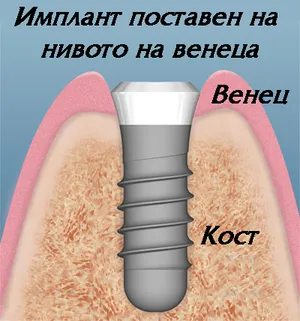
With tissue-level implants the implant–abutment connection is at the level of the gum. They are characterised by a long polished neck around which the gum adapts, while the roughened part is entirely in the bone.
- They can be used in patients with uneven bone, thus eliminating the need for bone grafting procedures.
- Because they remain at the level of the gum, a second operation to uncover the implant, as is needed with bone-level implants, is not required. This saves time, money and unpleasant sensations for the patient.
Their only drawback is the possibility that after some time the gum may recede and a small part of the polished neck may show, which would spoil the aesthetics. For this reason they are avoided in the area of the front teeth, but are a good choice for the back areas.
Short and narrow implants – when are they used?
Implants come in different sizes. As standard the medium ones are from about 3.5 mm to 5 mm in thickness and 8 to 16 mm in length (most often 10 – 12 mm), depending on the implant system. These sizes cover the bulk of clinical cases, but where there are problems with the amount of bone, specific implants can be used.
Narrow implants – eZtetic
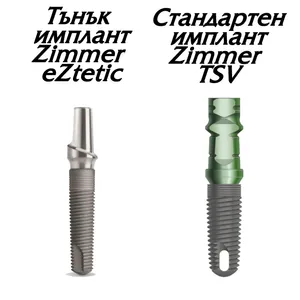
For very thin bone in the area of the front teeth, the company Zimmer has developed a special implant called eZtetic. It is only 3.1 mm thin and made of a special, stronger alloy. In this way single lower front teeth can be restored without additional bone grafting procedures even with very thin bone, which was previously impossible because of the little space available in the bone.
Short implants – Biomet 3i
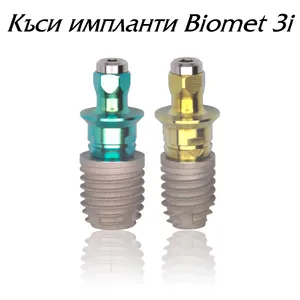
For patients who do not have sufficient bone height (less than 8 mm) there was until recently also no effective implant solution, and they were forced to use removable dentures. There is, however, a solution – the so-called short implants. These are special implants from the company Biomet 3i, a subsidiary of Zimmer. They are 5 or 6 mm in height and allow implant treatment with minimal bone height. They avoid entering the sinuses and doing the sinus lift that is required with standard implants.
A characteristic of theirs is that they are quite thick – within 5 or 6 mm in diameter – which means there needs to be sufficient bone thickness. This thickness is necessary to compensate for the implant being short. It has been proven that the area for osseointegration in short implants is similar to that in normal ones, precisely because of the difference in thickness. This makes them stable in function and, in durability, comparable to standard implants.
This innovation allows implant treatment in patients with extremely insufficient bone, in whom in the past it was not possible even to think about placing implants.
Frequently asked questions
What is osseointegration?
The so-called “acceptance” of the implant by the body – the attachment of bone cells to the surface of the implant. It takes place in several stages and is analogous to the healing of bone after a fracture.
How long does osseointegration take?
Three stages: the first lasts about 2 – 3 weeks, the second until about a month – a month and a half, and the third until the 4th – 6th month. Then the bone has matured, the implant is osseointegrated and can bear chewing loads.
Why should loading of implants not be rushed?
By around the 2nd – 3rd week the primary stability of the implant is already lost and the implant may move under the action of chewing forces. Mobility before osseointegration would lead to the healing process not taking place and to rejection of the implant.
What surface do modern implants have?
A roughened one – made by sandblasting and special acid etching, which forms micro-roughness of precisely defined size to which bone cells attach. High-end implant systems have patented surfaces.
What types of implants are there?
One-piece (basal) implants, which are almost never used, and two-piece implants – an implant and an abutment. Two-piece implants are bone-level and tissue-level.
When are short implants used?
When the bone height is less than 8 mm. Biomet 3i short implants are 5 or 6 mm in height and avoid entering the sinuses and the sinus lift, but require sufficient bone thickness.