

Grinding down teeth for crowns, bridges and veneers is not harmful and does not ruin the teeth: for devitalised teeth a crown greatly extends their life, and for vital teeth the preparation in itself does not damage them. Problems most often come from delayed treatment, incorrect planning of bridges or poor workmanship. Here we explain how and when we decide on tooth preparation.
The need for tooth preparation is one of patients’ main worries. In recent years the number of patients looking for treatment of the teeth without tooth preparation has been growing rapidly. Sometimes there are even patients who describe how their teeth were “ruined” by preparation for crowns and bridges — with this we categorically cannot agree.
Why do devitalised teeth need a crown?
Modern thinking on making dental crowns or bridges is based on the rule that a crown or overlay must be made for every devitalised tooth. This is due to three main reasons:
- The unfavourable mechanics of fillings in devitalised teeth.
- The reduced strength of the tooth structure in teeth with the nerve removed.
- The tendency to develop secondary caries.
Devitalised teeth finished with a filling or built up with a post are in no way healthy teeth. The fact that their fillings may have the correct shape, be white and look indistinguishable from the others misleads many patients into thinking things are as before and the teeth will last a long time, but this is not so.
First reason: the unfavourable mechanics of fillings
It is due to 3 specific points — the weakened tooth structure, the size of the fillings and their wedge shape.
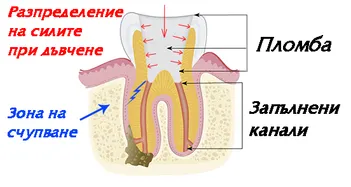
If a tooth has to be devitalised, the damage from the caries is serious and a lot of softened and damaged tissue is removed. Sometimes some healthy tissue is also removed to open access to the canals. The tooth is weakened as a result of the large amount of enamel lost. Restoring it with a filling is possible, but the filling is too large — it usually takes up about 75% of the tooth’s surface, which concentrates a large chewing force on it. In the favourable case, when the filling does not involve the side parts of the tooth, it has a wedge shape.
The combination of these 3 factors transmits the chewing forces not to the base of the tooth but to its walls. Fillings in devitalised teeth act like wedges for wood.
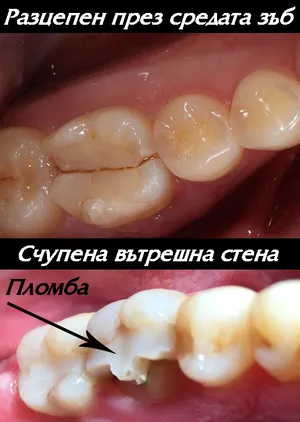
The chewing forces are vertical, while a horizontal force is applied to the thin walls of the tooth and leads to its splitting. The splitting is also favoured by the thinning of the tooth towards the root and the lack of enamel. Usually the inner or outer half breaks, almost always at a different depth below the gum. This may lead to the need to extract the tooth.
With more superficial fractures it is possible to place a post and build up the tooth, but this type of build-up has low durability and success. The most basic reason is that almost no enamel is left, and bonding of fillings and build-ups is reliable only on enamel. Dentine does not adhere to dental materials as well, because it contains far more organic substances. This leads to the need for root posts.
Post build-ups left without a crown are even weaker mechanically and the risk of fracture is even greater: the build-up transmits the chewing loads to the post and concentrates them at a point at its tip. The load concentrated in this way in the lower third of the root, where it is thinnest, leads to easy splitting of the root or — in healthy roots — to the post debonding and the build-up falling out. From here on the result is almost always extraction of the tooth.
Second reason: reduced strength of the tooth tissue
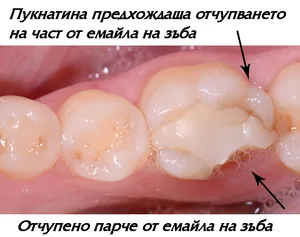
Besides the mechanical problems (leading to overloading) created by fillings and build-ups, the strength of the tooth tissue itself is also reduced (enamel and dentine). Once the nerve is removed, the teeth are also left without blood circulation, which leads to their “drying out”. They become less elastic and more brittle, like dried-out wood, and this further increases the likelihood of splitting.
Third reason: secondary caries
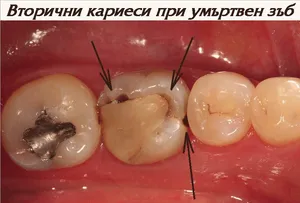
The third factor is also of primary importance for the loss of devitalised teeth without crowns — susceptibility to secondary caries. It is due to micro-leakage between the filling and the tooth tissues. When the tooth is devitalised, the filling has a large area and most often in the zones between 2 teeth it goes below the gum line, where there is no enamel and the filling bonds to dentine. Below the gum it is always moist, however, and this leads to micro-leakage and secondary caries.
It usually goes unnoticed because devitalised teeth do not hurt, and it is discovered only when the build-up falls out. At that point the tooth is almost always unrestorable and has to be extracted.
How often do patients lose teeth for these reasons?
These are the three main factors for which patients lose devitalised teeth that have not had crowns made and have only been finished with a filling or built up. In our observations more than 90% of patients who come with a complaint of a broken tooth fall into this category.
To the question “Why was this tooth left without a crown?” the answer is almost always that the reason is financial or reluctance to grind down “healthy” teeth. Such teeth, however, are not healthy at all — practice proves it with the large number of fractures and secondary caries in devitalised teeth without crowns.
How does a crown protect a devitalised tooth?
Dental crowns, despite the tooth preparation, increase the life of teeth — this is beyond doubt. They eliminate all three factors that cause problems (breakage or secondary caries) in devitalised teeth.
First factor: large cone-shaped fillings and post build-ups
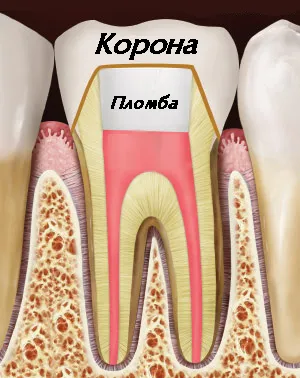
Large cone-shaped fillings or post build-ups transmit the chewing pressure horizontally to the thin walls of the tooth and the root. Standard full-coverage crowns cover the tooth completely on top and on the sides, with their margin at the gum area. In this way the crown is like a ring that grips the walls of the tooth and splints them, and does not allow them to split. It also balances the chewing forces, transmitting them evenly to the neck of the tooth, as the enamel layer does in healthy teeth. This is the mechanism by which nature created teeth, and we manage to copy it.
Second factor: reduced strength of the enamel and dentine
Full-coverage crowns replace the enamel and part of the dentine, thus protecting the parts of the tooth beneath them from direct chewing load, which would lead to pieces of varying size breaking off.
Third factor: susceptibility to secondary caries
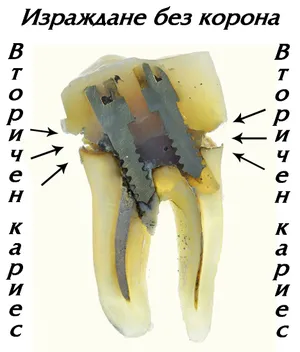
The larger the area of the filling or build-up, the greater the polymerisation shrinkage of the photopolymers. It leads to micro-gaps at the material–tooth boundary. Build-ups with a larger area also have longer margins, which creates more places for secondary caries to develop. Sub-gingival parts of the filling further increase the risk.
When crowns are placed on devitalised teeth, they seal all these margins hermetically, with special attention paid to the places where fillings are sub-gingival. There the aim of the crown is to go below the boundary between the filling and the root. After it is cemented onto the tooth stump, all the micro-leakage zones are covered by the crown and sealed and filled by the cement, so the risk of secondary caries is reduced many times over.
Why do some crowns fall off?
Some patients think tooth preparation for crowns is harmful because they have heard of crowns falling off or breaking, or have experienced it themselves. The causes of crowns falling off and the loss of the teeth beneath them are different.
Delayed fabrication
The most basic reason for crowns falling off and teeth with crowns breaking is that they are made too late.
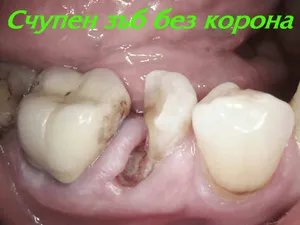
In Bulgaria making crowns is widely put off until the last moment, and crowns are made only for severely destroyed teeth that cannot be restored with fillings. Many patients have a crown made for a devitalised tooth only after it has broken, but the prognosis for durability is no longer the same. The reduced durability of crowns on seriously destroyed and neglected teeth is due to a mechanical feature — the so-called ferrule effect.
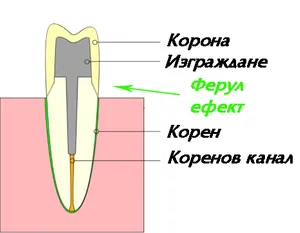
The ferrule effect is the requirement for the crown to enclose at least 1.5 mm of sound tooth tissue at its neck. It ensures that chewing forces are transmitted from the crown straight to the root of the tooth, as in healthy teeth, and protects against splitting of the root and also against secondary caries. Crowns made on teeth with a ferrule all around their walls have a very long life — sometimes even more than 40–50 years.
If the tooth is severely destroyed, it is enough for there to be no ferrule in just one small zone and for the crown not to cover the restorative material below the gum. This leads to micro-leakage under the filling/build-up and to secondary caries, which is painless and extensively involves the root, without the patient having any complaints until the crown falls off together with the build-up and the post sticking out of it. By then the tooth is unrestorable and the patient loses it. The cause of this cascade of problems is not the preparation of the tooth, but the late moment at which it was done.
Supporting teeth that are too short
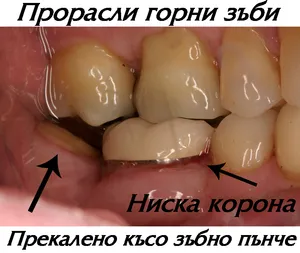
Another reason for crowns and bridges falling off is when the supporting teeth are too short. This is usually seen in patients with worn teeth or bite problems resulting from caries left untreated for a long time, where the opposing teeth have overerupted and taken up part of the space for the future crown.
Very often we meet such problems in patients who have built up their teeth with posts but have not completed the treatment with a crown. The opposing tooth overerupts, wears away the build-up material and rests on the post. If in such patients a compromise is made and the opposing healthy tooth is not shortened, the crown made is shallow and its bonding is unreliable. The problems with low tooth stumps again result from delayed treatment and the postponing of crowns.
Problems in planning bridges
A very common cause of problems with bridges is the mechanics of planning them. It is due, on the one hand, to changes in the bite — again overeruption and a change in the position and axes of the teeth as a result of not taking timely treatment.
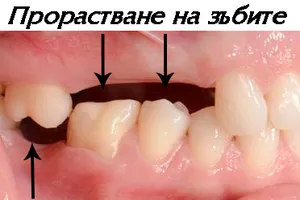
Patients widely refuse to wear braces for a period of 1 year so that the displaced teeth return to place, and insist on having the bridges made in that situation. The compromise made leads to uneven distribution of the chewing forces onto the supporting teeth and to problems — breaking or debonding of bridges, food retention and the impossibility of cleaning, and so on.
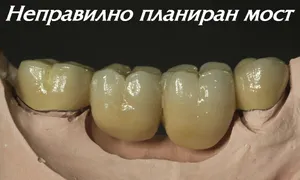
There are also problems with bridges when the rule for constructing a bridge is broken: for 1 missing tooth at least 2 supporting teeth are needed. The ratio must be 2:1 — the area of the supporting teeth must always be twice the area of the missing ones, so that they can take the increased chewing load without being overloaded.
Compromises are very often made by not including a vital tooth in the bridge construction, contrary to the rule and on the pretext of not grinding it down. The “saving” of that tooth, however, almost always leads in the long term to loss of the teeth carrying the bridge because of overloading — either the weaker supporting tooth breaks or the whole bridge loosens and falls off together with the teeth. Thus at the price of “saving” 1 tooth from preparation we lose 2 or more other teeth that would have had a much longer life if they had not been overloaded because of the compromise and incorrect planning.
Poor workmanship and the price of crowns
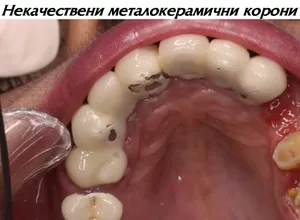
There is also poor workmanship in the dental laboratory or poor work by the dentist, which likewise leads to tooth loss. It is directly linked to the price of crowns — making quality crowns cannot be cheap. The group of patients who suffer is usually the one that chooses the highest class of crowns available to them at the lowest available price.
By making crowns we mean not only the laboratory work but also the preparation of the teeth and the taking of an accurate impression by the dentist. All this requires a certain set of knowledge and skills, specific materials and, most importantly, time. When the price of a crown is below average, this should cause concern, because it means a compromise in the quality of work and the time for the manipulations, which are of fundamental importance for the durability of the tooth and the crown. Prices are in the Price list.
What types of crowns are there and how does the material matter?
Now that it is clear that tooth preparation for crowns does not ruin the teeth, let us see how the material affects durability. The main types of crowns by material are:
- Metal — standard chromium-cobalt-nickel and gold.
- Metal-ceramic — standard and gold-ceramic.
- Zirconia — monolithic and zirconia-ceramic.
- All-ceramic crowns — lithium disilicate ceramic and feldspathic ceramic.
Metal crowns
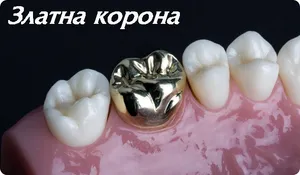
Full-coverage metal crowns, whether gold or standard, are made rarely because of their poor aesthetics, but they have one big and indisputable advantage — they need the least tooth preparation. Metals are thin and strong enough, which allows crowns to be made only 0.5 mm thick. This preserves the most healthy natural tooth tissue, and metal crowns, especially gold ones, have excellent durability (read more about gold crowns).
Metal-ceramic and zirconia crowns
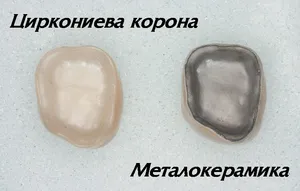
In essence they are the same thing, and the requirements for tooth preparation and cementation are approximately the same. The only difference is in aesthetics, because zirconia was introduced as a substitute for metal because of its white colour. From a functional point of view there is no significant difference between these 2 types, nor in their performance over time. They are the most commonly used crowns today (read more).
All-ceramic crowns
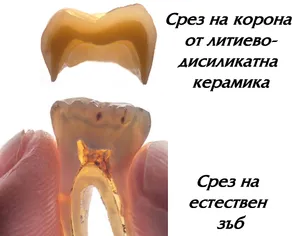
In the past, feldspathic porcelains were used, which are not strong enough and today have been replaced by lithium disilicate ceramics — IPS Emax, Vita Suprinity, Amber Mill and others.
They are the best modern material for single dental crowns at present, because their mechanical and aesthetic qualities are as close as possible to those of natural enamel. The specific high-strength bonding of ceramics to the teeth also matters, which differs substantially from the cementation of the other crowns. Crowns made of lithium disilicate ceramic and bonded to the tooth recreate its original appearance, imitating the two layers — enamel and dentine — that nature created. This is the modern way of restoring teeth in the most biological manner (read more about ceramic crowns).
Does preparing vital teeth harm them?
So far we have looked at why preparing devitalised teeth for crowns is not only not harmful but greatly increases their life. For vital teeth things are a little different, because of their resilience and longevity. When we have vital teeth, we recommend choosing a treatment method that avoids preparing them, and if it is unavoidable, not devitalising them unless there is no other way. Here are several clinical situations and how we can avoid tooth preparation.
Clinical situation one: no missing teeth, but a tooth with a bad large filling
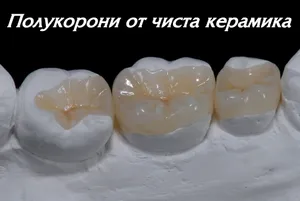
There are no missing teeth, but there is a vital tooth or teeth with a large filling of poor shape and poor contact with the neighbouring tooth, which collects food, falls out or breaks often, or develops secondary caries at the edges or at the base. Treatment with a filling does not give satisfactory results.
- First choice: to be maximally micro-invasive and effective, we make so-called half crowns (overlays) of pure ceramic.
- If the filling is too large: the best option is a pure ceramic crown that replaces the lost enamel without devitalising the tooth.
- Third choice: the other types of full-coverage crowns.
- The worst option is to leave the problematic filling — it will again create the same problems, which sooner or later will lead to devitalisation of the tooth. By then a crown is mandatory, but the tooth no longer has such a good long-term prognosis.
Clinical situation two: teeth are missing and the rest are completely healthy
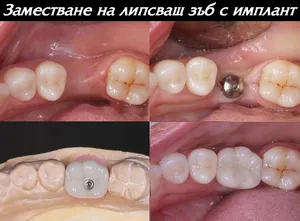
1 or several teeth are missing, and the remaining teeth are completely healthy, with no fillings.
- First choice — implants. The missing teeth are restored without affecting the others. This is the most correct, gentlest and most comfortable way of treatment.
- Second choice — removable dentures or micro-dentures for 1 tooth. Correct and gentle on the other teeth, but not comfortable, and patients reject it.
- Third choice — adhesive bridges. A good way to postpone full tooth preparation, but with lower durability and an increased risk of secondary caries.
- Fourth choice — preparing the teeth for a standard bridge. We recommend that the teeth are by no means devitalised. However surprising it may be to patients, vital teeth covered with crowns or carrying bridges are just as durable over time as unprepared ones.
Clinical situation three: teeth are missing and the rest have small fillings but are vital
1 or several teeth are missing, and the remaining teeth have small fillings but are vital. The order of treatment choices is the same as for completely healthy teeth.
Clinical situation four: teeth are missing and the rest are vital but have large and deep fillings
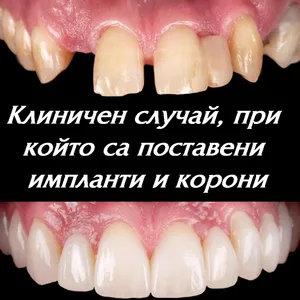
1 or several teeth are missing, and the remaining teeth are vital but have large and deep fillings.
- First choice: implants for the places of the missing teeth, and an overlay or full-coverage crowns on the teeth with large and deep fillings, so that they last as long as possible.
- Second choice: standard full-coverage crowns and bridges made without devitalising the prepared teeth.
- Third place: dentures and adhesive bridges. These patients’ teeth are not caries-resistant and, left like that, would be very prone to secondary caries, which would lead to premature tooth loss. Our aim of keeping the teeth unprepared would in this case harm us more than if we prepared them.
Clinical situation five: only front teeth remain
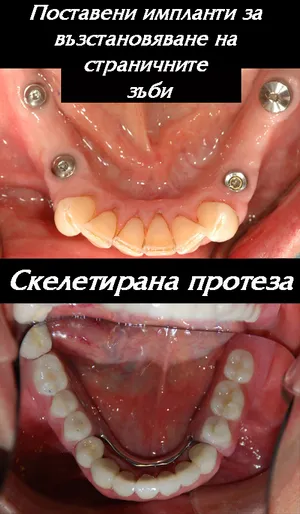
Only front teeth remain, with no back teeth at all. Most often the front 6 or 8 teeth remain, which are vital, but all the chewing teeth are missing.
- First choice: the chewing teeth are replaced with implants, and the front ones stay natural.
- Second choice (if the patient rejects implants): standard dentures. They are often rejected because they are not comfortable and move in the mouth, and the teeth carrying the clasps that hold the dentures are overloaded and often become loose.
- Third choice: skeletal dentures. They involve preparing the front teeth, without devitalising them, and including them in a common bridge construction that splints them. The denture is attached to it by special attachments. This gives maximum comfort — the denture feels like a removable bridge rather than a plate denture, while the front teeth are splinted and protected from overloading and loosening.
Clinical situation six: several teeth are missing and the rest are healthy but loose
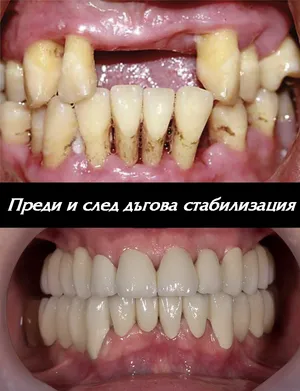
Several teeth are missing and the remaining teeth are healthy but loose. This is usually seen in patients with periodontitis. The first choice is the so-called arch stabilisation — preparing all the available teeth without devitalising them and covering them in a common bridge construction. It plays a double role: it restores the missing teeth and balances the bite, and it also splints the available teeth and protects them from further loosening.
Making dentures is an option, but the remaining teeth must necessarily be splinted in a bridge construction, otherwise the denture would very quickly loosen further the teeth that are already loose because of periodontitis.
Not taking treatment, out of the noble idea of “keeping our healthy teeth as much as possible”, leads in this group of patients to premature loss of the healthy teeth because of the imbalance in the bite. The mechanism is the same: a tooth becomes loose and falls out almost by itself, then the next and the next — the more teeth the patient loses, the faster the process of tooth loss becomes.
Does preparing healthy teeth for crowns and bridges harm them?
Grinding down healthy teeth, as required for crowns and bridges, does not harm them and does not shorten their life when the teeth remain vital. This is proven by many observations in patients whose bridges on healthy teeth were removed after more than 20 years in function for aesthetic or periodontal reasons (exposure of the crown margins). Usually the part of the tooth that was covered by the crown is, after its removal, absolutely healthy and intact.
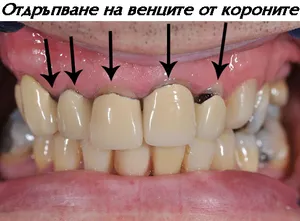
Problems with bridges and crowns on vital teeth are usually seen when the replacement period is not observed. However much patients dislike it, it is between 8 and 10 years. Over that time in most patients the gum recedes from the margin of the crown — a normal process linked to ageing. The margin of the crown is exposed on the outside and inside, and spaces open between the crowns as the interdental papillae lower. Places and undercuts form in which plaque that is hard to clean is retained. This leads to periodontal disease and caries under the crowns. This, and not the tooth preparation, is the cause of problems in patients with crowns and bridges.
Patients who do not want, or do not have the bone for, implants, and want neither removable dentures nor to have their healthy teeth ground down for bridges or crowns, should know that they harm themselves more by not taking treatment than with any of the possible treatments. Our advice is to take timely treatment, so that in future they do not have to make heavy and difficult decisions about their teeth.
Frequently asked questions
Does grinding down teeth for a crown harm them?
No. For devitalised teeth a crown greatly increases their life, and grinding down healthy teeth that stay vital does not harm them or shorten their life. The problems come from delayed treatment, incorrect planning of bridges and poor workmanship.
Why does a devitalised tooth need a crown?
Because the filling of a devitalised tooth is large and wedge-shaped and can split the tooth, the tooth tissue is more brittle after the nerve is removed, and secondary caries under the filling is painless and goes unnoticed. The crown grips the tooth like a ring, replaces the enamel and seals the margins of the filling.
Why do crowns and bridges fall off?
Most often because they were made late, on a severely destroyed tooth without enough ferrule (at least 1.5 mm of sound tissue around the neck), on supporting teeth that are too short, on an incorrectly planned bridge (for 1 missing tooth at least 2 supporting teeth are needed), or because of poor-quality workmanship.
After how many years should crowns and bridges be replaced?
The replacement period is between 8 and 10 years. Over time the gum recedes from the margin of the crown and plaque is retained there, leading to periodontal disease and caries under the crowns.
What is recommended for missing teeth with vital neighbouring teeth?
Implants are recommended as the first choice, as they do not affect the other teeth. Preparing vital teeth for a bridge is the last choice, and we recommend that these teeth are by no means devitalised.