

The Monoreductor is a partial hinged micro-denture with no visible clasps, connected to joined crowns, which restores up to 3 missing back teeth. It takes about 2 – 3 weeks to make, with 4 – 5 visits, requires no surgery, and is taken out once a day for cleaning.
What is the Monoreductor and when is it used?
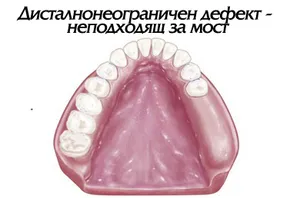
The Monoreductor is a partial hinged micro-denture that restores up to 3 missing teeth. It is used when there is a distal free-end gap (the back teeth are missing) and making a dental bridge is not possible. It is made for patients whose loss of back teeth is on one side of the jaw only.
In such clinical cases, making standard dentures is a problem because the clasps do not hold them well. This means extending the denture and placing an additional clasp at the far end of the opposite row of teeth, which makes the denture bulky, uncomfortable and occupying the patient’s whole mouth.
The best solution for such patients is placing implants (read more…), but not all patients choose this method because of the high price and the need for surgery. The Monoreductor is a good alternative to standard dentures as well as to implants and glass-fibre supports.
How is the Monoreductor built?
The Monoreductor is a construction of 2 parts – a micro-denture with no clasps sticking out of it, and at least two or three joined crowns.
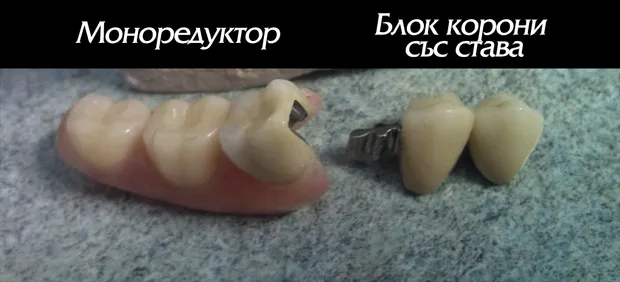
The two parts are connected to each other by a special hinge-type element, which is attached to the rear surface of the joined crowns and, when fastened, fits into a special seat on the inside (under the first tooth) of the micro-denture.
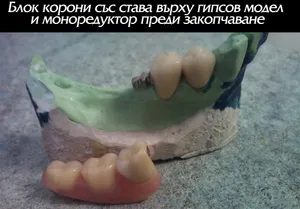
This hinge holds the construction in place and does not allow it to move freely in the mouth. Fitted this way, the Monoreductor is immobile and the only direction in which it moves is upwards, to be taken out and cleaned.
After cleaning it “clicks” back into place and stays immobile like a bridge while chewing. This is ensured by a special seal placed between the two elements of the hinge, which keeps them fitting tightly together.
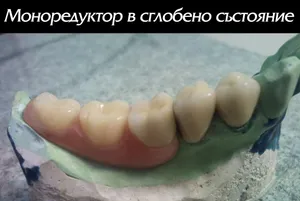
This achieves perfect aesthetics, comfort close to that of bridges and comfort when eating.
What is needed to make one?
To make a Monoreductor, good healing of the wounds after tooth extraction is needed, and the supporting teeth must be free of gum disease.
How is it made?
Making the Monoreductor goes through 3 stages.
First stage
Preparing the supporting teeth and taking an impression.
Second stage
The joined crowns with the hinge and a wax prototype of the micro-denture are made in the dental laboratory. They are placed in the patient’s mouth and the construction is tried in to see whether everything is right.
Third stage
If everything is right at the try-in of the prototype, the final construction is made in the laboratory. After that the joined crowns are cemented and the Monoreductor is “fastened” to the hinge.
What are the advantages and the disadvantage?
- No surgical interventions.
- No chance of rejection by the body.
- Making it takes about 2 – 3 weeks.
- Its price is more affordable than implant treatment.
- Once in the mouth it is immobile, is no different from natural teeth and has no visible clasps or retaining elements.
- The feeling when eating is close to eating with a bridge.
The advantage of the Monoreductor over the glass-fibre support (read more…), which is its alternative, is less load on the supporting teeth – at the expense of greater transmission of chewing pressure through the mucosa (gum), which contributes to the longevity of the construction.
The only disadvantage of the Monoreductor is that it is removable and must be taken out once a day for cleaning.
How much does it cost?
A Monoreductor with a metal framework costs about 350 – 400 €. All prices are in the Price list.
Frequently asked questions
How many teeth does a Monoreductor replace?
Up to 3 missing teeth. It is used for a distal free-end gap – when back teeth are missing – and only on one side of the jaw.
Is surgery needed for a Monoreductor?
No. An advantage of the Monoreductor is that no surgical interventions are needed and there is no chance of rejection by the body.
How long does it take to make a Monoreductor?
About 2 – 3 weeks, with 4 – 5 visits to the clinic.
How is a Monoreductor cleaned?
It is taken out once a day for cleaning – it is removable, and after cleaning it “clicks” back into place.
What is needed to make a Monoreductor?
Good healing of the wounds after tooth extraction, and the supporting teeth must be free of gum disease.