
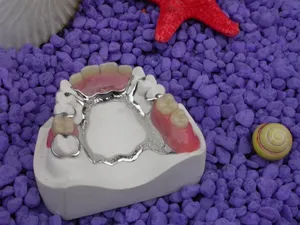
A cast partial denture is a partial denture with a metal framework and clasps and plastic teeth. It is suitable when there are enough healthy abutment teeth, it is made over 2 or 4 – 5 visits, and getting used to it takes from a few days to two weeks.
What is a cast partial denture?
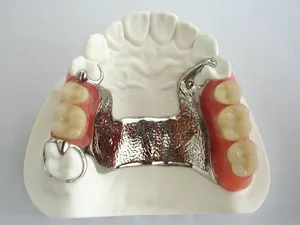
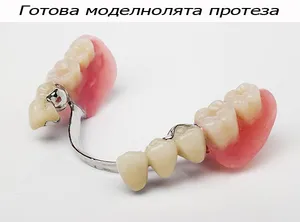
These are partial dentures made of metal and plastic. The framework and the clasps that hold the denture in place are metal, while the visible parts and the teeth are plastic.
In all-plastic dentures, the denture base covers the whole palate of the upper jaw or the area under the tongue of the lower jaw. This causes discomfort, a feeling of a large foreign body in the mouth, and reduced sensations of taste, heat and cold. In cast partial dentures this base is replaced by a metal framework for the upper jaw or a connecting bar for the lower jaw.
What are the advantages and disadvantages?
- A very strong framework that can be made smaller. This greatly improves comfort – there is no feeling that the denture fills the whole mouth.
- Sensations of taste and temperature as close to normal as possible.
- Quick adaptation – patients get used to this type of denture very quickly.
- Stability when chewing – the denture is very stable in the mouth and has only minimal movement. This is ensured by individually cast metal clasps that match the shape and features of each person’s teeth.
- Disadvantages: they are difficult to make and cost more.
When is it suitable?
Cast partial dentures can be used for all defects of the dental arches where there are enough healthy teeth to carry the denture. This is required because these dentures are very stable in the mouth and can have only minimal movement.
Planning them is a complex process and must meet many requirements – correctly transferring the chewing pressure to the existing teeth, and optimally restoring speech and aesthetics.
How is it made?
The stages are similar to those of an ordinary acrylic denture (read more…), so only the most important points are briefly described here.
First visit
Impressions of the upper and lower jaw are taken and the central occlusion is determined from the existing teeth. In the dental laboratory, plaster models of the jaws are cast and set in the correct relationship (central occlusion). At this stage individual trays are made and the main analysis of the denture is carried out.
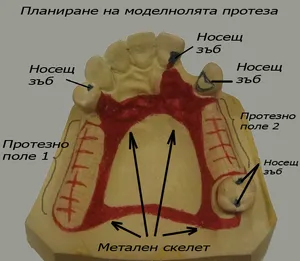
The path of insertion and removal of the denture, the abutment teeth and their retentive areas that will hold the clasps are determined, and the type of clasps is chosen.
Second visit
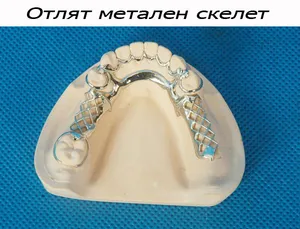
With the individual trays and special silicones, impressions are taken, from which working models are cast. The metal framework and the clasps, which are a single piece, are made on these models. Occlusal templates with bite rims are also made.
Third visit
The metal framework is tried in the patient’s mouth. It is important that it fits the oral mucosa correctly without injuring it. The clasps are also tried – whether they fit tightly on the abutment teeth and hold the denture well enough.
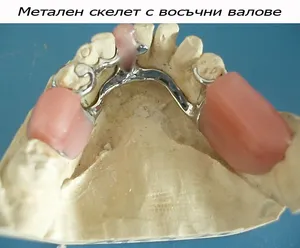
The height and the bite (occlusion) are determined with the help of the templates. After that, the artificial teeth are set up in the dental laboratory and the denture is finally completed.
Fourth visit
The finished denture is placed in the mouth. Only the chewing surfaces of the teeth are adjusted, and the metal framework is not touched. Instructions are given on how to insert and remove, store and clean it, as well as on maintaining good oral hygiene.
How long does it take to get used to it?
Adaptation to this type of denture is faster – from a few days to two weeks. It is easily removed and inserted by the patient and is much more comfortable and stable when chewing. Carefully planned and well made, it restores proper eating, speech and aesthetics.
How much does it cost?
A cast partial denture costs about 720 € per denture. All prices are in the Price list.
Frequently asked questions
How many visits does a cast partial denture take?
Four visits: taking impressions and analysis, making the metal framework, trying in the framework, and fitting the finished denture.
How long does it take to get used to a cast partial denture?
Adaptation to this type of denture is faster – from a few days to two weeks.
When is a cast partial denture suitable?
For all defects of the dental arches where there are enough healthy teeth to carry the denture.
How does it differ from an all-plastic denture?
In all-plastic dentures the base covers the whole palate or the area under the tongue. In a cast partial denture it is replaced by a metal framework for the upper jaw or a connecting bar for the lower jaw, so the denture is smaller and the feeling of a foreign body is weaker.