

Acrylic complete or partial dentures are the most commonly made type of denture – they suit a large share of dental deformities, are inexpensive and restore proper eating and aesthetics. They take 2 or 4 – 5 visits, and getting used to a first denture takes from 15 days to 1 month.
When is an acrylic denture made?
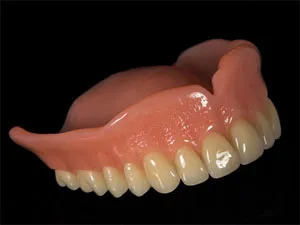
Complete or partial acrylic dentures are the most commonly made, because they are suitable for a large share of dental deformities, are inexpensive and restore proper eating and aesthetics.
After the preliminary preparation and planning of the type of construction, its fabrication begins. It takes 2 or 4 – 5 visits to the dental clinic.
How is it made?
First visit
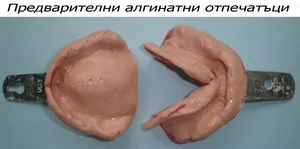
A preliminary impression of the upper and lower jaw is taken using standard metal or plastic trays and a special impression material called alginate. The preliminary impressions are sent to the dental laboratory, where plaster models that reproduce the situation in the mouth are cast from them.
The denture is then finally planned on these models and individual impression trays are made.
Second visit
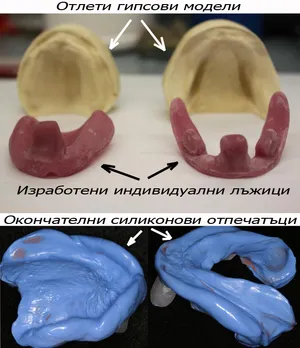
A second impression is taken with the individual trays and special silicone or wax. It is very precise and the denture is made on it. For this reason, a number of tests are carried out while taking it, aimed at shaping the edges of the denture perfectly. Such tests include swallowing, saying the letter A, and making specific movements of the lips, performed according to the dentist’s instructions.
After the second (final) impression has been taken, the dental laboratory casts the plaster model from it, on which a prototype of the denture (a template with wax rims) is made.
Third visit
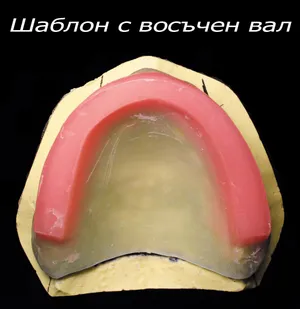
The finished templates with wax rims are placed in the mouth and are used to determine the height of the bite and the relationship between the upper and lower teeth (the occlusion). In partial dentures, this stage is in some cases already determined by the existing teeth that come into contact. In complete dentures this is a very important and demanding stage, so all the principles for determining central occlusion and bite height must be observed.
At this visit the shape, size and colour of the artificial teeth are also determined. Where natural teeth are present, their characteristics are taken into account. When all teeth are missing, the patient’s individual characteristics (skin colour, shape and size of the face) and wishes are taken into account.
For partial dentures, this is the stage at which the means of retention (clasps, joints, telescopic crowns and others), chosen when the denture was planned, are specified. Once all the details have been settled, the templates are returned to the dental laboratory, where the dental technician sets the teeth.
Fourth visit
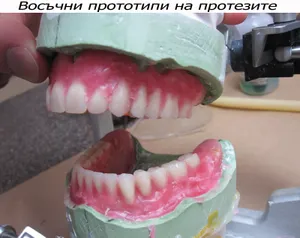
The template with the set teeth is now an exact model of the denture and is used for a try-in. The templates are placed in the mouth and the patient can see how their future dentures will look. The occlusion (bite), aesthetics and phonetics are checked and corrections are made if necessary.
The phonetic test is done in patients with complete dentures to ensure that words and sounds are pronounced correctly and clearly. The templates with the set teeth are then returned to the dental technician, who makes the denture from pink acrylic and polishes it.
Fifth visit
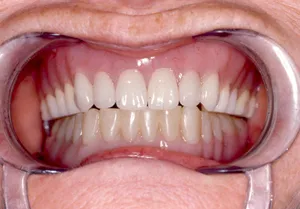
The finished denture is placed in the patient’s mouth. The edges are examined and, where there is a visible need, corrections are made. The contacts between the teeth are also examined and the teeth are lightly ground until even contact surfaces are obtained on the left and right.
Fitting a denture, especially for the first time, is an important moment, because the construction is new and bulky and the patient has to go through an adaptation period of varying length. The dentist gives instructions on how to put the denture in and take it out, how to clean and store it, and explains how to eat with dentures (chewing on both sides). The patient is warned that after the first one or two meals the mucosa may become sore.
How long does it take to get used to it?
It is advisable to have a follow-up check-up the next day to establish how well the patient has adapted to the denture and, if there are any sore spots, to grind and correct the problem areas on the denture base.
Getting used to a first pair of dentures is individual and takes from 15 days to 1 month. With good-quality fabrication, and with perseverance and care on the part of the patient, dentures can provide proper eating, speech and aesthetics for a long period of time.
How much does it cost?
An acrylic denture costs about 350 € per denture. All prices are in the Price list.
Frequently asked questions
How many visits does an acrylic denture take?
It takes 2 or 4 – 5 visits to the dental clinic.
How long does it take to get used to a first denture?
Getting used to a first pair of dentures is individual and takes from 15 days to 1 month.
Is a follow-up check-up needed after fitting?
It is advisable to have a follow-up check-up the next day to establish how well the patient has adapted to the denture and, if there are any sore spots, to correct the problem areas on the denture base.
Why is a phonetic test done?
The phonetic test is done in patients with complete dentures to ensure that words and sounds are pronounced correctly and clearly.
Can there be discomfort in the first days?
Yes. The dentist warns the patient that after the first one or two meals the mucosa may become sore.