
The clinic makes 20 types of dentures for partial or complete tooth loss — from standard acrylic and soft dentures to implant-supported ones. The most suitable type is determined at an examination and consultation at the clinic, to which you bring a recent panoramic X-ray.
How is the right denture chosen?
Our dental clinic provides comprehensive prosthetic treatment for patients with partial or complete tooth loss. In this article we introduce you to the 20 types of dentures we make. Some of them are widely known among patients, while others are specialised and are used to solve difficult clinical cases.
To determine the most suitable type of denture for your case, you need to come for an examination and consultation at the clinic. You must bring a recent panoramic X-ray.
We recommend having the panoramic X-ray taken at DentalXLab or TMLaboratory.
What types of dentures do we make?
1. Full and partial acrylic dentures
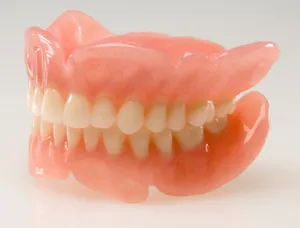
These are the standard dentures that have long been familiar. They are made of pink acrylic and ready-made, highly aesthetic three-layer plastic teeth that imitate the natural look of teeth and provide high aesthetics. They can be full or partial; partial dentures have wire metal clasps used for retention, while full dentures are held entirely by suction.
- Production: 1 or 2 weeks, with 2 or 4-5 visits to the dental clinic
- Price: about 350 € per denture
2. Full and partial flexible (soft; silicone) dentures
Flexible dentures, also called soft or silicone dentures, are made of various materials – Thermosens, Valplast, Breflex and others. All these materials have similar characteristics. The main advantage of flexible dentures applies to partial dentures and is due mainly to their clasps.
The clasps of soft dentures are cast from the material of the denture and are an integral part of its base. They are therefore highly aesthetic and practically invisible, unlike the wire clasps of ordinary dentures. The casting method of the clasps leads to extremely precise fabrication, matched to the individual shape and features of the patient’s teeth.
In this way they provide very good retention, and this is the source of the great comfort of soft dentures, their wide use and the many satisfied patients.
- Production: 1 or 2 weeks, with 2 or 4-5 visits to the dental clinic
- Price: about 460 € per denture
3. Full acrylic dentures with a soft silicone base
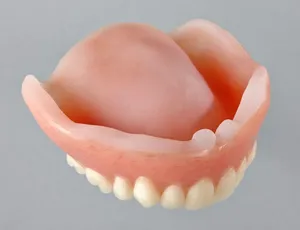
These are standard acrylic dentures, but after they are made, a layer of soft silicone is placed on their inner surface, which is in contact with the patient’s mucosa. It is about 2 mm thick and its hardness is comparable to that of standard silicone – this is the only material that feels soft.
The soft relining gives patients exceptional comfort and greatly improves the suction and retention of the dentures.
Because of the specific qualities of the material, it needs to be replaced about every 6 months; this is done without making a new denture – the old layer is simply removed and a new one is placed (rebasing).
- Production: about 2 weeks, with 4 or 5 visits to the dental clinic
- Price: about 400 – 460 € per denture with soft relining
- Rebasing only: production: 3-5 days / price: about 100 – 150 €
4. Micro-dentures
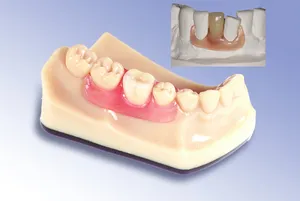
Micro-dentures are partial dentures usually made of flexible plastic and consisting of 1 to 3 teeth. They most often consist of one tooth and flexible clasps, by which they attach to the 2 teeth adjacent to the missing one. They are usually used as temporary space maintainers, but can also be permanent replacements for bridges in patients who do not want their teeth prepared for a bridge. They are especially often made for a lost front tooth in patients with periodontitis who do not want to undergo definitive treatment.
We recommend using them as temporary dentures before, but not during, implant treatment. If implants are not going to be placed, they can stay permanently.
- Production: about 3 to 7 days, with 2 visits to the dental clinic
- Price: about 230 € per denture
5. Immediate dentures
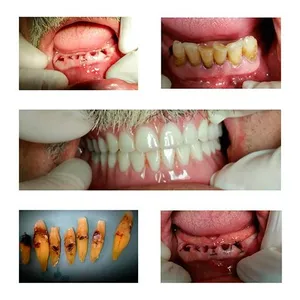
Immediate dentures are standard acrylic dentures, which can be either full or partial. What is specific about them is that they are made using a special technique before the patient’s teeth are removed. In this way, when the patient comes to the clinic to have the teeth extracted, the denture is already ready and is placed immediately after the extraction.
This gives patients the opportunity not to go a single day without teeth, to carry out their daily tasks with confidence, and to eat and smile without worry. Immediate dentures are worn during the wound-healing period, which is about 1 to 2 months after the teeth are extracted. After that they must either be replaced with new definitive ones, or be rebased and become permanent.
- Production: about 1 week, with 2 visits to the dental clinic
- Price: about 350 € per denture
- Rebasing only: production: 3-5 days / price: about 100 – 150 €
6. Cast partial dentures with cast clasps (Ney)
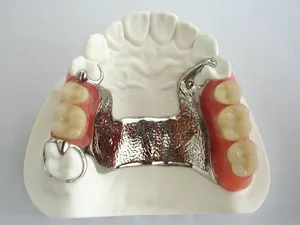
These are high-grade partial dentures from classical prosthetics. They are made with a metal framework and cast metal clasps on the patient’s teeth. Their main advantage is good retention, great stability when chewing and a high level of comfort.
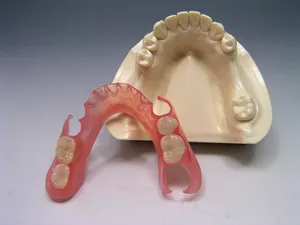
This is due to the metal framework, which provides exceptional strength and allows the denture to be made extremely fine, thereby minimising the feeling of a foreign body in the oral cavity. Upper cast partial dentures have no palate, only a connecting plate like the one shown in the photo on the left. For lower dentures, a connector only 2 mm thick is made, which runs under the tongue.
- Production: 1 or 2 weeks, with 2 or 4-5 visits to the dental clinic
- Price: about 720 € per denture
7. Cast partial dentures with flexible clasps made of soft plastic
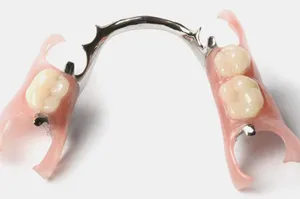
This type of denture is the modern variety of cast partial dentures, combining the two main advantages of cast and soft dentures. The very thin metal framework, practically invisible in the oral cavity, and the highly aesthetic clasps made of flexible plastic provide perfect aesthetics and comfort for the patient. Dentures of this type are as fine as possible and sit very stably in the oral cavity, the feeling of a foreign body in the mouth is minimal, and eating with them is confident and secure. Another advantage is that they are practically unbreakable when eating or when accidentally dropped on the floor.
- Production: 1 or 2 weeks, with 2 or 4-5 visits to the dental clinic
- Price: about 720 € per denture
8. PEEK dentures
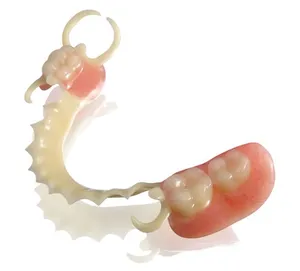
This is a modern variety of cast partial dentures, in which the metal framework is replaced by a special polymer material (PEEK – polyetheretherketone). It is an exceptional “bio” material that has the strength and durability of metal, but at the same time is much lighter, which makes the dentures extremely comfortable. It also does not cause allergies, leaves no metallic taste in the mouth and is highly aesthetic, because its colour is close to that of natural teeth.
Dentures made of PEEK are the best solution for people who cannot tolerate metals in the oral cavity, are allergic to metals, or do not want them for aesthetic reasons. It is still little known in Bulgaria because PEEK denture frameworks are cut only by computer using CAD/CAM systems, and until recently this meant they had to be cut abroad.
- Production: 2 to 3 weeks, with 2 or 4-5 visits to the dental clinic
- Price: individual, after a consultation at the clinic and an enquiry to the milling centre
9. Articulated milled dentures (skeletal) with cylindrical or spherical attachments
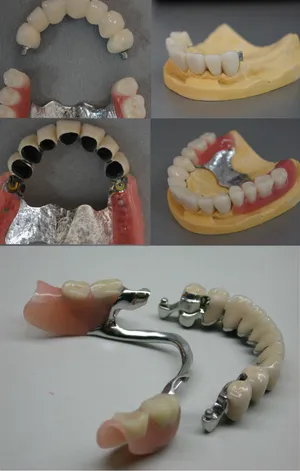
Articulated dentures are the highest class of prosthetic restorations from classical prosthetics. In essence they are restorations consisting of two parts – a bridge with attachments fixed to it (metal-ceramic or zirconia) and a denture (cast partial or PEEK denture), which can be fixed to each other rigidly. They have very high stability in the oral cavity and can practically be described as “detachable bridges”.
Eating with such dentures is the closest to the comfort of eating with dental bridges. This is because the denture is attached to the patient’s existing teeth by special cylindrical, spherical or more complex retentive elements. The teeth themselves are splinted by the bridge restoration, which protects them from loosening.
Articulated dentures are a better solution than bridges with pontics and bridges on glass-fibre support. This is due to the specifics of the attachments. They are in two parts – one part is cast into the framework of the bridge restoration and the other part is built into the framework of the denture, and the two parts are joined together on the principle of matrix and patrix.
Between them there is a special silicone seal, which on the one hand ensures a tight fit of the two parts of the attachment and rigid fixation of the denture in the mouth, and on the other, an even distribution of chewing pressure over the whole restoration without overloading the supporting teeth. This type of denture has very high aesthetics and is practically unnoticeable in the mouth because it has no clasps or retentive elements on the visible side.
- Production: about 2 to 3 weeks, with 4-5 visits to the dental clinic
- Price: about 720 € per denture with two attachments; bridge restoration – according to the type and number of teeth
10. Articulated dentures with a bar
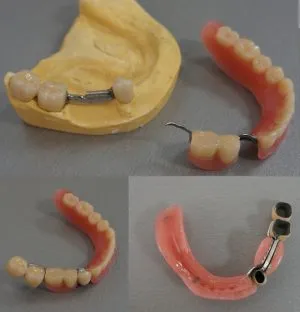
These are a specific type of articulated denture made for difficult prosthetic cases. These are usually patients with severe tooth loss on one side, who are missing many of their teeth and whose remaining teeth are unfavourably distributed in the jaw. As is well known, one-sided dentures do not sit well in the oral cavity or cause loosening of the teeth on which the clasps are placed.
The reason for this is the long lever arm that the denture represents. This calls for cross-arch splinting of the teeth with a bridge restoration and the placement of an articulated denture, which, however, overloads the attachment and the bridge restoration and leads to problems. These unfavourable effects are minimised by making a bar in the bridge restoration in place of the missing teeth.
This is a metal rail that splints the individual teeth like a bridge, but at the same time serves as an attachment for holding a skeletal denture. A denture made in this way is two-sided and is balanced when eating, which greatly reduces the load on the natural teeth. Retention is excellent thanks to the specific shape of the attachment, and aesthetics are at a high level because the denture completely covers the bar.
- Production: about 2 to 3 weeks, with 4-5 visits to the dental clinic
- Price: about 720 € per denture; bridge restoration – according to the type and number of teeth
11. Articulated dentures with telescopic retention
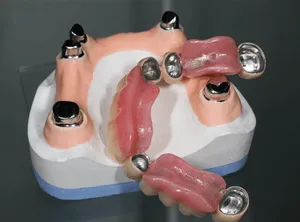
These are the so-called telescopic dentures. They are a dental restoration that sits somewhere between bridges and dentures. The only thing that classes them as dentures is that they are removable and, in the areas where there are no teeth, they are shaped more like dentures than bridges, mainly for aesthetic reasons.
All their other characteristics are those of bridges – once in the mouth they are absolutely immobile, the feeling of a foreign body is like that of bridge restorations, there are no elements on the palate or under the tongue, and the aesthetics are the same as for a bridge restoration. Because they can be removed by the patient, telescopic dentures are ahead of bridges from a hygiene point of view, since perfect cleaning underneath them is possible, which is difficult and sometimes impossible with cemented restorations. To make a telescopic denture, the existing teeth are prepared and covered with metal or gold crowns that are cylindrical, milled at an angle of between 1 and 0 degrees, and the framework of the denture is milled to them, fitting the copings extremely precisely.
In this way, thanks to the friction and the suction created between the tightly fitting framework and the telescopes, the denture stays in place as if glued, yet it can also be removed.
- Production: about 2 to 3 weeks, with 4-5 visits to the dental clinic
- Price: individual, after a consultation at the clinic and an enquiry to the milling centre
12. Overdenture with telescopic crowns
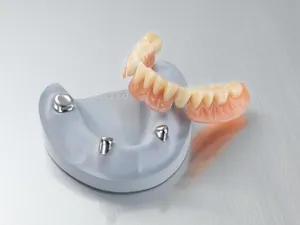
This type of denture is made when only a few teeth remain in the jaw and they are unfavourably distributed or could not carry a bridge restoration. The teeth are prepared and covered with telescopic crowns, in the same way as for telescopic dentures. The difference is in the denture itself: in this case the overdenture has no metal framework to fit the telescopic crowns.
It is usually a standard acrylic denture, but its underside has holes into which the telescopes fit. This provides retention of the overdenture similar to that of telescopic dentures and gives patients excellent comfort. Another main advantage is the high aesthetics of these dentures, because the metal copings are completely hidden under the denture and cannot be seen, and, last but not least, the considerably lower price compared with telescopic dentures.
The other particularly valuable advantage of overdentures with telescopes is that if there is a problem with one of the teeth under them, the denture does not need to be replaced. The tooth is extracted if necessary, its place in the denture is filled in the clinic or the dental laboratory, and the patient keeps the denture. The telescopes can also be made of zirconia or PEEK.
- Production: about 2 weeks, with 4-5 visits to the dental clinic
- Price: about 350 € per denture; the price of the telescopes is set according to their number and type
13. Articulated dentures with bonita posts
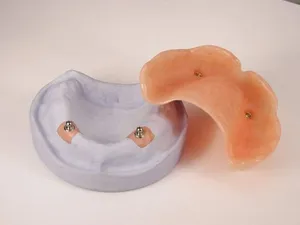
This type of denture is similar to overdentures with telescopes and provides the same retention, aesthetics and comfort. The difference is that they are most often made for patients who have neglected their teeth to the point that only roots remain. If the patient has healthy roots that can be built up, so-called bonita posts are made.
These are laboratory-made post-and-core build-ups of the teeth, which have a cylindrical attachment (a small ball) at the top. These build-ups are cemented onto the tooth root and are left protruding slightly above the gum. A full acrylic denture is made over them, covering them, and special metal buttons with a spherical Teflon seal are built into the denture above the bonita posts and snap onto them.
This provides stable retention of the denture on the patient’s roots.
- Production: about 2 weeks, with 4-5 visits to the dental clinic
- Price: about 350 € per denture; price of the bonita posts: about 150 €
14. Full dentures with magnetic retention
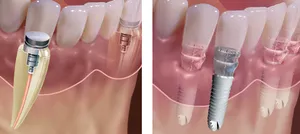
Magnets are rarely used retentive elements for full dentures; they are placed either on the patient’s natural tooth roots or on implants. The denture that is made is a standard acrylic one, and the 2nd part of the magnet is built into it in the area under the teeth. Retention of the denture is provided by suction and is assisted by the attraction of the magnets.
Their main advantage is that the denture is held to the teeth or implants not mechanically but only magnetically, so there is no danger of overloading them, because under excessive load the two magnetic parts detach from each other. In addition, there are no protruding or visible parts, which leads to better hygiene and excellent aesthetics.
- Production: 1 or 2 weeks, with 2 or 4-5 visits to the dental clinic
- Price: about 350 € per denture; the price of the magnetic attachments – according to their number and type
15. Monoreductor (articulated micro-denture)
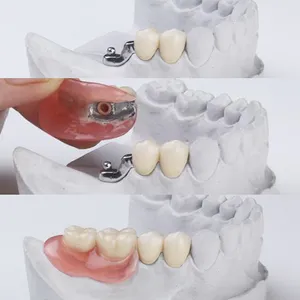
Monoreductors are perhaps the most convenient removable micro-dentures. We regard them rather as detachable mini-bridges, because of the comfort they provide when eating. They are the perfect solution when a back tooth is missing and a standard bridge cannot be made, and the patient does not want implant treatment.
A monoreductor is an articulated micro-denture that attaches, by means of a special attachment, to a restoration covering at least 2 or more stable natural teeth of the patient. It can be made with standard metal-ceramic and a metal framework for the reductor, or with a zirconia restoration and a PEEK monoreductor for patients who are concerned about, or do not want, metal in the oral cavity. Patients get used to monoreductors extremely easily, because they do not need to take them out, except 1 time in the evening, just to clean under and around them.
From a mechanical and hygiene point of view they are a better solution than bridges with pontics and glass-fibre supports, and just as aesthetic, because the retentive elements are hidden.
- Production: about 2 to 3 weeks, with 4-5 visits to the dental clinic
- Price: about 350 – 400 € per monoreductor with a metal framework; bridge restoration – according to the type and number of teeth
16. Full dentures on implants with ball abutments
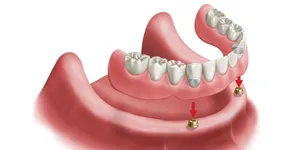
Ball abutments are special retentive elements used to secure full dentures to implants. They are especially valuable for patients whose dentures have no suction and therefore no retention in the oral cavity. In such patients the bone available for implants is usually deficient too. In most cases, if we manage to find bone and place 2 implants with ball abutments, we secure the denture in place, with the main chewing load taken by the mucosa and the implants playing only a stabilising role so that the suction is not lost.
This greatly improves comfort when eating with the dentures without overloading the implants, which is due to the spherical shape of the ball abutments, which allow some rotation of the denture around their axis and distribute the chewing load from the implants to the mucosa.
- Production: about 2 weeks, with 2 or 4-5 visits to the dental clinic
- Price: about 350 € per denture; the price of the implants and ball abutments is separate, according to their type
17. Full dentures on implants with locators
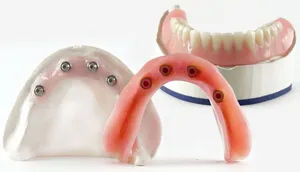
These are again full dentures attached to implants, mainly used for patients with complete tooth loss whose dentures do not stay in the oral cavity. The difference here is that locators, unlike ball abutments, provide more stable retention of the denture. This is due to their specific shape, which resembles a snap button like those on denim clothing.
As with dentures on ball abutments, here too one part of the special retentive elements is fixed on the implants, and the second part is built into the underside of the denture. When the denture is snapped onto the locators, it is immobile in the oral cavity and provides very good eating comfort. To make dentures on locators we usually use 4 implants, when their position in the jaw is not favourable for an All on four restoration, or for financial reasons, since the denture is a much cheaper option than a bridge restoration fixed entirely on implants.
Aesthetics are at a very high level, because all the retentive elements are hidden under the denture, and the chewing load is evenly distributed.
- Production: about 2 weeks, with 2 or 4-5 visits to the dental clinic
- Price: about 350 € per denture; the price of the implants and locators is separate, according to their type
18. Full dentures on implants with a bar
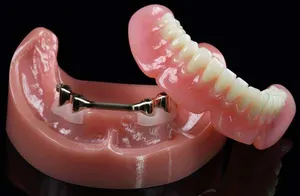
A variety of full dentures retained on implants, in which 4 implants are again used, and again in the case of an unfavourable position or when an All on four bridge restoration is not possible for financial reasons. What is specific here is that all 4 implants are splinted to one another by means of the bar. This is more favourable for the implants themselves from a mechanical point of view than locators and ball abutments.
Bar dentures, however, are skeletal by nature, since a metal framework that fits the bar exactly and clips onto it is built into the denture. The chewing load is taken to a greater extent by the implants and to a lesser extent by the mucosa. This type of denture is extremely comfortable because the bar blocks movement in all directions and the denture is firmly fixed to the implants.
Aesthetics are again at a high level, because all the retentive elements are hidden under it.
- Production: about 2 to 3 weeks, with 4-5 visits to the dental clinic
- Price: about 720 € per denture; the price of the implants and the bar is separate, according to their type
19. Hybrid dentures / bridges, permanently screw-retained on implants
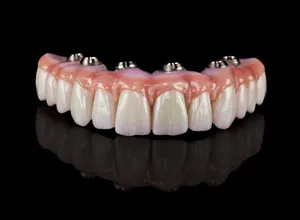
These are the highest class of dentures attached to implants.
In essence, and in feel, they are actually bridges (also called Toronto bridges), but with the possibility of being easily removed at the dental clinic, which also places them in the category of dentures. They are widely used in the All on four and All on six concepts, where they are called bridges. Personally, we prefer to make hybrid dentures on 6 or even 8 implants because of the much more balanced and even distribution of the chewing load and the avoidance of long pontics, as is the case with All on four.
We make hybrid dentures on 4 implants only when there is not enough bone to place 6, because in this way we load the implants to their maximum, which may lead to problems in the future, but we still manage to give patients good eating comfort. Hybrid dentures are fixed on the implants by special two-part abutments. One part of the abutment is placed and screwed onto the implants, and the other part is built into the framework of the denture/bridge.
By means of special micro-screws the two parts are screwed together and the denture in effect becomes a screw-retained bridge that the patient does not remove. The materials from which hybrid dentures are usually made can be metal-ceramic and zirconia, as well as PEEK, or the newest development – a titanium framework with photopolymer inlay. Their main advantages are the extremely high aesthetics that can be achieved with the photopolymer restoration and the ability to repair it directly in the mouth without having to remove it and return it to the dental laboratory.
Eating comfort is similar to the comfort of eating with dental bridges.
- Production: about 1 month, with 2-4 visits to the dental clinic
- Price: individual, after a consultation at the clinic and an enquiry to the milling centre
20. Transparent full and partial acrylic dentures
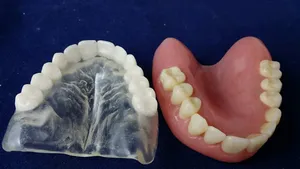
These are standard acrylic dentures, but made of acrylic without dyes. They are suitable for patients who are allergic to the dyes in standard pink acrylics. They can be full or partial; partial ones have metal clasps or rests.
They go through the same stages of fabrication and offer the same comfort as standard acrylic dentures. They are rarely used today because of the soft/flexible Thermosens dentures, which are also hypoallergenic but more comfortable than partial acrylic dentures.
- Production: 1 or 2 weeks, with 2 or 4-5 visits to the dental clinic
- Price: about 350 € per denture
How much do dentures cost and how long does fabrication take?
The production time, the number of visits and the approximate price are given for each type of denture above. All prices are in the Price list.
Frequently asked questions
What should I bring to the denture consultation?
A recent panoramic X-ray. We recommend having it taken at DentalXLab or TMLaboratory.
How many types of dentures does the clinic make?
20 types — from the widely known acrylic and flexible dentures to specialised restorations for difficult clinical cases and dentures on implants.
What are immediate dentures?
These are acrylic dentures that are made before the teeth are extracted and placed immediately after the extraction. They are worn during the wound-healing period, about 1 to 2 months, after which they are replaced with definitive ones or rebased and become permanent.
How often is the soft base of a denture replaced?
The soft silicone base is replaced about every 6 months. This is done without making a new denture – the old layer is removed and a new one is placed (rebasing).
Which type of denture is suitable for a metal allergy?
Thermosens dentures are the best solution for people who cannot tolerate metals in the oral cavity or are allergic to them, as well as for those who do not want metal for aesthetic reasons.
Other ways to replace missing teeth
Other ways of replacing missing teeth besides dentures are making bridges and crowns (read more…) or placing implants (read more…).