
The removal of an impacted wisdom tooth at Ralev Dental Clinic can be either a planned or an emergency operation. It is performed under local anaesthesia by a specialist oral surgeon with over 20 years of experience in removing problematic wisdom teeth. For most patients it takes no more than 20-30 minutes in the clinic.
How do you prepare for the operation?
Before the surgical extraction, a mandatory consultation at the clinic is required. The patient must have a panoramic X-ray, on which the position and complexity of the wisdom tooth are examined. The approximate price is determined according to the expected difficulty of the operation and a date is scheduled.
Patients who need an impacted wisdom tooth removed face many questions and fears. As a clinic specialising in the surgical removal of wisdom teeth, we will tell you how we approach this problem with our patients.
Who performs impacted wisdom tooth removal operations?
Operations to remove wisdom teeth can be performed by general dentists as well as by oral surgeons. In our clinic they are performed by a specialist oral surgeon with over 20 years of experience in removing wisdom teeth.
How long does the operation take?
For over 80% of our patients, the surgical removal of a wisdom tooth takes no more than 20-30 minutes in the clinic. In extremely rare cases of very difficult wisdom teeth fused to the jaw bone, the operation may take up to about 1 – 1.5 hours. In such cases we warn the patient in advance to expect a longer extraction.
Does it hurt during the operation?
No pain is felt during the surgical removal of an impacted wisdom tooth, because the procedure is performed under anaesthesia. Patients do feel touch and pressure in the area of the tooth being removed. Some vibration may also be felt for teeth that are cut into pieces in order to be removed. No pain is felt either when the gum is sutured at the end of the operation.
Can it still hurt?
In patients who have let their wisdom teeth become inflamed and have active inflammation and swelling in the area because of pus around the tooth, the effect of the anaesthetic may not be complete and pain may be felt during the extraction. With such patients we avoid operating at that moment. We first treat the inflammation and only once the tissues around the tooth have healed do we proceed with the operation.
What anaesthetic do we use?
The operation is done under local anaesthesia only in the area of the tooth to be extracted. The numbness covers the whole half of the jaw where the problem tooth is located and is entirely sufficient for the whole operation to be carried out painlessly.
Is general anaesthesia possible?
General anaesthesia for removing wisdom teeth is possible, but we do not recommend it, for several reasons:
- There is no difference in how the patient feels after the operation, and even after general anaesthesia there is additional overall discomfort in the body as a result of coming out of the anaesthesia.
- General anaesthesia is much more harmful to the body and has many side effects, unlike local anaesthesia.
- General anaesthesia is needed only for small children and patients with disabilities (Down syndrome, etc.) who cannot be treated under normal conditions.
- General anaesthesia makes the operation many times more expensive – such anaesthesia costs an extra 500 € or so, on top of the removal of the wisdom teeth.
- When patients are put under general anaesthesia, all 4 wisdom teeth are usually removed, which subsequently leads to a difficult postoperative period and harder recovery.
How do we handle patients who are afraid?
100% of patients who need an operation to remove a wisdom tooth feel anxiety or fear about the procedure, and this is completely normal and understandable.
- Slightly worried patients who can effectively control their fear: the operation goes like any ordinary dental procedure – for example, treatment of caries.
- More anxious patients who are quite worried but still have control over their fear: we recommend taking a mild sedative before the operation, such as validol or valerian. It helps them relax, reduces the anxiety about the forthcoming extraction and also improves the pain-relieving effect of the anaesthetic, because, as is well known, fear reduces the effect of anaesthetics.
- Patients with panic fear who repeatedly postpone the extraction and insist on an operation under general anaesthesia: we recommend a consultation with a psychologist, who will teach them how to overcome and control their fears. Once this has been achieved, we carry out the operation in the standard way.
This is the most appropriate option for people with panic fear, since they are afraid of the thought of the surgical intervention, while the operation itself is not unpleasant. The unpleasant moments begin after the effect of the anaesthetic wears off. This is yet another reason why we do not recommend general anaesthesia.
How does the operation go?
The operation to remove an impacted tooth differs from a standard tooth extraction. Surgical removal is most often needed for the lower wisdom teeth, but the essence of the operation is the same for all other impacted teeth.
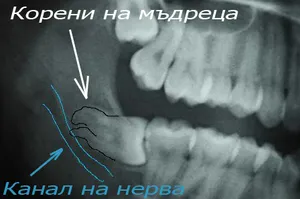
The presence and position of these teeth in the bone are determined from the X-ray. On it the position of the wisdom tooth is established, along with the least traumatic way of reaching it, and the position of the nerve supplying the lower jaw. This matters because if the nerve is injured or severed during the operation, temporary or even permanent numbness of part of the lower jaw and the tongue may result.
Once the operation has been planned, it is carried out. Such operations are always performed by a team of a surgeon and a dental assistant or a trained nurse.
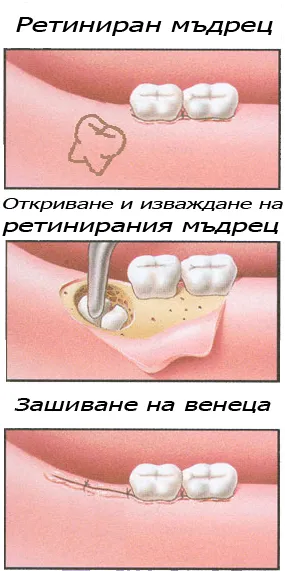
First stage: anaesthetic
The anaesthetic is placed at a specific site and in sufficient quantity to be effective until the end of the operation. A characteristic feature of dental anaesthetics is that they remove only the sensation of pain. The sensations of touch, pressure, vibration, pulling, tension and stretching remain.
Second stage: incising the gum
The gum over the impacted tooth is incised and the bone is exposed (raising a mucosal flap).
Third stage: exposing the tooth
The bone over the tooth is carefully cut away with special bone burs until the crown of the tooth is exposed. Then its removal begins.
Fourth stage: removing the tooth
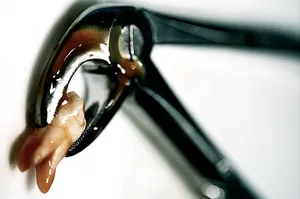
The tooth is loosened with an elevator and then removed. If it cannot be removed with an elevator alone, the tooth is cut into pieces, separating the crown from the roots, and they are removed one by one.
Fifth stage: cleaning and suturing
After the tooth is removed, the bone wound is cleaned, its edges are smoothed and the gum is sutured over it. For deep wounds and removal of a lot of bone, a bone graft material may be placed in the wound before suturing.
What happens after the operation?
After the operation is finished, we give the patient written instructions on what to do and how in the postoperative period, to ensure quick and unhindered healing of the wound. Where necessary, at the dentist’s discretion, an antibiotic and vitamins are prescribed to be taken after the tooth is removed, to prevent possible complications. Painkillers are also prescribed, and patients are instructed to take the first tablet/powder before the effect of the anaesthetic has worn off. This ensures a painless recovery period.
It is recommended to apply cold compresses on the first day to reduce swelling, and warm ones from the second day onwards, and, if possible, to avoid heavy physical activity in the first days.
How do patients feel?
After a normally uneventful operation, patients are able to work and can continue their daily activities. Only for people whose work involves mainly speaking or appearing on screen do we recommend 2 – 3 days of rest after the extraction.
In some patients we observe slight swelling of the cheek and difficulty opening the mouth wide. These signs are usually seen after more difficult operations. In rare cases, in smokers who do not follow the instructions and smoke immediately after the extraction, pain appears after the extraction, arising on the 3rd – 4th day – alveolitis.
How does the patient eat?
After the operation, patients should not eat during the first 4 hours. After that they can return to their normal eating rhythm. We recommend eating mainly soft and pureed foods for the first 4 – 5 days after the extraction, so that the surgical area is less irritated and heals more quickly.
When are the stitches removed?
A follow-up check-up is done on day 7–10 after the tooth is extracted and, if healing is going well, the stitches are removed.
For some patients travelling from abroad or from elsewhere in the country, we may, at our discretion, suture with absorbable stitches, so a repeat visit to the clinic and a trip to Sofia are not necessary.
How much does it cost?
Surgical removal of an impacted or partially impacted wisdom tooth costs 200 – 300 €. The approximate price is determined at the consultation according to the expected difficulty of the operation. All prices are in the price list.
Frequently asked questions
Does it hurt during the removal of an impacted wisdom tooth?
No pain is felt, because the procedure is performed under local anaesthesia. Only touch and pressure in the area of the tooth are felt, and for teeth that are cut into pieces, some vibration.
How long does the operation take?
For over 80% of patients no more than 20-30 minutes in the clinic. In extremely rare cases of very difficult wisdom teeth fused to the jaw bone, it may take up to about 1 – 1.5 hours.
Can wisdom teeth be removed under general anaesthesia?
It is possible, but we do not recommend it. The operation is done under local anaesthesia, because general anaesthesia is much more harmful to the body, makes the operation many times more expensive and usually leads to all 4 wisdom teeth being removed, which makes recovery harder.
When are the stitches removed after the extraction?
Usually on day 7–10 after the tooth is extracted, at the follow-up check-up. For some patients travelling from abroad or from elsewhere in the country, we may, at our discretion, suture with absorbable stitches and a repeat visit is not necessary.
How does the patient eat after the operation?
Not during the first 4 hours. After that the patient can return to their normal eating rhythm, but mainly soft and pureed foods are recommended for the first 4 – 5 days.