
Treatment of pericoronitis is a quick and simple surgical excision of the inflamed gum over the crown of a lower wisdom tooth. It is most often done for partially erupted wisdom teeth, always under anaesthesia, and is completely painless.
What is pericoronitis and why does it occur?
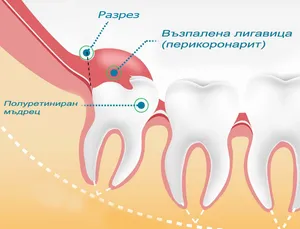
In partially erupted or erupting wisdom teeth, the tooth is in many cases half exposed and at its back there is a flap of gum that is constantly chewed on and injured during eating. Because of this, and because food gets pushed in between the gum and the tooth, inflammation develops.
The symptoms are pain, redness and difficulty opening the mouth.
How does the treatment go?
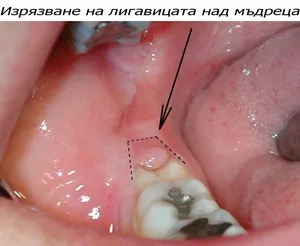
If the wisdom tooth is in a normal position and does not need to be extracted, the inflamed mucosa covering it is removed. The procedure is very quick and simple and is always done under anaesthesia, which makes it absolutely painless.
- Fine incisions are made around the crown of the wisdom tooth with a scalpel.
- The inflamed mucosa is removed down to the neck of the tooth with special surgical scissors.
- In rare cases a stitch may be placed, and if there is an infection a drain is also placed for faster healing of the wound.
What follows after the procedure?
Painkillers or physiotherapy may be prescribed if needed. Follow-up check-ups are necessary, as is maintaining good oral hygiene.
Frequently asked questions
What does treatment of pericoronitis involve?
Surgical excision of the inflamed gum over the crown of the lower wisdom teeth, most often for partially erupted wisdom teeth.
Is the procedure painful?
No. It is always done under anaesthesia, which makes it absolutely painless.
How does pericoronitis show itself?
With pain, redness and difficulty opening the mouth.
What follows after the gum is excised?
Painkillers or physiotherapy may be prescribed if needed. Follow-up check-ups are necessary, as is maintaining good oral hygiene.