
Gold and gold-ceramic are materials for dental crowns, bridges and inlays that, according to the clinic, last the longest. The main drawback of gold – its colour – is overcome by gold-ceramic.
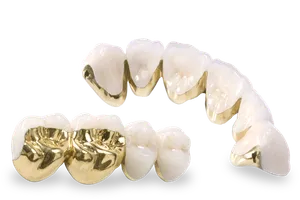
Why is gold still used today?
However hard it may be for 99% of patients to believe, the best material discovered and used to this day for making bridges and full and partial crowns (inlays) is gold. It is the material that gives the longest-lasting results in restorative dentistry and with it a person’s natural teeth are preserved the longest. We increasingly come across older patients who arrive with gold crowns and bridges in their mouths, made, by their own account, 40 or even 50 years ago and still in excellent condition. Such patients usually come with a problem in another tooth that was filled with amalgam, chemopolymer or photopolymer, but with no complaints about the teeth with gold restorations. In patients whose gold bridges or crowns have aged and no longer look aesthetic, we again see durability and comfort being prioritised over aesthetics.
Aesthetic dentistry is the focus of the development of dental medicine today, and this is clearly seen in the new channels of visual advertising – Facebook, Instagram and other social networks. There the emphasis is mainly on aesthetics and on how a person’s smile looks, while the durability and functionality of the constructions made are left in the background. This leads to gold being used ever more rarely in prosthetic dentistry and being replaced by metal-ceramic, photopolymers and zirconia. Years of accumulated experience with these modern materials have led to their drawbacks being discovered and clarified, which in turn has led to the conclusion that there is no other material that fits and protects the teeth as well as gold. Fortunately for patients, its main drawback – its unaesthetic appearance – has now been overcome through the making of gold-ceramic.
What are the drawbacks of gold as a material for making crowns, bridges and inlays?
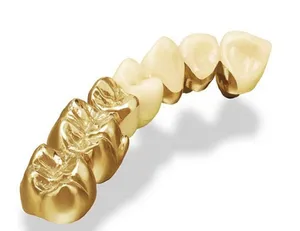
Gold is not tooth-coloured
This is the main drawback that has led to a decrease in its use as a material for making crowns and bridges. Today it has already been overcome by making monolithic gold restorations only on teeth that are not visible when smiling, while for the aesthetic zones gold-ceramic is used – the visible areas of the crowns and bridges are covered with ceramics. In this way gold-ceramic is more aesthetic than metal-ceramic, because there is no greying of the gum and teeth.
Gold-containing crowns and bridges are more expensive than standard ones
This is due to the fact that it is a precious metal and the purity that needs to be used is 22-carat gold, or a gold-platinum alloy in gold-ceramic. On average, between 3 and 4 grams of gold alloy are needed for one crown. This drawback, however, is also open to reconsideration, because the 22-carat gold used in dentistry can be recast.
Advantages of gold as a material for making crowns, bridges and inlays
Gold restorations do not break
When properly made, gold restorations do not break, unlike amalgam, photopolymer and zirconia. Amalgam, photopolymer and zirconia are good permanent restorations, but, all other things being equal, they carry a higher risk of fractures, due to their hardness, which makes them brittle when bent. Gold, for its part, is softer and allows good absorption of chewing loads.
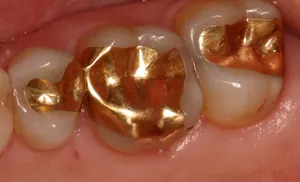
Gold does not suffer erosion at the margin in contact with the tooth structure
Photopolymers and amalgam are known for microleakage at the material-tooth margin as a result of erosion of the material’s fine edges. Gold, as a comparatively softer metal, withstands these loads and effectively protects the edges of the tooth and stops microleakage, which is of great importance for the durability of the restoration.
Gold has a coefficient of contraction and expansion closest to that of natural teeth
This is a key advantage of gold over other materials. As is well known, teeth and their restorations expand when hot and contract when cold. Because we consume both ice cream and hot coffee, sometimes even at the same time, it is of great importance for the restorative material and the tooth to have similar contraction and expansion, so that cracks do not develop in either the natural tooth or the restoration, which would lead to a problem.
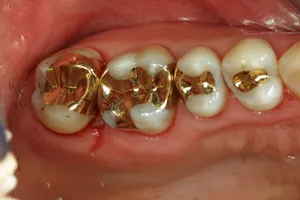
Gold allows fillings (inlays) to be made with the correct anatomical shape
Gold inlays are made outside the mouth, and this makes it possible to restore the shape and size of the chewing and side surfaces of the tooth perfectly. This ensures the best possible chewing, unlike photopolymer and amalgam fillings, which are made directly in the mouth and are not always correctly shaped.
Gold can be polished to a perfectly smooth surface
Gold has excellent polishability and, because it is made outside the mouth, it allows perfect polishing under laboratory conditions. And as is well known, perfectly polished surfaces in the mouth do not retain plaque and bacteria and reduce the risk of caries many times over, and they also feel comfortable to the tongue and lips.
Gold does not absorb fluids and odours
Saliva and fluids in the mouth cannot penetrate the surface of gold, unlike photopolymers, where such penetration is observed. This is also the reason why photopolymer fillings discolour and have an unpleasant smell when they are removed.
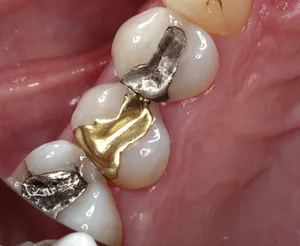
Gold does not oxidise in the mouth
Because gold is a precious metal, it does not oxidise and does not age over time, unlike amalgam and photopolymers, which darken and whose surface becomes uneven and retains plaque.
Gold does not discolour the tooth structure
Unlike amalgam and standard dental alloys, which discolour teeth grey, gold does not change their structure and they keep their colour unchanged. Even in very thin teeth, where amalgam shows through, gold provides better aesthetics because its colour is close to the colour of dentine.
Gold restorations do not require special cementing methods
Gold crowns, bridges and inlays are cemented extremely well with standard dental cements. This eliminates the need for the difficult and demanding adhesive cementing used with modern ceramic and zirconia constructions, which provides comfort for the patient.
Gold is an exceptional biomaterial
Gold is very well tolerated by both the gums and the mucosa of the oral cavity. It does not cause allergies and is the material of choice for allergic patients. The margins of gold restorations are extremely smooth and do not irritate or inflame the gums. Gold contains no mercury, nickel or BIS-GMA, which are present in the standard alloys for metal-ceramic and in photopolymers. Gold does not release toxins, unlike some light-cured materials.
Gold does not wear down the opposing teeth
One of the important characteristics of gold is that, unlike most materials (such as zirconia and ceramics), it does not wear down the opposing teeth during chewing. This is a serious drawback of standard hard materials, but gold is many times better, because it wears down as much as the neighbouring healthy teeth. This is a normal process that takes place throughout a person’s life. In this way gold crowns, bridges and inlays adapt themselves to changes in the bite, which leads to their exceptional durability.
Gold crowns, bridges and inlays are the most durable dental restorations to date
Patients are increasingly found with gold crowns and bridges made 40 and even 50 years ago that are still in good condition and function properly. This is also why gold is still used, however much the focus of modern dentistry has shifted to aesthetics. If we are looking for the “eternal” material for our teeth, we can say without hesitation that it is gold and its variety with improved aesthetics – gold-ceramic.
What types of gold-ceramic are there?
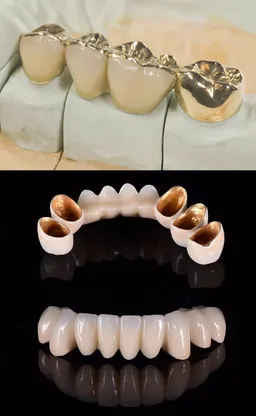
Gold-ceramic comes in two types – standard and metal-ceramic with a gold-platinum alloy.
Standard gold-ceramic
Is a gold crown or bridge that is partially covered with ceramics – usually on the visible outer surface. These constructions are made of 22-carat gold, and can be melted down after years and a new construction made from the old one.
Metal-ceramic with a gold-platinum alloy
It is made like standard metal-ceramic, but in terms of aesthetics and biological qualities it is much better than standard metal-ceramic. This is due to the gold-platinum alloy used. It has a colour close to the natural colour of teeth, which is due to its gold content, and in this way it does not discolour the gums. The platinum included provides the alloy’s high durability. With this type of crown and bridge, however, the alloy cannot be reused, but their durability makes that irrelevant.
How much does it cost?
A gold crown or inlay costs 250 €. All prices are in the price list.
Frequently asked questions
Why is gold considered the most durable material for crowns and bridges?
Gold crowns, bridges and inlays are the most durable dental restorations to date: patients are increasingly found with gold restorations made 40 and even 50 years ago that are still in good condition. Gold wears down as much as the neighbouring healthy teeth, and so adapts itself to changes in the bite.
What are the drawbacks of gold?
Gold is not tooth-coloured, and gold-containing crowns and bridges are more expensive than standard ones. The first drawback has been overcome with monolithic gold only on teeth that are not visible when smiling, and with gold-ceramic for the aesthetic zones. The second is open to reconsideration, because 22-carat gold can be recast.
What types of gold-ceramic are there?
Two – standard gold-ceramic (a gold crown or bridge partially covered with ceramics, usually on the visible outer surface) and metal-ceramic with a gold-platinum alloy.
Is gold suitable for allergic patients?
Yes. Gold does not cause allergies and is the material of choice for allergic patients. It contains no mercury, nickel or BIS-GMA, which are present in the standard alloys for metal-ceramic and in photopolymers.
How much gold is needed for one crown?
On average, between 3 and 4 grams of gold alloy. The purity is 22-carat gold, or a gold-platinum alloy in gold-ceramic.